




Author Archives: zhromin

Charlie Witek – ONE ANGLER’S VISION: PART II MANAGING FOR ABUNDANCE

Editor’s note

In a lot of ways, we consider anything Charles Witek has to say on fisheries management and conservation a “must read”. Charlie has recently started a blog at http://oneanglersvoyage.blogspot.com/

I hope many of you check it out and subscribe to be notified when Charlie posts his thoughts on this very difficult and often confusing subject. But in case you are too lazy to click it we will repost his blog right here. But I do urge you to subscribe to his feed on his blog

Zeno

ONE ANGLER’S VISION: PART II MANAGING FOR ABUNDANCE


Last Thursday, in Part I of this series, I questioned a premise behind a recent report issued by the Theodore Roosevelt Conservation Partnership, entitled “A Vision for Managing America’s Saltwater Recreational Fisheries” (http://www.trcp.org/assets/pdf/Visioning-Report-fnl-web.pdf).  I asked whether it is truly possible to create a “unified vision” for both anglers and the recreational fishing industry, and whether any effort to do so would inevitably leave the recreational angler, and particularly the recreational angler who cares about the effective conservation and restoration of fish stocks, as the junior and oft-ignored partner in the enterprise. 

However questionable such “unified vision” might be, parts of the report are unquestionably true.  It is difficult to take issue with the statement that

“Recreational and commercial fishing are fundamentally different activities that require different management approaches.  Currently, federal fisheries managers set catch limits for recreational and commercial fishing at or near maximum sustainable yield.  While this may be an ideal management strategy for commercial fishing, where harvesting the maximum biomass is desired, it is not an effective management tool for saltwater recreational fishing.  Recreational anglers are more focused on abundance and size, structure of the fisheries, and opportunities to get out on the water…”

Ricky Gease, Executive Director of the Kenai River Sportfishing Association, was a member of the commission that produced the final report.  He expanded on the above concepts at a recent Senate hearing, noting that

“Recreational fisheries are based on angler days, and reliant on maximum sustained production, which is getting the most fish into an ecosystem, rather than maximum sustained yield, which looks at value from the fishery.”  (http://peninsulaclarion.com/news/2014-02-27-4)

As an angler, it all strikes me as common sense.  For example, the current striped bass regulations generally allow an angler to keep two 28-inch fish every time they go fishing.  From a “quality fishing” perspective, there is a very big difference between a day when you only catch two bass, even if you keep both of them, and a day on which you land a dozen fish, keep a couple and let the rest go free.  If all you want is a couple of fish for dinner, it is far quicker, easier and—especially—cheaper to pick them up at the store.  Recreational fishing should offer something more.

What seems to make no sense at all is that after correctly identifying the problem, the “Vision” report turns around and makes recommendations that do exactly the wrong thing, perpetuating the sort of management that emphasizes harvest rather than abundance.

Before I explain that comment, we should probably take a brief detour to examine concepts related to “maximum sustainable yield” and their implications for fisheries management.

NOAA Fisheries defines “maximum sustainable yield” as

“the largest long-term catch or yield that can be taken from a stock or stock complex under prevailing ecological and environmental conditions.”

A stock managed for maximum sustainable yield (“MSY”) may seem abundant, but will generally have an attenuated age and size structure.  There will be almost no older, larger fish.  Such a stock reflects the adage that “any fish that dies of old age is wasted;” fish are harvested when still relatively young, and successful spawning depends on having a large number of newly-matured fish in the population, as the high fishing mortality rate allows few older fish to survive.

Because the data available to biologists and to fisheries managers are, at best, imperfect, trying to manage a stock for maximum sustainable yield is risky.  Any error can cause harvest to exceed sustainable harvest levels.

Still, MSY provides a useful benchmark for federal fisheries managers.  A stock which is much too small to produce MSY—in most federal management plans, about half the size needed to produce MSY—is deemed to be “overfished”, and the Magnuson Act dictates that it be promptly rebuilt.

Similarly, a fishing mortality rate that exceeds MSY—that is, the harvest rate that’s too high to be sustainable—constitutes impermissible “overfishing” under Magnuson, which currently emphasizes sustainability.

In practice, federal fisheries managers normally set an “Overfishing Limit” equal to MSY but then, to allow for the inevitable “scientific uncertainty”, set a lower “Allowable Biological Catch” (“ABC”) to cap harvest.  They then set an “Annual Catch Limit” that may be equal to the ABC, but is typically set somewhat lower, to account for “management uncertainty” resulting from any errors in predicting the effect of regulations on landings or in quantifying what such landings (particularly recreational landings) actually were.

Commercial fishermen generally want to see the Allowable Biological Catch set as close as possible to the Overfishing Limit, and the Annual Catch Limit set right at ABC, because doing so will lead to the highest possible landings, and will thus yield the highest economic return.

However, as the “Vision” report noted, anglers want something else.  They don’t want to kill as many fish as they can, they want to catch as many fish as they can—even if most of those fish are let go.   And they want a reasonable chance to catch a “big one” once in a while.

Managing at MSY won’t produce that kind of fishery.  Instead, managers must grow the population beyond what is needed to produce maximum sustainable yield, and keep harvests well below MSY, if they want anglers to “encounter” plenty of fish, including a few “big ones” that don’t get away.

Such a management approach, which sets landings well below MSY, is also prudent from a conservation perspective, as it provides a buffer that protects against years of poor recruitment, normal environmental variability and the errors that inevitably plague managers’ calculations from time to time.

Thus, there are a lot of reasons to maintain harvest well below the limits permitted by federal law.  Anglers will encounter more fish.  Anglers will catch bigger fish.  And the fish themselves will have a “cushion” against hard times.

Yet the TRCP’s “Vision” report doesn’t propose such reductions in landings.  Instead, the report recommends changing the Magnuson Act to let folks kill even more fish than the law allows now.  And it recommends handing the management of some species over to the states, where they would have no federal protection at all.

The management approach described in the report would lead to anglers encountering fewer fish.  The fish they catch would be smaller.  And the overfishing would slow or halt stock rebuilding; it could even cause stocks to decline.  But it would allow anglers to kill more fish in the short term, and maybe that’s what it’s really about.

Of course, the “Vision” report can’t come out and say that.  So it uses certain “code words” that don’t raise red flags—and in fact, might sound downright reasonable—when most folks read them, but are fraught with meaning to those engaged in the fisheries management debate.

Of all those kind of words, none is as filled with meaning as “flexibility”.  It might sound like “reasonable accommodation”.  But in this context, it means something closer to “continued overfishing” and ‘indeterminate rebuilding times”.

The “Vision” report notes that

“The Magnuson-Stevens Act currently states that the timeline for ending overfishing and rebuilding fisheries ‘be as short as possible’ and ‘not exceed 10 years” with a few limited exceptions to allow for longer timeframes.  While some stocks can be rebuilt in 10 years or less, others require longer generation times, or factors unrelated to fishing pressure may prohibit rebuilding in 10 years or less.”

Of course, it never completely closes the circle, and discloses that those “limited exceptions to allow for longer timeframes” that are already a part of the law include “cases where the biology of the stock of fish, [or] other environmental conditions…dictate otherwise,” which would cover both “longer generation times” and “factors unrelated to fishing pressure.”  That’s something that should have been caught by the proofreader, because it could make someone unfamiliar with the law believe there’s a problem, when no problem really exists.  Sloppy drafting, at best…

“Echoing the concerns raised by stakeholders and many of the regional fishery management councils, a report by the prestigious and nonpartisan National Academy of Sciences concluded that the 10-year rebuilding provision should be revised to provide greater flexibility than is currently allowed under the law.  Instead of having a fixed deadline for stocks to be rebuilt, the NAS recommended that the regional councils and fisheries managers set lower harvest rates that would allow fish stocks to recover gradually while diminishing socioeconomic impacts.”  [emphasis added]

Note that the concerns about flexibility were raised by “stakeholders,” and not by “anglers.”  That sheds real light on the motivation for weakening Magnuson, and it’s the same motivation that rendered the law essentially toothless prior to its amendment by the Sustainable Fisheries Act of 1996.

It looks a lot like the same motivation that has motivated fishing industry interests—on both the recreational and commercial side—to try to weaken the law ever since Sustainable Fisheries was signed into law:  “socioeconomic impacts.”

It’s not about abundance, and it’s not about big fish.  It’s certainly not about conservation.

The report, in recommending “flexibility,” echoes the position of the Gloucester groundfish fleet (http://www.gloucestertimes.com/opinion/x86521185/Editorial-Science-report-shows-need-for-Magnuson-changes), a group not renowned for their conservation ethic.  It echoes the position of a lot of other commercial groups as well.

For conserving marine resources may be a noble endeavor, and the Magnuson Act may be the best and most effective fisheries law in the world, but in the end, there are costs associated with the effort.

Conservation isn’t compatible with short-term profits, and if you’re in the industry, that matters.

That is nothing new.  Conservation writer Ted Williams, who is also a hardcore angler, pretty well said it all back in 2010 (http://www.flyrodreel.com/node/14680).  He started by explaining that, prior to ‘96

“Quotas could be modified by short-term, short-sighted ‘economic considerations,’ and such considerations always ‘justified’ overfishing. Whenever scientists cautioned against overfishing, the ‘stake holders’ would overrule them, regulating in flexibility. ‘There’s no such rush to rebuild,’ was the mantra. Rebuilding while continuing to overfish is, of course, impossible.  Overfishing means you kill fish faster than they reproduce, that you’re in a hole and digging.”

When we see “flexibility” recommended in the “Vision” report, we see the same kind of pre-1996 thinking starting to reemerge.  Given how badly things turned out the last time, we also have to wonder why.

We also have to wonder why anyone who claims to want to manage for “abundance” thinks that it is OK to manage fish that way.  Again, Ted William might supply an answer, while showing that the “Vision” report is little more than history repeating itself.

“Enter Rep. Frank Pallone, Jr. (D-NJ), who in 2008…introduced the ‘Flexibility in Rebuilding American Fisheries Act.’ Pallone’s bill…would supposedly do the impossible—that is, permit overfishing while restoring stocks. What it would really restore is the pre-1996 system of manipulating scientifically determined quotas with short-term, shortsighted economic considerations.

“Of course, the proponents of Pallone’s bill don’t call what they’re trying to do ‘overfishing,’ arguing instead that the rebuilding timeline of 10 years is ‘arbitrary,’ that there’s no such rush. For instance, timelines are not ‘a moral issue’ to Flexibility in Rebuilding American Fisheries Act co-sponsor Rep. Barney Frank (D-MA), who accuses the National Marine Fisheries Service of harboring ‘an anti-fishing bias.’ [BLOGGER’S NOTE:  Frank’s comment re NMFS ‘anti-fishing bias’ almost seems a distorted echo of the ‘Vision’ report’s comment that ‘the federal system to control commercial fisheries exploitation is largely inappropriate to managing recreational fishing.’  Could it be that ‘bias’ or an “inappropriate’ system isn’t the issue, but rather the fact that no business really wants to be regulated for the good of the general public?]  What attracts Frank and his allies to the bill is that it would allow continued procrastination while shielding managers from both lawsuits and the obligation to rebuild fish populations.

“Give the councils 50 years, and they will still opt for the largest short-term harvest,” one enlightened council member told me. “In year 47 we’ll be right where we are today, with the industry people weeping about their hard lot and demanding flexibility.’”

“The Oz figure behind this attempted gutting of Magnuson is the Recreational Fishing Alliance (RFA), which reports that Pallone’s bill has the backing of 100 fishing groups and industry members. The board and staff of the RFA is dominated by fishing-boat builders, fishing-gear manufacturers, advertisers fronting as fishing writers, party-boat owners and charter-boat owners…

“There’s scarcely anyone involved who doesn’t make money killing fish—not that there’s anything wrong with that. But the RFA would get more respect if it was honest and called itself a trade association.”

The RFA had nothing to do with the “Vision” report, but there’s another group which did, and is arguably as much a “trade association” as RFA.  That group, the Center for Coastal Conservation, is listed as a “contributor” to the “Vision”, and was formed by several other such “contributors”—including the Coastal Conservation Association, the American Sportfishing Association and the National Marine Manufacturers Association—specifically to lobby for their vision for fisheries management (http://www.coastalconservation.us/index.php).  If you take a look at who sits on the Center’s board of directors (http://www.coastalconservation.us/board_members.php), calling them a “trade association” doesn’t seem like a stretch at all.

People who have the same interests tend to have the same goals.

And when you realize that, and when you note that of the seven organizations—not including TRCP—that “contributed” to the “Vision” report, four were either the Center for Coastal Conservation or it’s “Partners”, one, the Berkley Conservation Institute, states on its website that it “is working closely with American Sportfishing Assn., Coastal Conservation Assn., the Center for Coastal Conservation” on various fisheries, and that the President of the Center for Coastal Conservation sits on the Board of Directors of yet another contributor, the Congressional Sportsman’s Foundation, you might start to believe that the effort to weaken Magnuson is being driven by a single “trade association” this time, too.

Which may explain why they talk about abundance, butact to weaken Magnuson, just like another trade association tried to weaken Magnuson before.

Magnuson isn’t perfect.  But if you really want to manage for what recreational anglers want—for abundance and for more big fish—you change the law to make it even harder to overfish.  You change it to make the prompt rebuilding of diminished stocks easier and more certain.

You don’t try to impose “flexibility”.

Win two custom lures, GRS and Black Label swimmers

The reason you haven’t heard much from us is because we are in the middle of putting together new issue of the Surfcaster’s Journal Magazine. Between that and shows and trying to hold down our jobs and be parents and husbands, the “free” time is basically nonexistent. The weekends? What weekends? That is the time when we run around northeast doing shows like chickens without heads. But its all good, we’ll be at Asbury on Sunday and we should wrap us the new issue this weekend for you.

What do we have for you ?

Stories from

Bill Jakob
Zach Harvey
“Crazy” Alberto Knie
Frank Pintauro
Dave Anderson
Zeno Hromin
DJ Muller
John Skinner
Russ “Big Rock” Paoline
John Papciak
Lou “Rod Guru” Caruso
Al Albano
Roger Martin
Chef Chris Blouin

Some videos too

Speaking of new issues and shows. This is just a note, because part of my brain is telling me that many of you who signed up at last years shows are unaware that your subscription has expired. The easiest way to check is to log into your account

ec

If you get a screen like this that tells you that you have No Active Subscription, your subscription is expired. You can renew on line or at any shows we will be this year. I just do not want to get emails from people on Monday as to why they cant read the new issue. Where will we be ?

Asbury Park Flea Market this Sunday March 9th

Somerset Saltwater Expo Somerset NJ March 14th to 16th

River’s End Surf Day March 22nd (still working details on this)

St Joseph College Flea Market in Patchogue on March 29th

RISAA in Providence RI  March 28 -30

Ok, now for the fun part of my day, when I get to give something away. Hmm, what to give away today?

How about something special? Like stuff that people line up at 3 AM at these shows to buy

Let me dig into the box, sent in by anonymous reader recently, and see what I can come up with

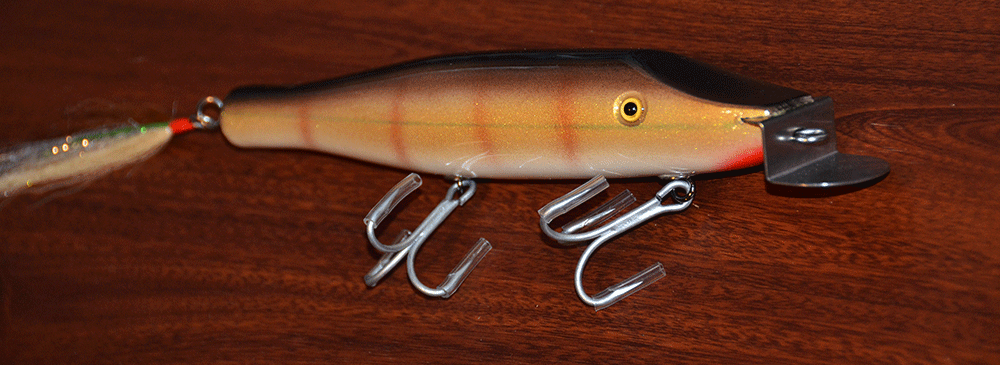
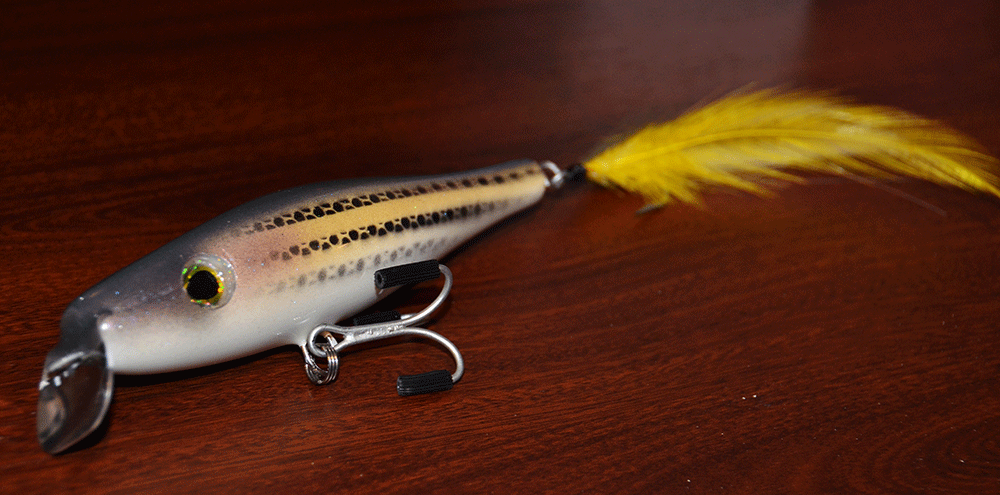
Well, golly, isn’t this one of them fancy Garry “Big Water” Soldati GRS pikies?

Yes it is and its obviously gorgeous

DSC_3434

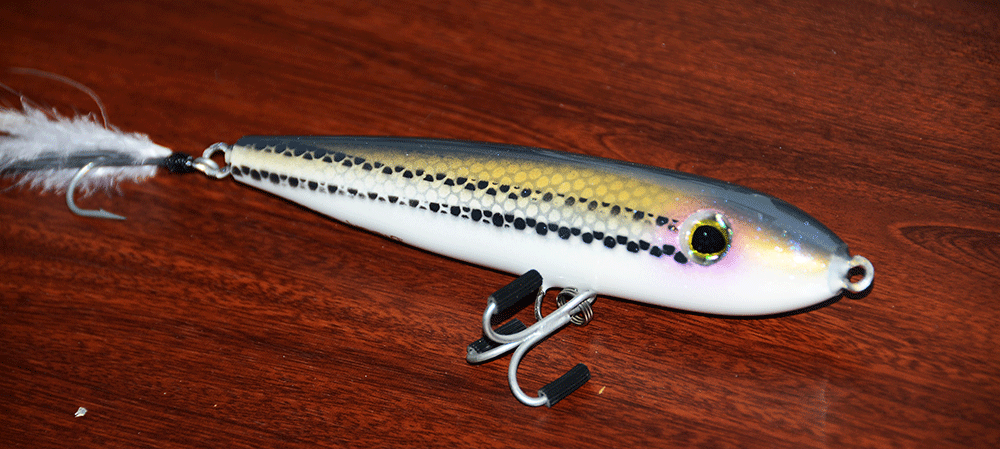
And we’ll toss in a sweet Black Label Spook for a winner, so that your GRS is not lonely during shipping to your house

DSC_3438

Good luck and Come On Spring!!

Charlie Witek speaks on conservation ……we listen

Editor’s note

In a lot of ways, we consider anything Charles Witek has to say on fisheries management and conservation a “must read”. Charlie has recently started a blog at http://oneanglersvoyage.blogspot.com/

I hope many of you check it out and subscribe to be notified when Charlie posts his thoughts on this very difficult and often confusing subject. But in case you are too lazy to click it we will repost his blog right here. But I do urge you to subscribe to his feed on his blog

Zeno

****************************************************

ONE ANGLER’S VISION–FISHERIES MANAGEMENT: PART I THE MYTH OF “COMMUNITY”

Earlier this month, the Theodore Roosevelt Conservation Partnership issued a report entitled “A Vision for Managing America’s Saltwater Recreational Fisheries” (http://www.trcp.org/assets/pdf/Visioning-Report-fnl-web.pdf).  The report is apparently intended to inform federal legislators during the run-up to the Magnuson Act reauthorization, and serve as a guide to how anglers want federal fisheries laws to work.The problem is that I’m an angler, and you’re probably an angler, and there’s a pretty good chance that TRCP never asked any of us whether we shared this “Vision” of theirs.  I’m not sure who represents my point of view these days—the folks who once did have since changed their minds—but given how the “Vision” came out, I don’t think that anyone consulted them, either.  Yet, because of the people behind the “Vision”, it is going to be promoted as our agenda, whether or not we were asked, and whether or not we agree.That said, the “Vision” report isn’t irreparably bad.  It contains some pretty good ideas.  But because it tries to please everyone connected to recreational fishing, it also contains some really awful suggestions that, on balance, outweigh the good.  After I read what was probably the inspiration for the “Vision” report—a paper produced by one of the report’s “contributors” about a year ago—I walked away from the folks responsible, even though I had worked with them for seventeen years.  Those bad parts are really bad…Do you remember Procrustes?  In Greek myth, he was a sort of innkeeper from Hell, who invited weary travelers to spend the night.  If someone was too tall and didn’t fit in his bed, Procrustes would just chop of their legs to fix things.  And if someone was short and didn’t use the full mattress, he was more than glad to stretch that squat body until it filled the available space.

TRCP’s “Vision” is a sort of Procrustes’ bed for the angling community.  TRCP notes that

“The work to implement a national policy for recreational fishing will take a collective effort in which all segments of the recreational fishing community will need to come together and engage with fisheries managers, policymakers and other stakeholders to create a unified vision.”

That sounds pretty nice in a Kumbaya sort of way, but when TRCP took it upon itself to “set the foundation for a management system that addresses the needs of anglers and industry,” it assumed an impossible task.

That’s largely because, despite wishful thinking, no “recreational fishing community” truly exists; rather, there are a lot of discrete and often mutually hostile interest groups that are involved with recreational fishing.  What is mother’s milk for one group is anathema to another.  The folks who contributed to the “Vision” report have been involved in their share of internecine squabbles, and know that as well as I do.

As far as anglers go, there are fish hogs who kill everything that the law allows—plus a few more—and anglers who never keep fish at all.  Most, including me, fall somewhere in between those extremes.  And as far as the angling industry goes, there are those who cater to the pigs, those who cater to the catch-and-release folks and the majority who sell to anyone with a dollar to spare—which usually means catering to the least common denominator, because that way, their doors are open to all.

To get all of those folks under the same big tent, the “Vision” report must also take a least common denominator approach.  It freely admits that conservation is important to anglers (the report makes 22 references to “conservation” in just 11 pages of text).  But when it becomes time to put words into concrete recommendations, conservation concerns are subordinated to economic and allocation issues that require weaker fisheries laws.

Thus, the “Vision” will appeal to people who want to kill more fish, people who sell stuff to anglers who kill more fish and to people who run boats out to places where more fish can be killed.  It probably won’t be so attractive to those who want to promptly restore distressed fisheries, who enjoy an abundance of fish or who want to leave healthy fisheries behind for their children.

I’m one of the latter sort, and TRCP’s vision certainly doesn’t resemble mine.  But then, I’m probably never going to agree with headboat captains over in Sheepshead Bay, where enforcement folks can run out of summons books when they take on the poachers.  Yet those captains are part of the “recreational fishing community,” and if TRCP wants them to share in the “unified vision,” some compromises must be made.

I worry about fish stocks collapsing.  I have watched winter flounder, once the most abundant recreational fish in our bays, all but disappear.  Representatives of the local marine trades, bait dealers and tackle shops freely acknowledge that there’s a problem—but oppose any concrete efforts to fix it, out of fears that their incomes could fall.  Those folks are a part of the “recreational fishing community” too, and given TRCP’s emphasis on economics, a more important part of the “Vision” than my fellow anglers and I.

I’ve been involved with fisheries advocacy for a long time.  I don’t get paid for it, and it’s more work than fun—if I ever quit, I’d have to start sticking pins in my eyes to keep up the pain—but I’ve been an angler for all of my life, and I feel an obligation to leave something good behind for the generations that follow.  If there is anything that I’ve learned along the way, it is that the professed interests of fishermen and the fishing industry seldom coincide.

That doesn’t make intuitive sense, because fishermen are the industry’s customers, but it seems true just the same.

A decade ago, when I sat on the Mid-Atlantic Fisheries Management Council, the debate over summer flounder was reaching is rhetorical peak.  The greatest opposition to needed rebuilding measures came from party boat operators and tackle dealers—members of the “recreational fishing community.”  If they had their way, the spectacular recovery of the summer flounder, which led to the abundance and the size of the fluke we enjoy today, might never have happened.  As an angler, do you share that “vision”?

Take that a step further.  Many—probably most—of the captains and mates on the for-hire boats also hold commercial licenses.  They’re more than happy to sell their passengers’ fish.  Do you think that their “vision” is anything like yours?

There is a reason that the Magnuson Act contains different definitions for “charter fishing” and “recreational fishing.”  The sectors’ interests and motivations just aren’t the same.  If they can’t be included in the same definition, why should we think that they can be included in the same “Vision”?

Maybe I’m a little sensitive about this, but I’m a veteran of the various striped bass fights here in New York, when conservation-minded anglers repeatedly squared off against a profit-minded industry.

I was here during the moratorium, when some Montauk boats engaged in “civil disobedience,” publicly landing illegal bass, to protest regulations that impeded their business.

I was here the only time that legislation outlawing commercial bass harvest had even a slim chance of passage, when the Montauk Captains’ Association refused to support the bill, because—well, a lot of them sold fish.

I was here in ’95, when striped bass were declared to be “recovered,” and the Atlantic States Marine Fisheries Commission said that it was OK to take two 28-inch fish.  New York’s striped bass anglers filled hearing rooms, asking that the state keep the old limits of one fish at 36 inches, while the for-hires and the tackle shops demanded two at 28.  There was money to be made by turning a gamefish into a panfish that could replace disappearing fluke, tautog and flounder in their customers’ buckets, conservation considerations—and public opinion—be damned.

And I was here during the Amendment 6 debate, when the owner of a fishing website and magazine asked his readers whether they wanted harvest reduced, so that more big spawning females survived.  Anglers strongly preferred conservation, and the site owner said so at an ASMFC hearing.  Early the next morning, the shops and the boats initiated a boycott to punish him for representing anglers’ interests instead of theirs.

Based on such experience, when people talk about a “unified vision” of the “recreational fishing community,” I hear “the unified vision of the recreational fishing industry,” because the price that the industry imposes for “unity” is doing things their way—making sure that conservation never interferes with their business.

Which takes us back to TRCP’s “Vision”, and to this blog.

As  I wrote at the beginning of this piece, TRCP’s “Vision” isn’t mine. However, it might be yours—that’s up to you to decide.

To decide, you need information, and that’s not easy to come by.  Pretty soon, you’ll probably start reading a lot of articles hyping the “Vision” in the angling press.  But you’re unlikely to find much thoughtful analysis, and you probably won’t see any criticism at all, because advertisers would never approve.

So, beginning with this post, and continuing for the next three weeks, I’m going to be analyzing aspects of the “Vision”.  I’ll tell you what I think, and more importantly,why.  You might think I’m right or you might think I’m wrong, but in many ways, that doesn’t matter.

What really matters is that you think—long and hard—about how people want to change the Magnuson Act, and whether making such changes is the right thing to do.

And when the time for thinking is done, I’m going to ask you to follow up and to act—to contact your Congressmen, your fishing clubs, your friends—and tell them exactly whatYOUR vision for fisheries management might be.

Because the industry doesn’t just have their “Vision.”  They have their staff and their lobbyists and a friendly press at their beck and call.

But we anglers, particularly we anglers who care about rebuilding and conserving the fish we depend on, have no one but ourselves.

But there are a lot of us.  And if we think and act and speak with the courage of our convictions, maybe—just maybe—that will be enough to win the day.

A NOTE ON THIS SERIES OF POSTS

I’ve touched on a number of fisheries management issues over the short life of this blog.

The “One Angler’s Vision” series of posts that began with this post may well be the most important thing that will ever appear here.  There are about 11,000,000 salt water anglers in the United States, and right now, maybe two dozen people, representing a handful of business and fishing advocacy organizations, are getting ready to tell Congress and federal policymakers how the fish crucial to those 11 million anglers should be managed.  They will try to shape policies that may well determine whether your children’s children ever see a winter flounder, catch a codfish or experience the diversity of a healthy southern reef.

The TRCP’s “Vision” represents those folks’ effort to shape the fishery management process.  We can expect it to be rolled out in the press and at conferences, as its supporters try to create a bandwagon effect and win broad angler support.  But anglers should know what they’re supporting before they jump on that wagon.

So I’m writing this series, which reflects my own vision for the management process, to provide anglers an alternative to the stories they’ll read in an industry-friendly press.

If you believe that it’s important for anglers to hear what I have to say, and if you think that this blog is worthwhile, I ask you to forward it to your fishing friends, and to anyone else who you might think is interested.  Mention it in a club newsletter, or post it on a Facebook page.  Just try to get out the word, and ask others to do the same, before the coming hype makes folks deaf to others’ voices.

Maybe my vision is wrong, and TRCP got it right.  Maybe it’s the other way around.

But either way, anglers should decide for themselves, and not let a handful of industry folks and a few of their friends make the decision for them.

In case you’re interested, the whole series will look like this:

Part I:  The Myth of “Community”

Part II:  Managing for Abundance

Part III:  Groundfish and Gamefish

Part IV:  South vs. North

Part V:  The “Cooperation” Con

Part VI:  A Time for Visionaries

I hope that you read them and pass on the word.  And that you find them worthwhile.

Weekend news

Lets get the business end out of the way first

The winners of last week Tool of the Trade t-shirt giveaway are Montauk Gal and Jim Nash

You have 5 days to contact us with shirt size and your shipping address at info@surfcastersjournal.com

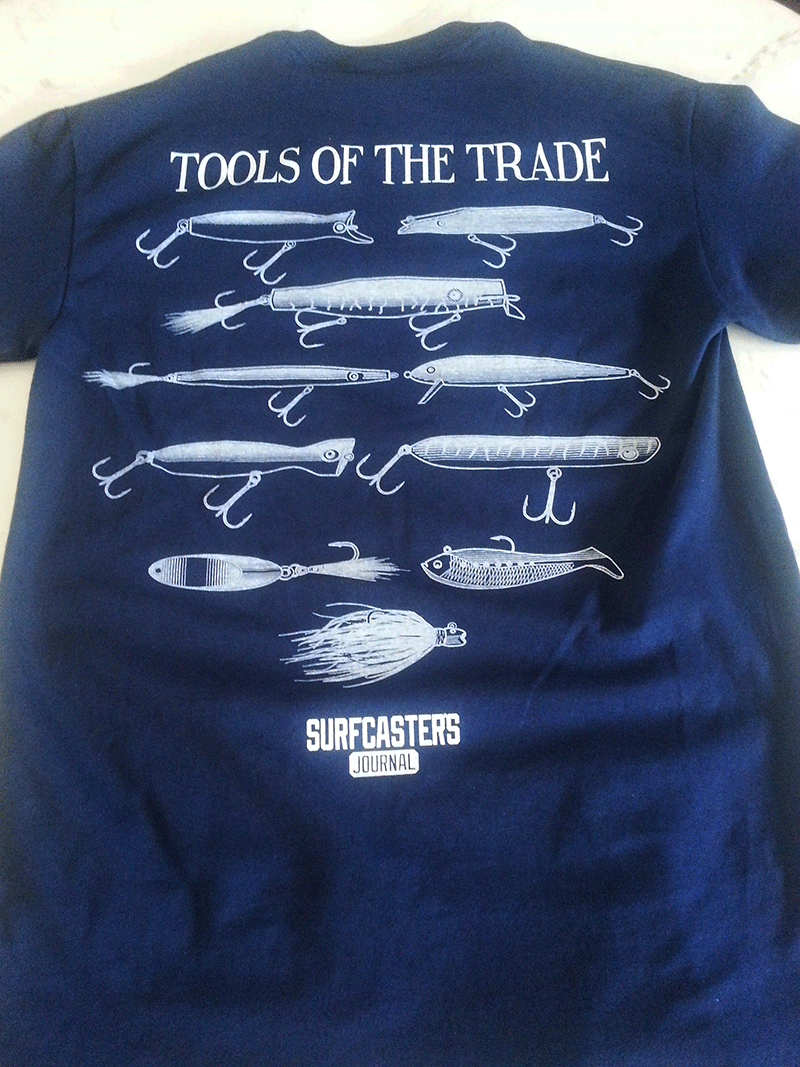
Consequently, this new SJ Tools of the Trade t-shirt you can only get at  shows and it will cost you…big fat zero. This shirt is your for free at any shows with renewal or new subscription.

20140223_082340

And that brings me to the shows. Big weekend for a lot of people,

First, our friends at Ward Melville High School Fishing Club in Setauket are having a show and fundraiser tomorrow.


Its for kids, its free and there is A LOT going on there. Tommy will be there and you can swing by and pick up your Tool of the trade shirt

Here is a list of exhibitors and SJ will have specially priced hoodies, hats, caps, long sleeve Grim Reaper Performance shirts and ton of stickers.

Did I mentioned the show was free ?


Al Goldberg Custom Rods

Angelo Peluso

Bloodline Sportfishing w/ Capt. Joe Wenegenofsky

Blue Frog Bucktails

Capt. Neil Faulkner (Custom Fishing Rods by Capt Neil)

Captured McGraphics

Chris Kunzmann

ChunkZ Customs

Costal Angler Magazine

ePoseidon Tackle Company w/Tom Gahan

Fish Guy Photos

Gear Up Surfcasters

Grand Slam Charters w Capt. Tom Mickoleski

Great South Bay Bait & Tackle

Great South Bay Images

Harvey Cooper (Harvey’s Killer Teasers)

Jones Beach Fishing Station w/ Captain Ed Walsh

Kayak Fisherman Association of NY

LI Outdoorsman

LI Spearfishing Group

Lori C Fishing w/ Capt. Cary Palmer

Luv2Fish Charters w/ Captain Barb Fusco

Mama Mia Charters/Reel Obsession Charters

Miller Place Bait and Tackle

Premier Bucktails w/ Capt. John Paduano

Rocky Point Fishing Stop

Ronald Setnikar

Stony Brook Charters w Capt Bob Simon

Sunrise Fishing Charters w/ Capt. Gary Nilsen

White Water Outfitters

Bill Smith

Classical Education Services — Boaters Safety

Chucks Bucks

George Fabricore

Great Oak Marina

North Bar Tackle

Shinnecock Star

Surfcasters Journal Magazine

The Fisherman Magazine


RAFFLES

Custom Al Goldberg rod

Custom Capt. Neil spinning rod

1/2 day fluke trip or 1 person skinny trip courtesy of Capt. Barb Fusco Luv2fish Charters Mt. Sinai, NY

Full day StripedBass charter courtesy of Gary Nilsen of Sunrise Charters

Full day trip aboard Celtic Quest out of Port Jefferson, NY

Full day trip aboard Celtic Quest out of Port Jefferson, NY

1/2 day fluke trip (4 person max) courtesy of Capt. Paul Mandella MaybeTonight Charters Bay Shore, NY

1/2 day charter on the Lori C courtesy of Capt. Cary Palmer Stony Brook, NY

(2) open boat passes with Stony Brook Charters courtesy of Capt. Bob Simon  Stony Brook, NY

Fish Guy Photo matte print

Fish Guy Photo matte print

Captain Segull’s Sportfishing Charts

Berkley Tackle Bags

(2) 40% off coupon for any St. Croix rod


SEMINAR PRESENTERS

Al Goldberg (Al Goldberg Custom Rods)

Angelo Peluso (author, columnist, Fly Fishing Expert)

Bill “Doc” Muller (surfcaster, author, columnist)

Capt. Brian Phelps (Reel Obsession Charters)

Bruce Froh & Doug Brodsky (Blue Frog Bucktails)

Chris Paparo (biologist, columnist, Fish Guy Photos)

Capt. Gary Nilsen (Sunrise Fishing Charters)

Capt. Jerry McGrath (Captured McGraphics)

Capt. Joseph Alexander (Bloodline Sportfishing )

Capt. Paul Mandella (Maybe Tonight Charters)

Capt. Paul Peluso (Mama Mia Charters)

Capt. Roger Bing (Bingo Charters)

Capt. Tom Mikoleski (Grand Slam Charters, author “Bass Buff”)

Capt. Tom Kampa (R & G Charters and Coastal Angler Magazine)

Warren Dennington (surfcaster, columnist)


On Sunday, its the annual Berkley Flea Market in Toms River NJ. If you are in custom wood plugs, this is THE show to be

Just look at that list

Toms River Intermediate Schl Nrth
150 Intermediate North Way
Toms River, NJ 08753
Custom Plug Makers

RM Smith
J.Stirpe Woodworking
Black Talon Plugs
Black Label Plugs
Fish On 8 Lures
Arsenal Lures
Couch’s Cedar Works
Choopy Lures
D-Mag Custom Lures
Guppy Lures
Buzzard Plugs
Glitter Plugs
Big Rock Lures
Chumbucket Lures
Bernzy Bait Co. Lures
NTA Custom Lures
Linesider 69 Lures
Northbar Tackle / Sporting Wood
24/7 Lures
Fish On Plugs
Surf Asylum
M.Fischer Plugs
Striper Bites Lures
Luna Custom Plugs
Hook “R” Lures

Fishing Tackle Dealers

Dock Outfitters Bait & Tackle
Grumpys Bait & Tackle
Fisherman’s Supply Bait & Tackle
Betty & Nicks Bait & Tackle
Giglios Bait & Tackle
NJ Tackle Co.
Slammer Tackle
Shadman Tackle
Fishermen’s Source
Jetty Ghost Tackle
Tin Man Tackle
Fishermen’s Headquarters Bait & Tackle
The Tackle Box

Misc.

NJ Beach Buggy Assoc
Tom Lynch Surf Photo’s & Prints – AngryFish.TV
Berkeley Striper Club Member Tables
Gear Up Surfcasting
Surfcasters Journal
RH Custom Rods –CTS Dealer
Century Rods
The Old Man’s Tackle Box

Tables From:

Bill Veldorf
Dave DeGennaro
Alan Bogdan
Glen Luckey
Jack LaGrosa
Jim Ward
Kevin Markow
Paul Cutrufello
Paula Marksfield
Skip Snyder
Stan Prusik
Tom Scibek


I will be there on Sunday with my son, as Tommy will take a day off from shows and work on the new issue. See you all on LI or NJ. Either way, stop by and say hi..dont be shy..lol

Roof rack rod clips with Surfcaster’s Journal Magazine Rod Guru, Lou Caruso

I hope you guys enjoyed that story by our Rod Guru Lou Caruso (louscustomrods.com is his email in case you want to pick his brain about a new rod). And yeah, we know you enjoyed his latest video on how to make the new inserts for your bag. And guess what, we have yet another video that he is a featured star.

Maybe we should rename this place Lou’s Blog and call it a day ?

Many of us use Rod Vault roof racks (formerly Hunter).They are well made products and will keep your fancy reel as safe as just about anything on the market currently. Other then a armed guard sitting by your truck. The weakest part (for a lack of better word) is the front clips that hold the rods. The shrink rubber tends to look warn out after awhile, the spring in the clips start to loosen up. And I’ve heard many of you when complaining about your finish on the Barbie rods getting scratched slightly by rods bouncing in the rod holders.

Rod Vault recently upgraded its clips and replaced them with rubber ones. And our resident genius Lou Caruso found them on Amazon and will show you how to quickly replace your front clips with rubber, one for better grip and a lot less friction. Of course, you can get these clips and use them with any type of rod roof rack you got.

Thanks Lou

btw, last time I spoke to Lou he was sitting in the basement at 3 am with a head in his hands trying to figure out if he will be able to fish at all this year if orders for custom rods keep rolling in at this pace. We suggest you talk to him sooner rather than later if you will be needing his services..haha. Get some sleep Lou

[youtube]http://youtu.be/krtCSCHXMPk[/youtube]

on Friday, winners on Tools of the Trade t-shirts and plans for this weekend. We have two shows, one in NY and one in NJ so stay tuned. We’ll tell you were you can pick up this new shirt, not available online, for free

Land of the Giants by Lou Caruso

Land of the Giants

By Lou Caruso

I have been fishing a long time. I have had good days and bad days but no matter what the day or night brings I am happy with the outcome. I still get just as excited catching a 2-pound bass as I do a 15 pounder, and if I catch nothing, so be it. This fall turned out to be different. I was fortunate enough to have 2 friends let me in on a bite. Turns out the bulk of the fish were quality fish besides. We had been picking a few fish a night for a while. I between I would run out to Montauk and fish a few days for so-so luck, then return home.

At the end of October we had some really late tides. It was the middle of the week and the other 2 guys had to work the next day so I hit the spot myself. Now mind you, I had already dropped a few good fish here because of hooks that were too small, and the fish either straightened the hooks or snapped them. Not this time. Second cast, I hook up and my drag is screaming. Let the fish run and when I finally got it in turns out to be a mid twenties fish. I’m not a guy that gets a lot of big fish. Hell, my personal best to this point was 36 pounds. That had been the only fish I had over 30 pounds in the years I had been fishing. I have dropped a few I’m sure were bigger LOL. So now I weigh the fish and get it right back in the water. I’m standing there with a big grin enjoying the night. Next cast, BAM !!!!!! This fish took off like a freight train. I’m letting her run all the while saying to myself, “don’t blow this”. After a few minutes I finally get the fish in. One look and I knew it was big. She weighed 39 pounds on the boga. Now I have the shakes and I’m giggling like a schoolgirl. Get her revived and released was all I could think about. Now I’m back in the water a little quicker. This went on for almost 2½ hrs. Wound up with 8 fish, smallest 18, largest 39 with a few in the mid  to upper 20’s. In all my years fishing I have never had an outing like this.

First thing the next morning I let my two fishing buddies know what went on and they needed to be there…

So here we are the next night and I’m praying to god there are fish there. Luckily they were and we wound up with some good fish. This went on a few more nights before things slowed.

I have gotten pretty good over the years at knowing the tide, fish it and get out. Now I found myself staying longer without so much as a touch, knowing I wasn’t going to catch but just kept fishing “just in case”. I became obsessed. Hitting the place on bad winds without so much as a touch, wasting the night. The sand eel bite was on but I continued to fish the night tides. Had a slow pick until it got to cold for me. That is the one thing that shuts me down.

After it was over and I had some time to reflect. I realized how lucky I was, but I also realized how these fish had taken me over. I was willing to forgo first light outings with many fish, for a shot at 1 or 2 fish and the possibility of a big girl or the possibility of the skunk.  Times when I would have normally stayed home, I was out beating the water to a froth for nothing. These fish will ruin you.

It will be interesting to see how this upcoming season pans out, if there are many fish to be had and if there is any size to them. I now know what the guys that are constantly into large fish look forward to…

I will be happy with whatever the sea brings, but now I will have that twinkle in my eye for large…

Lou's_35

Win a new Tools of the Trade Surfcaster’s Journal t-shirt

First, I want to thank all of you that stopped by our table at Surf Day yesterday. The show was awesome as usual and we particularly appreciate you telling us how much you like the Surfcaster’s Journal. Everyone who renewed their subscription, your account was updated. You can check it by logging in your account and see your new expiration date

For those of you that subscribed for the first time, you should have received the email from the magazine with your credentials, if you did not, please check your Spam folder and then contact us at info@surfcastersjournal.com

We apologize for running out on certain shirts but its impossible to bring everything and anything when you are dealing with tight spaces. We will be at Ward Melville Fishing Club Show this Saturday in Setauket, NY and Sunday we will be at Berkley Flea Market in Toms River NJ with fresh inventory.

You can pick up this new “Tools of the Trade” shirt for free by renewing your subscription or subscribing for the first time, but only at the shows that we attend. The interest in this t-shirt was jus crazy yesterday and I am sure that I can speak for Tommy who designed it when I say, thank you. We are glad it was received well

DSC_3388

The winners of last week Black Label swimmers giveaways are Don H drh@bnl.gov and Big Jim bigjim121165@yahoo.com

You have 5 days to contact us at info@surfcastersjournal.com

DSC_3393


And since we are talking about the new Tools of the Trade t-shirts, lets have a giveaway for some, since these are for shows-only and wont be in our online store until sometimes in late April. Two winners, each one gets a Tools of the Trade t-shirt in his/hers chosen size and we’ll toss it in these three stickers from SJ.

20140223_082340

20140223_082421

My Friend Phillip By Dave Anderson

My Friend Phillip
By Dave Anderson
A few years ago I was fishing the Cape Cod Canal on one of those amazing mornings that everyone talks about. Huge schools of mackerel had been pushed into the Canal the night before by a huge school of bass ranging from 10 to over 40 pounds—maybe bigger. As the sun lit the eastern sky a heavy blanket of overcast hung over the Big Ditch and a steady NE wind blew down the chute ensuring an extended bite that might last into the afternoon if we were lucky. The morning bite was phenomenal, lots of eager fish exploding on all manner of topwater plugs and taking swimmers in tight to shore—these are the days I will never forget. But this day had a little something extra that will make it a standout day for the rest of my life.
When the tide started to move a little faster and the bite slowed down a bit, I decided to take a walk to a back eddy location that I count on to trap bait during the faster parts of the tide. I slipped into an open lane and started fishing again, as luck would have it there were plenty of fish there and metric tons of bait. As I was quietly giggling over another 20-something fish tearing line off my reel I felt eyes on my back and I turned around to see a young boy around age 8 crouching on the rocks behind me. I could see that he was transfixed on what I was doing but immediately turned away shyly when he saw that I had “caught” him quietly watching.
I turned around and tried to sound as welcoming as possible, “Hey man, what are you up to?”
He lifted his head slightly and said, “nothing” quietly.
“You’re not down here by yourself are you!?” I asked with a hint of concern.
“No, my dad and my sisters are fishing down there.” He pointed to east.
“How come you’re not fishing too?” I asked.
“My dad says I’m too little.” My new young friend said shifting his gaze quickly to the ground.
At that moment I decided that we were going to prove that notion wrong. I looked back at the young toe-headed boy and asked, “What’s your name anyway?”
“Phillip” he said.
“Alright, Phillip you want to catch a fish?”
His eyes flashed with excitement while he nodded and sprang to his feet. I fired a cast into the rip and began working my pencil back toward the shore, I can’t remember a time I wanted a fish to take my plug more than that moment and after about 20 feet of penciling, wham, I was tight to a fish. I shoveled the rod into Phil’s hands and the battle was on. My 10-foot rod dwarfed Phillip who featured the typical slight build of an 8-year old and he stood less than four feet tall but he battled that fish like a champion and with a little coaching from me he had the fish close and I was able to land the fish for him. Phil was ecstatic, the fish was maybe 14 pounds but it might as well have been 100, because this was Phil’s first striper and, perhaps more importantly, he had succeeded in proving his dad wrong—has wasn’t too little! (Take that, DAD). I let Phil hold and inspect his catch before we released it and I asked him if he wanted to try and catch a bigger one? I’m sure you can imagine what his response was…
“YES!”
This time the hit did not come easily. I fished through a few casts, gave Phillip a few clumsy casting lessons and asked him all kinds of questions about his favorite subjects in school, what he liked to do when he wasn’t fishing, etc. It didn’t take long before Phil and I were swapping stories like old friends. It’s amazing how smart and how observant young kids are, it’s easy to write them off as “just kids” but when you talk to them for a few minutes it’s just as easy to forget that you’re laughing it up with a second grader! Well after about 15 minutes of nothing I got one of those splashless “vortex” hits on the pencil, the mark of a sizeable fish! The rod bucked hard in my hands and I again handed the rod off to Phil. As he positioned the butt of the rod between his knees and tried to lean back on the fish he pitched forward and I had to lend a third hand for a few moments just below the first guide. When Phil was settled I let go and he got to work on this fish. It took about 10 minutes but finally the fish was within sight, an easy 25-pounder, but someone to our right cast over his line, tangled him up and we lost the fish! I wanted to scream but I knew I needed to set a good example for young Phillip so I just told him that these things happen and that we’d try to catch another one.
The fish Gods though, had given all they could for that day. About 20 minutes later his sister came to fetch him so they could go back to their vacation home. I said goodbye to Phil and asked if he’d be back the next day—I knew I would—he nodded, yes.
As rewarding as forging my friendship with Phil was I wished I could track his dad down and tell him to arm this kid with a rod. He wanted it SO badly and he was more than capable, especially if he had a rod that was matched to his size. I also know that telling people that they’ve missed the mark on their child’s readiness for something is also likely to be met with some kind of defensive retort—never mind when it comes from someone that they’ve never met! So I let it go.
The next day was just as good as the day before and when I made my move to the back eddy location I was really hoping to see Phil. I looked around but I didn’t see him. I walked past my spot to the east, remembering where Phil had pointed the day before and lo and behold there he was with his whole family and, he was sporting a new 8-foot rod and reel standing with a posture of pride that you’d have to be blind to miss! I yelled down to him, “Hey Phil, how many did you get today?”
“I’ve had six so far, that’s more than my dad!”
He was throwing a swimmer and having a blast.
Another victim of the disease.


Editors note

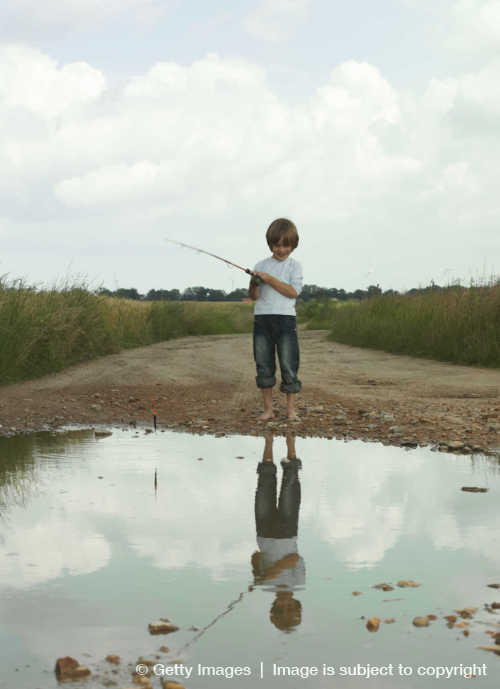
John ” I can catch a fish in the road side piddle” Skinner during his early years

lol

a4d1881f-a428-3193-82e8-15045ee3238c


How to put together two piece surf rod with Surfcaster’s Journal Lou Caruso

Something is on my mind today that we never talked about years ago. Even few years ago, most surfcasters fished with a one piece custom rods, mainly Lamiglas. At one point I had I think five Lami GSB 1321M custom rods hanging in my garage. How many one piece rods do I own today?…Not a single one. But I never, ever broke a rod in twenty years of fishing while using Lami. I snapped two in last year alone. You win some, you lose some, I guess.

Having said that I still think GSB 1321M and its shorter cousin 1201M are the best all around rods ever made. Before you jump all over me for that statement let me explain. If someone asks me for opinion on buying one single rod to use it under all conditions, plugs on south shore, Montauk, rigged and live eels, bucktailing the inlet, even tossing light bait I would tell them to get a GSB and call it a day. I really think its a rod that does everything well, and nothing great. If you know what I mean.

Unfortunately, it seems to me that Lami as a brand people “desire” to own and fish with has lost most if not all of its luster. I don’t remember last time someone asked me for an opinion on Lami rods. Its Century, CTS, Tsunami and Fiber Star ninety nine out of hundred times. Which is strange considering Lamiglas makes some quality rods. I liked the new Super Surf G2 quite a bit when I tested it but for some reason it does not seem to resonate with surfcasters like it did in the past.

But this blog post is not meant to be about brands but instead about two piece versus one piece rods. And not which one is better and which one you should get. Instead its about the little things that make the rods you already own perform at its best.

written every day about rod twisting during casting, during fighting a fish, inability to separate ferules…

In the current issue of SJ,  our Rod Guru Lou Caruso has video on how to separate the rod ferules that are stuck together by using nothing but a bag of ice. If you skipped over it while reading the current issue log on and check it out. Here is a follow up with a simple and practical information on how to put together your two piece rod properly.

And when you want an opinion on what rod to have made, you can contact Lou at  redhawk1944@aol.com for an honest opinion.

[youtube]http://youtu.be/m-8JnK334U4[/youtube]