




Author Archives: zhromin

Conventional wisdom turned upside down!

Bare with me as I wrote this 13 years ago and just found it on my PC…LOL

Trying to fit a word “consistency” in a same sentence with “surf fishing” is akin to words “no traffic” and “LIE”, Yeah ,they both happen occasionally but the duration is usually short lived. The spots that produce fish one day shut down the next for no apparent reason, other than the fact you weren’t there yesterday but you hear about it and showed up “today”. Beach structure undergoes changes after each onshore blow and baitfish is known to stage  disappearing act with regularity. The only “consistency” in this sport is that is inconsistent. There are few concepts that have over the years became a part of surfcasting lore. Part fiction, part wishful thinking and a lot of misinformation went a long way to make these “cant miss” occurrences an accepted practice in the eyes of some surfcasters. Many have accepted these ,for a lack of a better word “misconceptions” as if they were gospel passed on by some surfcasting Gods from good old days. I think this is a mistake. A surfcaster should never fb21.jpgbox himself into a narrow frame of mind. A good surfcaster should always be willing to expand his horizon in search of a new feeding ,bait or weather patterns. Its bad enough already  we as surfcasters are limited to certain areas because of access restrictions .

Weakfish feed only at night. Really?

The “cheat sheet” always said that weakfish come to play only at night and if you want to tangle with them then you should do the same. This is simply an exaggeration and nothing more than that. Heck, my two biggest weaks, were caught around midday on cloudless, sunny days with temperature pushing well into the 90’s in August. I’ll agree that if you seek quantity or consistence, nighttime offers much better opportunities to succeed. But if you can find deep water within casting proximity of the shore and if that area is not a highly traveled by boats in daytime, your chances of tangling up with a weakfish are quite good. Jetties and rocky seawalls due to their ability to offer baitfish shelter are first places you should explore with deep holes in back bays reachable with a cast from shore a good second choice.

Fish the higher tides

If I heard it once I heard it thousand times “best fishing is found on first of outgoing tide”. First let me explain where I am coming from to give you better understanding why I think this kind of thinking if flawed. I don’t fish areas without current flow. Although few times each season you might find me on a open beach throwing bait, 99% of the time I prefer to cast artificials in areas with current flow.Gamefish seek structure which when coupled with current flow create opportunistic feeding areas in which they are able to use structure and flow to their advantage. Their approach to feeding is simple, ”use least amount of energy to fill their belies”. In the area that I primarily fish, be that mouth of the inlets or back bays, first of the outgoing tide feature little or in some cases no current flow. For example, in Jones inlet ebbing current does not start to noticeably flow until one to two hours after the high tide, depending on moon stage and wind direction. Another reason why “high water out” is overrated is that there is just too much darn water at the time of high tide therefore increasing the territory the baitfish can use to hide from predators. I prefer decreased water level to condense the baitfish making it easier for gamefish to coral and ambush. At this stage of the tide current is not flowing therefore rips are not formed and bait is dispersed all over the place.No two places are the same and there are plenty of places where first of the outgoing is the best time to fish. Heck, last of the incoming tide has probably been the best time to fish the Montauk Lighthouse since they built the place. But each spot has its own tide  preferences. Generalities about surf fishing usually never work. The tide that works in one spot might suck at another spot. The mthly thing that works in every place is the fact that you cant catch them from your couch.

And stay away from bottom of the tide…

Strangely  enough, the low water or low tide stage is detested by many surfcasters who wrongly assume that you need deep water in order too catch fish. Nothing could be further from the truth. Many of my favorite hunting grounds are most productive during the last two hours of outgoing tide or the first hour of incoming water as baitfish is forced to congregate in less and less water, concentrating them in numbers that makes it appealing to gamefish. Remember that no gamefish worth its salt, be that bass, blue or weakfish will chase the baitfish around the ocean, expanding more energy in the process than they will gain it once they consume. Unlike you and me, gamefish don’t feed for “fun” like we do when we grab that bag of chips just because its there. They feed to survive and are constantly searching for opportunities to do so in the manner that is most advantageous to their cause, meaning eat as much as possible while spending least amount of energy doing so.

Popping plugsP10100021.jpg
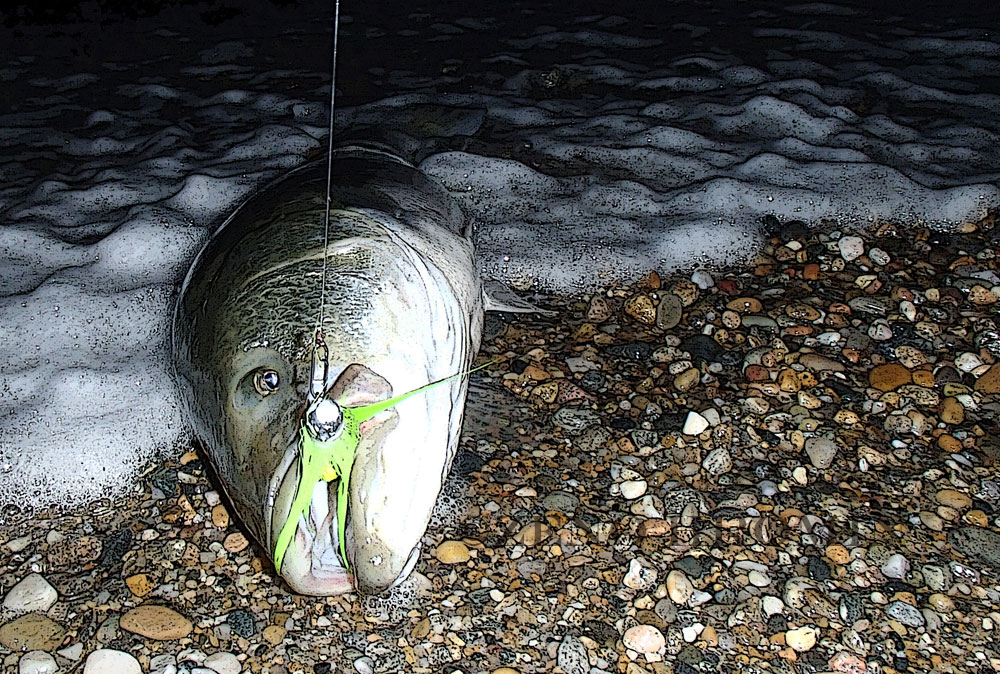
There is no denying that the most visually exciting part of surfcasting is enticing a gamefish to rise from the bottom and hit a top water lure. Water spraying everywhere and at times near misses, seem to only enrage the fish even more as it attacks the plug again and again until hooks are firmly planted in its jaws. But visual action notwithstanding, is popping plugs productive enough to justify their standing as one of the most commonly used lures in daytime? I believe for every fish that you raise to the surface to attack a popping plug, there are probably dozens cruising under the surface ,not showing any sign of their presence. So if you are raising fish but not hooking up as often as you would like try going under the surface with a bucktail or a similar lure. I would bet that your score goes way up.

Is dusk overrated?

Surfcasting around the time of dusk easily attracts more anglers than any other time of a day or night. Part of the reason for this is obviously due to our work and family obligations, which take up most of the daylight hours. But is it most productive time to fish? Judging by sheer numbers of surfcasters present in the water the answer seems to be overwhelmingly yes. But following the crowds in this instance might be a wrong thing to do. Tide, currents and wind conditions have greater impact on when the fish will become active than the time of the day itself. Having said that fishing during the night hours and at first light have always been most productive during the course of the season if we take out of equation those precious few weeks in the fall when bass and blues go on their feeding binges in the daytime. During the summer months water temperatures are at their highest during late afternoon and gamefish generally seek shelter at this time in the deep holes of back bays or cool ocean waters. Add to that a swimming public and boat traffic and you have a recipe for a lousy fishing. Think of it this way, do you really think that after hundreds of boats have crisscrossed the inlet in search of fluke filets during the day the fish will flip the switch, forget about the 70+ degree water temperature and go on the feeding binge, just because the sun its dipping on horizon? I wish it were that easy. The fact is if you seek consistent success with good size fish you must concentrate on night tides. It might take some sleep deprivation but in this sport you only get out what you put in.rgftrf

Leaders – what for?

Thankfully, majority of anglers have come top realization that they need a leader between their running line and a lure. They are aware that their main lines, be that mono or braid is not design to withstand abrasion from the rocks or sharp teeth of gamefish as leader material is. Even the jaw of striped bass which lacks a defined teeth structure will weaken your line when rubbed against it. Considering that bluefish are able to cut even the heaviest leader in seconds with their razor sharp teeth you can only imagine how long you will have service of your lure if you are casting without the leader while bluefish are present in the area. Leaders take tremendous punishment from our tackle, from absorbing shocks during casts, taking a hit from the fish or being held onto while releasing fish. Trying to grab your braided line while you have a trashing fish on business end is a recipe for a disaster. Due to its thin diameter and strength the braid will cut your hands to the bone in short order with a trashing fish on. The only reasonable argument against use of leader that makes sense at all is that by adding two more knots to out line we increase the chance that our rig will fail. True, but if you take the time to draw your knots slowly, making sure you wet them with saliva before you tighten them and paying attention that your loops on the finished knot are one on top of another instead of crisscrossed you virtually eliminate the possibility of failure. Most plugs are lost because of poorly tied knots or open snaps, not because your leader broke. Then there are those who insist that a fish can see a leader and therefore shy away from a lure that is attached to it. Yeah, maybe in Bahamas but not in the murky waters of Northeast. Shifting sediment, plankton growth and fast current make the waters we fish in cloudy on the best of days. Most of the time I can’t see my boots while wading in the water and that’s size 13 Wide, and you are worried about see-through piece of monofilament?

Bunker heads

I have friends who insist on using these 1 and ½ slivers of bunker and are often left wondering why are they catching primarily small bass. I tried over the years to get them to chunk a head out once in awhile but they do it with enthusiasm I usually reserve for cold pizza. Unfortunately they are not in the minority among surfcasters, as many are shying away from tossing heads or even large chunks. You heard about the expression “big lures catch big fish “ right? Well, same of that can be said when baitfishing too. Think about it for a moment’s a decent bass, not monster, but anything above teen fish can swallow adult bunker whole! And you are wondering about your chunk being too big? Add to the equation that bass feeds head first and swallows everything they eat whole and a head should be you favorite piece of bunker, not the least favorite one. Part of the aversion from tossing heads is use of a tackle not suited for baitfishing in general. Six to eight ounces of lead plus a head requires beefy tackle and if your rod cant handle this load you are most likely fishing with what I like to call a “spaghetti” rod, a stick too light for the job.  I use a conventional outfit, Lamiglas 1361MH, an 11 foot stick and I can honestly say that even with 8&bait this rod is just getting started to load. Another reason for using heads is the fact that small fish, sand sharks and skates will often leave the head alone while they mercilessly munching on your buddies chunk. I was fishing with few buddies and after landing third consecutive sand shark I was getting annoyed so when I re-baited, I cut bunker in a half and impaled the front half on the hook under the chin and out thru the nose. Of course my friend were chuckling as I lobed this monstrosity into the surf. They faces froze in grimaces when within few minute I slid a 35lb bass on the sand. Two heads are better than one, right?

Yes, i had few “extra” pounds then..lol
bass_5jj

just a heads up

Night Crew shirts and hoodies are back in the online store after a long absence . more stuff coming up..new color on caps, new hats, striper pins

www.surfcastersgear.comZip_B2-300x300dd_large

Spring STRIPERTHON 2016

Its is our pleasure to announce  Spring STRIPERTHON 2016 Catch & Release Tournament sponsored by VanStaal Reels, June 3rd to June 5th

We are psyched to have Van Staal as sponsors of not only Spring but also the Fall  Striperthon and of course , the StriperDay 2017. This also extends all the brands below too. We are truly fortunate to have as friends and sponsors some very remarkable people and great companies.

As much we and everyone else give credit to Van Staal reels for being a tough customer in the surf and for being able to take on punishing surf  fishing conditions, I still don’t think they get enough credit for something which to most surfcasters these days might be as important as the actual act of catching the fish.

You’ve seen VS Rep Craig Cantelmo in numerous videos and at shows advocating for sustainable harvest and for protection of striped bass stocks. It wasn’t a position they took up like many others after they’ve seen the other shoe drop. Do a little Google search and you will find it that Van Staal  Reels, often in cooperation with Edge Angling in Rhode Island has for many years trying to promote Catch & Release Tournaments to advocate Catch & Release and plight of declining striped bass stocks. Yes, Surfcaster’s Journal has been doing it from day one of our existence but not many major brands were willing to go down that path and actually commit to spend time and resources in promoting catch and release tournaments. Most of them probably said, let someone else do it. Well Van Stall did it.

And I just wanted to take a minute to recognize that.image001

In addition I want to recognize Super Strike Lures who have been on a forefront of striped bass conservation for years. From changing their advertising message to reflect how they are feeling ; yes catch the fish, have a good time BUT also respect that fish and respect the sport….

to not featuring dead fish in the social media campaigns, supporting catch and release programs and tournaments and of course, in case of great Don Musso, literally educating  anglers on the beach daily about importance of conservation and proper catch and release techniques.f f fc

Having said all this, no company that I am aware of it has bigger national footprint and influence when it comes to conservation and protection of species and natural habitats than Costa Del Mar. From sponsoring national tv shows and adventures that promote conservation and sportsmanship, to supporting local and regional contest like hours, Costa Del Mar is in the forefront of what a successful company can accomplish when its fabric is in the salt and fish. We are proud to be partnering with them in promoting Catch and Release  efforts and becoming good stewards of our natural resources

costa-del-mar-logo (1)Last but not least, in fact in many of your little black books they are probably first on the list,Peter and Wayne Hess from Guppy Lures. Guppy Lures has always been one of the first companies that reaches out to us regardless of what type of event are we doing and ask “how can we help”. They know that Surfcaster’s Journal is on the forefront of catch and release since its inception and although we will never ridicule someone for taking home a fish or keeping his PB we will continue along with our sponsors to advocate for responsible and sustainable harvest of not only striped bass but all species.guppy__01010.1428952779.1280.1280

Look for more details for this Tournament that stretches from Nova Scotia to California in few days

Striper Day 2017

Now that we have new issue and videos laid out for our readers and show season is done, its time to fish. Thanks to ALL of you that stopped  at shows by our table and shook hands. Your words of encouragement and thoughts on what SJ means to you and how much you enjoy it, they mean a lot to us. After all, without you, there is no SJ. We try to give you the best content possible. There are two ways of doing this, mailing it in and give you generic gibberish you can pick up at any website. Or we can give you thoughts from people who are as passionate about surf fishing as you are. That is how we have been doing it and we’ll stick to that. Passion is what drives you to the beach, it should be no different when we are looking for best story ideas for SJ

Speaking of that, if anyone has a story idea or want to contribute to SJ as a featured writer or even columnist, feel free to email Dave Anderson at dave@surfcastersjournal.com

There is bunker in a lot of places and NJ guys have been picking at schoolies for a while now. Not long from now , they will be spread along the coast. We have one more show to do, Patchogue Flea Market in April at St Joseph College but I think we are all “show’d out”.

Striper Day at Hofstra kicked off the season and Asbury closed it on in my mind. Yeah, they are few more shows you can attend but for a hardcore surfcaster the “meat” has been picked off the bone. Although to be fair to all our NE readers MassBass show is still to come.

Speaking of Striper Day, I think we documented well the struggle everyone, not just us, goes through on Long Island to find a venue suitable for a surf show or any show. No wonder flea markets are held in musky smelling, old halls, about as appealing as the coffee they serve at those places. The difference Striper Day and flea markets is that we feel that fisherman should be treated with some respect, with a classy venue, not WWII remnants. But regardless where we went, from catholic HS to indoor athletic fields, every college known to a man on LI, we ran into a wall at every place. Like no doubt everyone before us. So the decision had to be made, do we say screw this and let someone else deal with it? Or do we give our readers what they want , a classy show in the venue we know it works but we could use one twice as big? I though that having a big theater  was a huge part of what made Striper Day great. Someone asked me at NJ shows few weeks ago, “are seminars really that important, cant you just do a show without them”

To me personally, seminars are integral part of any good surf show, probably (to me) more important than any single vendor or even a group of vendors. I think a show without a single rod manufacturer is still a fine show. Show without a seminar is..well, i don’t know what it is

Zeno-Hromin-(19)The Striper Day 2017 will be held once again at Hofstra U. What I want from you today is some intelligent advice on how to make it better. Its no secret that everyone wants come in the morning but that cant happen.We will reduce the # of vendors to make little more room for attendees to browse. That is given. But the truth is (and I can speak from personal preferences and experience) everyone wants to come to any show in the morning. That is what most shows look like ghost town in the afternoon.
We were told to split a show in two days ( this will never happen with surf vendors for MANY reasons,), we were told to do fri night/sat show (again, same issues). Many plug builders sell out in hours, never mind two days. Plus added cost of hotel and food , its not economical for small business which most surf fishing vendors are.

Some suggested breaking show into 2 session, morning and afternoon. It sounds good in theory but then you have to chase everyone out and the what, you are going to charge a guy again for  the afternoon session? That is just silly in my book.

Some type of advance ticket sales or reservation is definitely something we are considering. As much as everyone wants to come first thing in the morning and split, we cant accommodate them all if we wanted to. So some type of advance sales only for first few hours might be in the  cards. Only those with tickets can be admitted for first few hours? And then general admission after 10 or something? It could work. The giveaways would probably start with general admission later in the morning?

Will there will be a  line at 10? Probably. Ever been to a surf fishing show where there is no line to get in? Do you want to go to the show where no one shows up?

I didn’t think so

In any event…..we are also strongly considering allowing SJ subscribers get a first shot at advance sales if we decided to go that route. I think that is only fair.

There will be some new vendors this year too, Arsenal Lures, Tom Lynch Photography, Luna Custom Lures and some others.P1010241-Edit-2

CYCLES The Midnight Rambler -by John Papciak

by  John Papciak

CYCLES

“They come and go in cycles, that’s just how it is.”

I hate that saying – a fisherman’s ready-made excuse for taking as many fish as possible. No need to think about conservation or restrictions. What the lord giveth, the lord will take away. And in due time, if we are patient, they will return.

As if synthetic materials for lines and nets, electronics, gas powered engines, and modern refrigeration and transportation played no part in being able to extract more fish, more quickly, and distribute them to a growing national and then global market.

But let’s save that debate for another day.

Today I’m thinking about cycles.

Miriam-Webster broadly defines a cycle as a set of regular or repeated actions or events. I admit to thinking of cycles when I consider fish and bait year classes.

We had the return of the sand eel a few years ago. Now we are up to our elbows in bunker. Peanuts were the main attraction this past fall.  My first official year of surf casting was 1976, and you couldn’t go anywhere that summer without running into weakfish. Christ, for a brief period of time, I thought this was the norm – that you could catch weakfish on anything, anywhere. Then we had blowfish in the bays. And spot. In the winter you could go surf casting for whiting.

The weakfish left, but returned by the mid 90s. As of this writing they are once again a rarity.

Whiting left, never to return to our local waters.

You all know the saga on bass.

Anyway, this “cycle” word popped into my head as I read a Bloomberg news article the other day. The buzz was the impact that “The Child” (El Nino) might have on global weather and crops in 2016.

Need a visual? Think “Trading Places” – Frozen Concentrated Orange Juice.

As I scanned this and related stories, I was struck by the repeated use of the words “cycle” and “oscillation.”

El Niño ?

Maybe a quick refresher on El Niño.

https://www.climate.gov/news-features/featured-images/february-2016-ocean-temperatures-across-tropical-pacific

Trade winds along the equator tend to blow east to west in the eastern Pacific. This pushes warm surface water away from the South American coast. Cooler water then comes up to the surface.  Thats how it normally should work. During an El Niño cycle (2015-2016 is an official El Niño event), the prevailing trade wind decreases, or even reverses. The eastern Pacific stays warmer. And much of the heat is transferred into the atmosphere. A portion of that is shipped to the U.S., thanks to prevailing winds in the Northern Hemisphere. Southern states get the moisture, but in the Northeast we generally see warmer-than-average temperatures. Aside from other general increases in air and water temperatures (Global Warming), the mild temperatures we saw this past winter were most certainly helped by El Niño.

There is plenty of scientific literature on how El Nino impacts weather, and how this weather impacts the life cycles of specific plants and animals. But what about the impact of El Niño on specific migratory species of fish in the mid Atlantic? I’m sure we can all come up with a laundry list, but now we begin to dance between verified science and junk science.  

So where am I going with this?

1. Unseasonable weather most certainly effects our local fisheries.

2. There is a meaningful – yet not fully understood – El Niño local weather impact.

3, El Nino happens at irregular but recurring intervals. Cycles.

So, as much as we hate to deal in things that we can’t comprehend, much less control, there is some truth in the saying that our fish “follow cycles.”

El Niño just so happens to be a very big and obvious cyclic event – so much so that early Peruvian sailors recognized it as such, generally observed in December, and so gave it the name of The Child.

The hidden message? We would be naive in thinking El Nino is the only naturally-occurring cycle to contend with when thinking about boom or bust bait or game fish.

So does that mean you might as well fillet and sell every fish you catch, Mother Nature will replenish it all when she’s good and ready?

That would sort of be like watering your lawn when the reservoir is running low. But at least then you can see exactly how much water remains. And officials are smart enough to enact emergency laws when they SEE it getting too low.

Getting back to the here and now, there are a few things I do know. We have all the makings of a VERY early spring run. I had or saw fish late into December, and I’ve seen plenty of reports of bait already in and around my home waters on Long Island.

Get on it now, before we enter another cycle.

ARTIFICIALS for BIG BASS

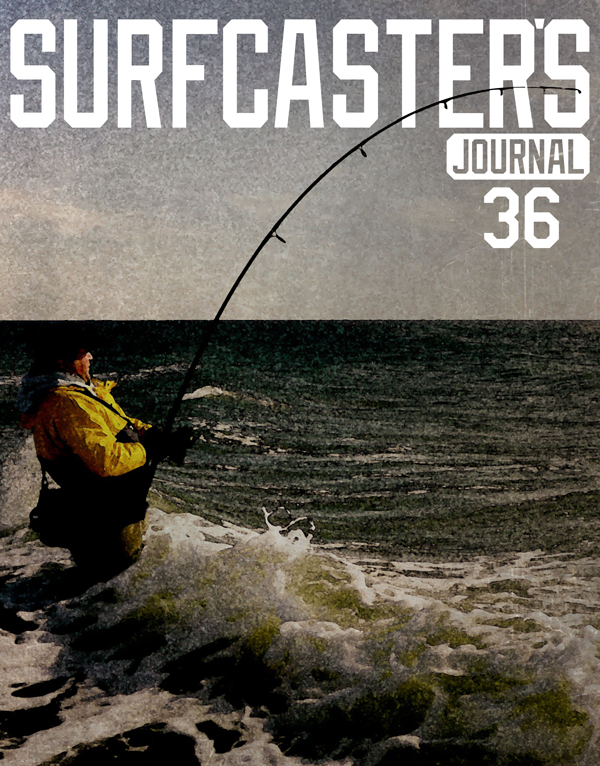
The new issue of the Surfcaster’s Journal Magazine is finished but unfortunately Tommy’s PC keeps crashing all week during the upload process. We are cautiously optimistic that it will be live tomorrow or Saturday

We sincerely apologize for this inconvenience

Zeno

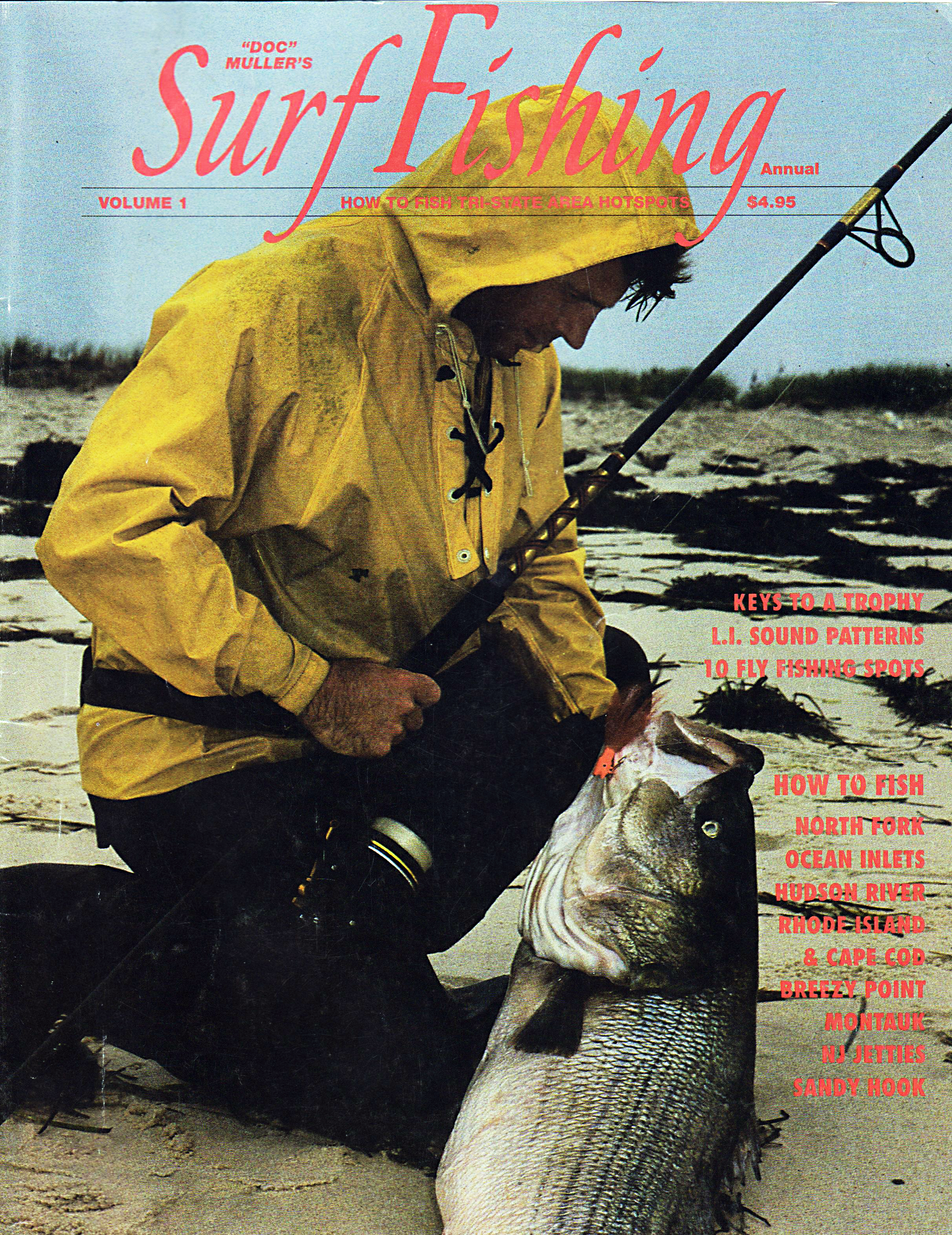
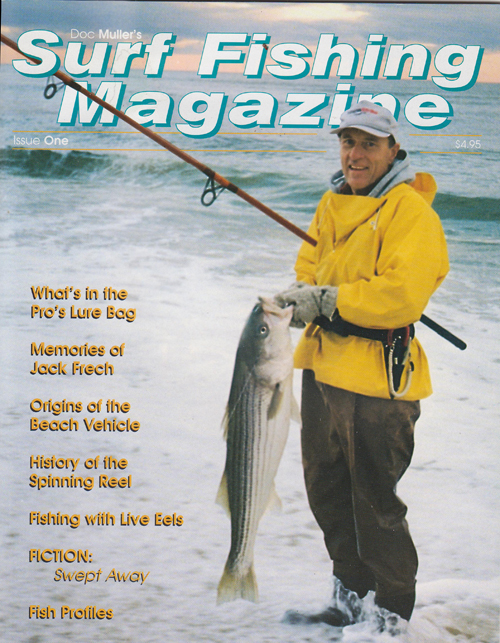
This article has been adapted from “Doc” Muller’s Surf Fishing Annual, originally published in 1994. Doc’s publication served as our inspiration when we started the Surfcaster’s Journal Magazine. We are proud to feature this classic article by Doc Muller in past issue of the Surfcaster’s Journal Magazine and on our blog. It originally appeared in Volume 1 of the Surf Fishing Magazine.

Image

ARTIFICIALS for BIG BASS

Patience and Discipline are Keys to a Trophy

By William A. “Doc” Muller


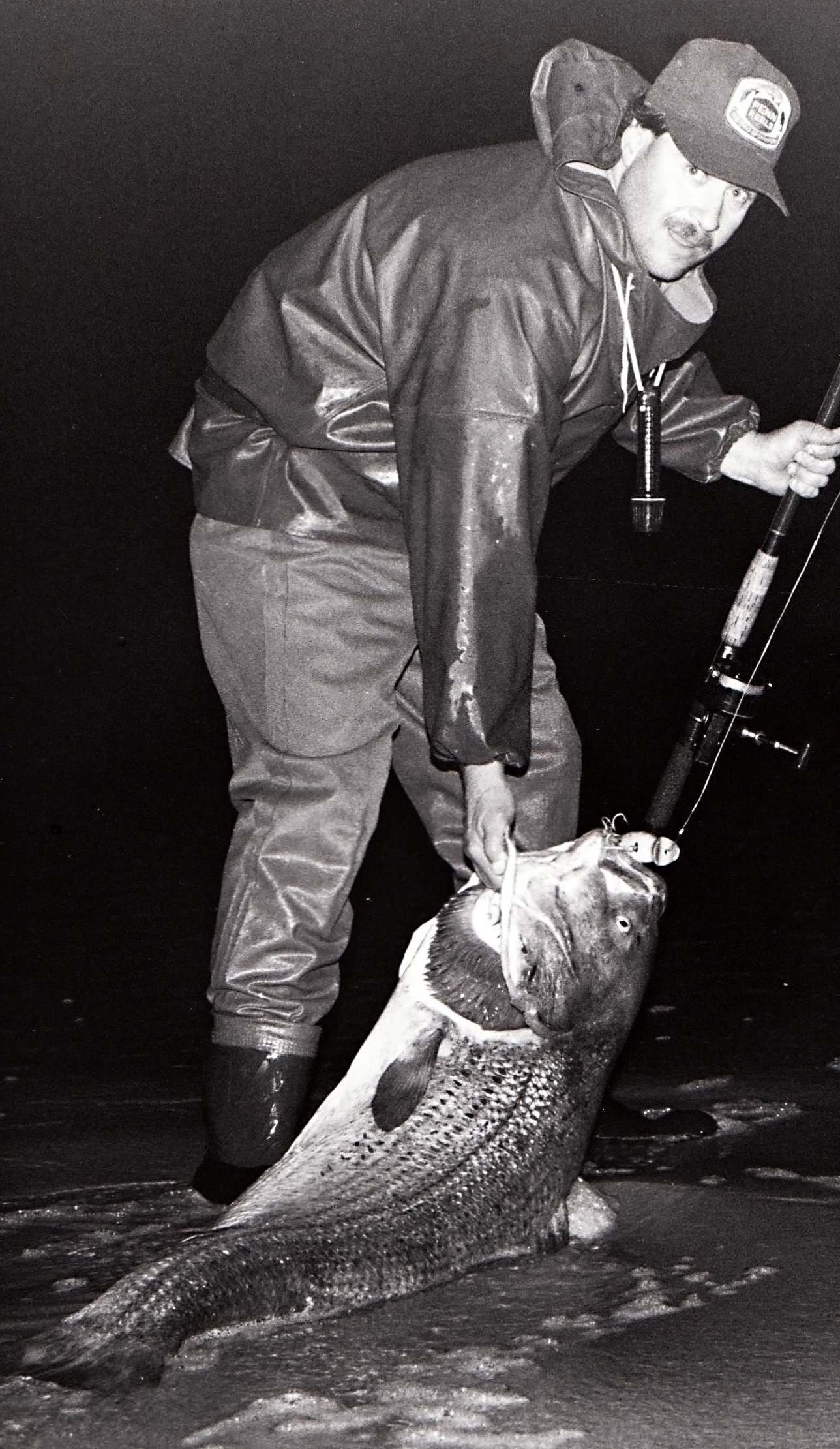
The quickest route to a trophy bass is to use bait, and I don’t think too many experts would disagree with this statement. However, many surf fisher people prefer artificials and want a sound plan that will put them into an out-sized bass using artificial baits.   Oddly, for all the bait fishing I do, and I do a lot, the biggest bass I’ve caught using bait has been 35 pounds.   The 53 pounder that graces the wall of my office was caught on an artificial. In fact, all the fifty pound class bass I’ve caught have been caught on artificial lures.aa


I share this with you so you’ll be confident that it is possible to catch very large bass on lures. However, there is a hitch. That is, you’ll likely work a lot harder at catching those monsters when you use lures as opposed to bait.


KEY FACTS


  1. BE PATIENT!


If you like lots of action, these techniques are not for you. Inevitably, lots of action involves small fish because there are so many more small fish than large ones.


  1. DON’T FISH AROUND SMALL FISH


Yes, big fish do swim with small fish, but the smaller fish are so much more aggressive that it becomes next to impossible to catch a big fish with a lure. One Halloween, my friend Brian and I were into a load of bass and blues that were running baby bunker up and down a beach all day. Finally, as the tide neared flood, the fish cornered a load of bunker against a jetty. It was cloudy and the water was gin clear. Brian climbed up on the jetty for a look see and his eyes almost popped out of his head. Mind you, the biggest bass we’d caught was 14 pounds.

“Bill, there’s a school of 30s and 40s lying on the sand! Throw your plug over here.”

I did as I was directed. Standing on the sand, I angled a cast towards the jetty and began cranking the plug down.

“Good! One’s coming off the bottom. Almost there. Keep reeling, almost on it. Damn!”

Brian’s play by play told me what my eyes could not see. Although the slower large bass were very interested in my 1 ounce plug, smaller fish beat the big fish to the plug every time. Just in case you’re wondering, we also tried big plugs, tins, and bucktails, but the results were the same.


  1. USE LARGE LURESPICTURE # 69


Although it is quite possible to catch a big fish on a small bait, big lures discourage small fish and big bass are often angered by the noise and gaudy action of bigger lures and they will attack them. As you can tell from item #2, it isn’t a perfect world.


  1. BE DISCIPLINED


If you are unable to stay focused and make every cast count, cast after cast, hour after hour, then your presentation will be sloppy and your odds of fooling a trophy go way down. It takes discipline to concentrate thoroughly on what you’re doing when nothing is happening, but it is an essential ingredient for success. When, after two or three hours, a 45 pound bass wanders into the strike zone of your lure, two things must happen to be successful and catch that fish. One, the presentation must be perfect. Imperfections will cause a fish to either never become curious or lose interest sometime during the pursuit. Second, you must be ready for the hit so you can strike quickly and hard. The mouth of a big bass is tough and you’ll need very sharp hooks and a quick strong set to put the steel home.


  1. FISH WITH APPROPRIATE TACKLE.dd


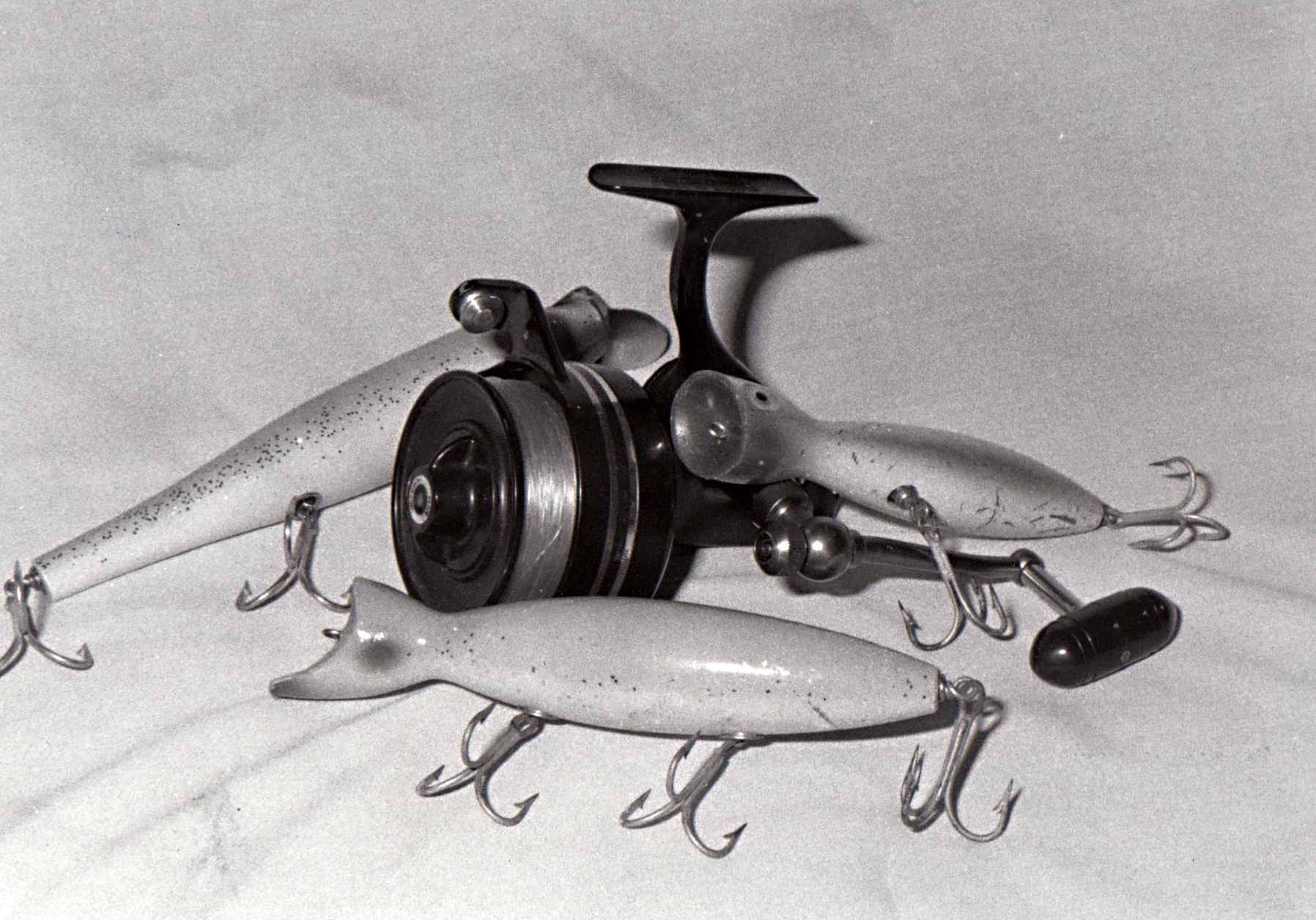
I see so many anglers on our beaches who are under-gunned. They may have fun with the little fish, but the big ones give them and their tackle fits. Look, just because your rod is eleven feet doesn’t mean you’re automatically outfitted correctly. Rapid taper rods, so common everywhere, can not deliver big baits for distance, and they can’t drive even sharp hooks into tough jaws. If it’s a trophy you seek, please get a parabolic eleven foot rod that will allow you the opportunity to hook and land your trophy.   While we’re at it, your reel and line must match the rod.   I prefer Penn’s recently reintroduced 706Z because it is rugged, casts far, and is reasonably priced. The Daiwa BG 60 and BG 90 are also serviceable reels at a reasonable price. There’s also the Van Staal reel which is a precise instrument but costs up to $400.   The Penn 850 SS is another solid surf reel. Please don’t use the 750 SS reel on an 11 foot rod because you’ll be under-gunned. Whatever the reel you use, fill the spool with 20 pound test line.   Although you’ll gain some distance with 15 pound test over 20, it isn’t a lot of yards in the final analysis. However, what you’ll gain with 20 pound test line is the ability to really lean into a cast with a wind in your face, maintain a 7 or 8 pound drag with confidence, be able to make a solid hook set, and have some insurance against sharp gill plates, rocks, and shells. I like Berkley’s Big Game Line and Fenwick’s Salt Line.


FIVE GOOD LURES


There is almost an infinite variety of lures to choose from in today’s technologically oriented marketplace. However, technology doesn’t necessarily produce a better product, and some of the best lures available are traditional standbys. They work and are still around because they have never stopped catching fish.


SEVEN INCH REDFIN


          I have been high on this lure for daytime big bassin’ for years.   At first I thought I’d stumbled onto something that only I knew. However, the last few years I’ve watched fishing videos where others use this lure to catch big bass in fresh water at places like Norris Lake in Tennessee, the Chattahoochee River in Georgia, and Lake Cumberland in Kentucky. They use the lure the same way I do, catch bass, and have the same problems I do. The biggest problem with this lure is that you lose a lot of fish because of the way the fish rise to, then roll over, the plug when they hit. However folks, this minor drawback is offset by the fact that this lure will attract bass and trigger them to strike when nothing else will in daylight. Further, it will catch them when they are in a neutral or negative feeding stage. I am talking exclusively about the floating model of the lure. It should be retrieved so that it wiggles on the surface, leaving a V-shaped wake.   The lure is not suitable for big wave water, but try it in sounds, bays, and inlets. You’ll like it!


BUCKTAILS

 Image (145)

          No one knows for sure how long bucktail lures have been used to catch fish, but I’ll bet the precursor of the modern bucktail has its roots in primitive society. Bucktails catch all species of predators in all kinds of water, and all over the world.   However, they are not idiot lures.   That is, you can’t just cast them out and reel in. They must be worked properly. The biggest mistake I see people make is they give the lure too much bouncing motion.   A bucktail should flutter, not bounce, for best results. Simply twitch your wrist slightly from time to time. Most hits will come when the lure drops back an inch or so. If the bucktail bounces wildly you could actually spook a predator.   The second biggest mistake I see involves the speed of retrieve. If you don’t lose at least some bucktails to rocks and clutter, then you aren’t fishing them properly. For peak effectiveness, a bucktail should be worked close to the bottom.   Bucktails work best when there is some depth to the water such as in the inlet channels, under the light at Montauk, off jetty tips, and around bridges. Attach a strip of porkrind for added attraction and action.


METAL LIP SWIMMERS


          This is another plug that requires reasonably calm water, so inlets, channels, bays, and sounds are appropriate places to try them. There are, however, calmer days when big bass chase big bait into the ocean wash or near it, and big metal lips will work great at those times.

Although you should feel comfortable adjusting the eye of the plug up and down, don’t bend the lip. Only very experienced surf fishermen can get away with doing this. Most often a bent lip renders a metal lip useless. Bend the front eye down to get the plug to ride higher, and bend it up to get the plug to dig deeper into the water.   There’s a time and a place for both.   Calm water in daylight, it seems to me, is the right time for a surface swimming plug. On the other hand, night time with some wave action seems to suggest we get the plug a little deeper. Big metal lip plugs like the Atom 40, Atom Junior, Danny Plugs, Larry’s Lures, and Bob Hahn plugs are quality products. Incidentally, metal lip swimmers are the best choice for making an eel skin plug. More about that another time.


BOTTLE PLUGS AND DARTERSPICTURE # 44


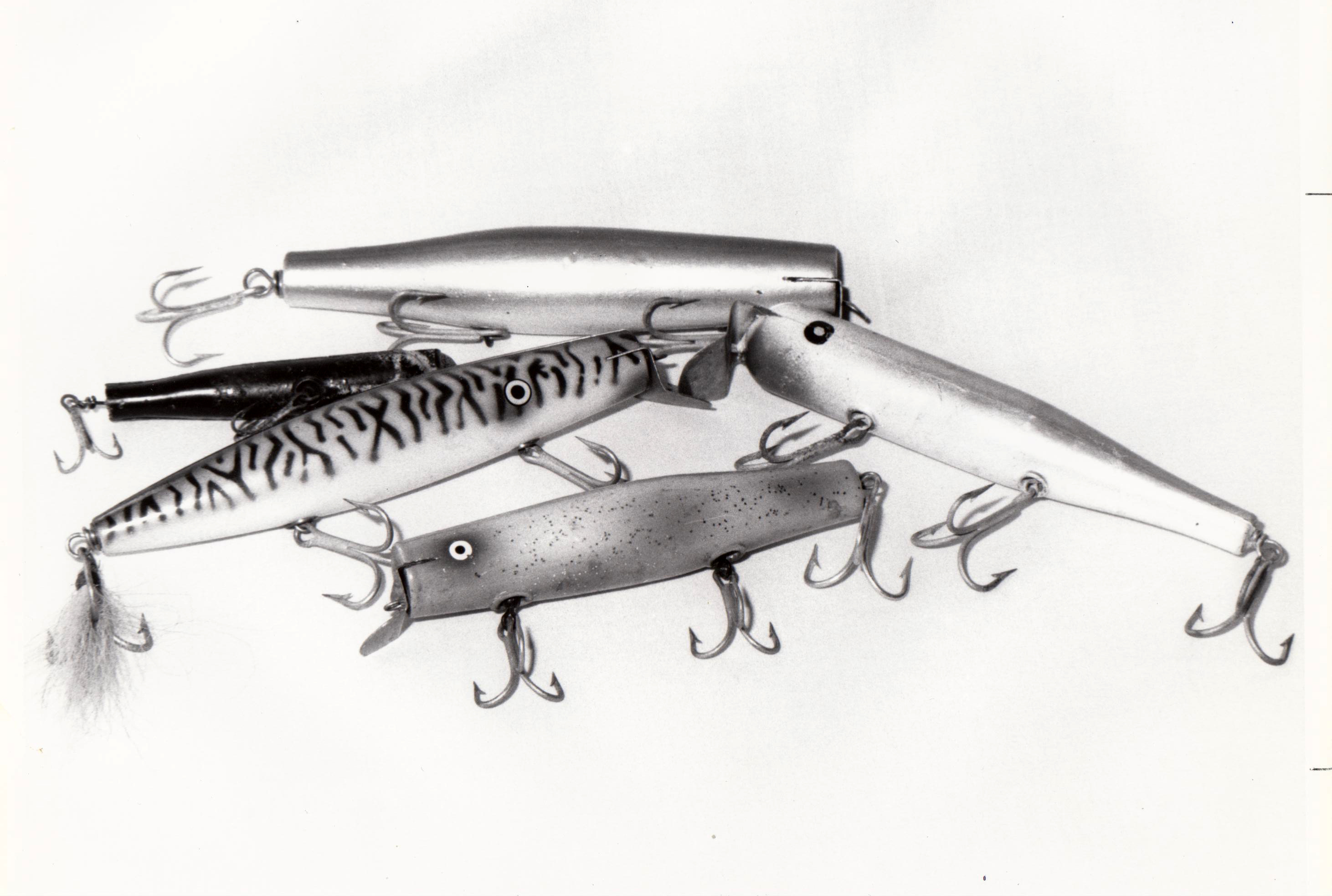
          These two types of swimming plugs are ideal for rough water and rip fishing. For that reason they have been mainstays at Montauk for years. They cast well and “bite” well. That is, they catch the water well enough so that even the rise and fall of waves doesn’t stop their action. In order to get the most out of them in rough water, stay in touch with the plug at all times. That is, increase and decrease the speed of retrieve as the waves push and pull on the plug so that the plug works at the same speed at all times. In a rip, cast out and retrieve slowly. These big plugs can be used to tempt a trophy at any beach and under any type of water conditions. These plugs should be in your bag at all times from September 1 until the end of the season. Old reliable models such as the Gibbs and Super Strike brands are excellent choices and they have caught a lot of big fish over the years. I recently helped develop and test a new breed of lures called Strike Maker, and this line includes the Throttle Bottle.

Believe it or not this is the entire recipe for catching a trophy bass on an artificial, the rest is up to you. Remember, there are no secrets spots or secret lures. All the lures I’ve discussed will catch a wall hanger, but only if you supply the most important ingredient of all. You must not only put your time in, but you must invest a lot of time with discipline, focus, and patience. Hey, if you do catch one, think about letting it go to fight another day. I can tell you from experience, it burns a life-long memory into your brain.


Bill “Doc” Muller is one of the most dedicated and successful surf fishermen on the east coast. He is also an accomplished author, publisher, editor, and lecturer. He was a college professor of biology for 35 years and recently retired. Doc joined the High Hill Striper Club in the early 1970s and was a member until 2001 when he, along with six other surf anglers, founded the Traditional Surfcasters, a club committed to preserving the philosophy of newly redefined post WW II surf fishing.