This article by Steve McKenna originally appeared in issue number 4 (yes 4!!!) of the Surfcaster’s Journal Magazine at www.surfcastersjournal.com

A Striper Experiment: A Season Without Eels
By Steve McKenna
I don’t know exactly when I got the idea for this “experiment”. I think the notion began sometime in late October of 2008. I recall that I received a phone call around that time from one of my old surf buddies who had recently gone over to the dark side and was now catching his striped bass from an 18 foot center console. Billy told me that he had been catching some nice fish right at first light directly in front of an old surf spot we had both fished many times together in the past. He related that he was so close to shore while he was catching these bass that he could touch the shoreline rocks with the tip of his 7 foot rod. He added that he had fish up to the 40 pound range on live bunker. After hearing this I knew that I would have to set my alarm for 3 AM the next morning and drag my butt out of the rack just to see if I could sample some of this great bass fishing from shore.
Early the next day I arrived “Johnny on the spot”. The spot was along the east facing shoreline of Narragansett, Rhode Island. I remember that this cold, fall morning was amazingly still. No wind with flat calm conditions and very little white water around the rocky shoreline. I quickly readied my gear and walked with a fast step to the rocky point where Bill had been experiencing all the action. It was still pretty dark when I made my first cast. I think I started out tossing a live or rigged eel into the 20 foot drop off directly in front of the large boulder I was standing on. Fifty or so casts later with notakers on the eel, the first signs of the new day appeared on the eastern horizon. With the new day dawning, I decided to take off the eel and snap on a wooden metal lip surface swimmer which was always standard operating procedure with me when these conditions presented themselves. I remembered that Bill said he had most of his action on bunker at first light so I was going to try to mimic his live bait with my parrot colored Danny plug.
The sun had just begun to peak over the island of Jamestown when I saw a large swirl in back of my Danny boy. I continued to reel slowly watching the plug a little more intently with my tired eyes. I remember that just as I was about to lift the plug out of the water to make another cast I saw and felt simultaneously a massive swirl and hit on the plug. The large fish inhaled the Danny and made its way eastward with a quick and very powerful run. About five minutes later and after a great fight I gilled a striper which looked to be about 40 pounds. I immediately unhooked the three sets of trebles, placed the fish up on the bank behind me and readied myself for another cast. I cast the Danny for another half an hour or so as I watched the sun take a high, almost blinding position in the sky. It was then that I decided the action was over and it was time to pack up my gear and get the large bass to the local tackle shop for the official weigh in. I kept the fish because I was in a club contest and knew
it was a contender. The weight of the striper on the digital scale was 40.3 pounds.
On the drive home I thought about the big fish and the manner in which I had caught it. It was the biggest striper I had taken on a wooden swimming plug in quite a while. It was at that moment that I began to think about metal lip wooden swimmers and what it would be like to fish with them exclusively for an entire bass season. I wrestled with the notion all that winter mainly because I was a tried and true live/rigged eel fisherman and only used artificials during specific situations like the aforementioned dawn scenario. I did, however, have some experience with using strictly artificials as I fished for stripers with nothing but nine inch Slug-gos for several years and had excellent success.
Over the winter of 2008/2009 I thought about the metal lip swimmer, learned as much as I could about them and bought many of them to use during the upcoming season. I was now locked in. No backing out. I would use the metal lips for the entire season and promised myself that I would not go near a live or rigged eel. Also, I would only use wood. No plastic or rubber allowed either. I decided to start my informal “experiment” on May 15 since this is about the time when bigger bass arrive inmy area and they almost always go “on the night feed” around that time.
There is one provision though that I must mention before I detail my experiences and findings of 2009. There are a lot of wooden, metal lip plug makers out there. An informal count shows about 64 of them and that doesn’t include part time or private builders. I am only one person and I could not physically use every one of these plug maker’s wares. What I did do is that I tried to fish with plugs that I had used in the past and with which I had caught fish. I also relied heavily on intel I gathered over the winter from surf fishing friends, the internet, books and magazines. I bought and  used those recommended plugs. I even selected several other builders’ stuff that I thought just looked like “fish catchers”.
In the end, I spent a lot of money and acquired quite a few wooden metal lips to use over the 2009 striper season. I can tell you too that most of the plugs that I used were effective but some were not. That is just the way it is. Some builders out there can make some plugs well and others not so well. If you decide to fish with wooden plugs, this article will hopefully assist you in picking the right plug for the right situation. As you might assume, I was really excited to begin the season and this is what happened!
First of all, I think we should establish that there are three types of wooden, metal lip swimmers. They are surface swimmers, shallow and medium depth swimmers and deep swimmers. Surf fishermen should carry all three types if they want to adequately cover the water column. In my experiment I used all three styles. Let’s break them down starting with surface swimmers.
SURFACE METAL LIPS
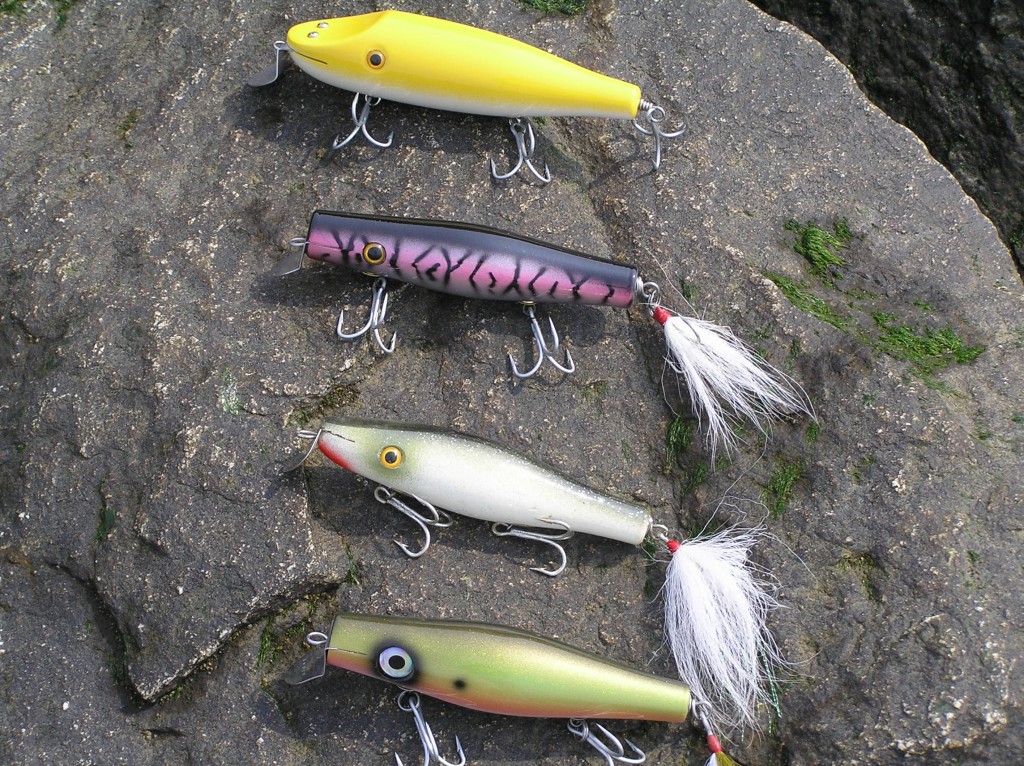
I believe that when most surf fisherman think of a wooden metal lip swimmer they think of the surface swimmer. It is certainly the most popular and all good plug builders/manufacturers turn them out to some degree. Furthermore, the most popular surface metal lip is the “Danny” plug. This plug was originally designed by the late master plug builder Daniel Pichney of Jackson Heights, New York. Dan made a super surface swimmer in three sizes, 1 ½, 2 ¼ and 3 ¼ oz. The 2 1/4 oz., 6 inch model was the most popular and the most copied since Dan’s death in 1985.
The surface metal lip should do just that, swim on the surface from splash down to the end of the retrieve. A good surface swimmer will do that right out of the package however some have to be tuned in order for them to perform correctly. “Tuning” them is easy. Just use small pliers to bend the line tie in the downward position. That’s the place on the front of the plug where you attach your line or snap. Bend it in small increments until you achieve the correct action. The good surface swimmer should have an alluring “S” type motion while rotating side to side on a slow retrieve all the time staying on the surface. If your plug does not do that then it has no business in your surf bag. Use it as a paperweight! A good surface swimmer will let you know if it’s going to produce. Just throw it in the water, during daylight hours to check its action. A good surface swimmer will look like a wounded bait fish crawling to reach safety in the rocks or in the shallows.
OLYMPUS DIGITAL CAMERA
There is another type of wooden, metal lip surface swimmer too. It is called a “Surfster” style plug. They look a little different than the Danny but achieve the same thing, swimming in an alluring manner on the surface. Surfster type plugs are popular but for some reason not as much as the Danny. I think because the Surfster might be a little tougher to make. The Surfster swimmer can also be tuned like the Danny style lure. Just bend the line tie wire down in small increments until it swims right on the surface from start to finish. Please note that I advocate tying your leader directly to the plug. If you must use a snap I highly recommend using a quality snap with a rounded nose like the new Breakaway F11. Utilizing such a snap will only make the action better on any swimming plug you want to use.
During my experiment of 2009, I used both the Danny and Surfster style surface swimmers a lot. The surface swimmer was my most productive swimmer by far. I used both the Danny and the Surfster during daylight hours, at dusk and dawn and after dark. My largest fish came after dark. They performed well from the middle of May until the end of November. My biggest fish of the year came on a surface swimmer, a Gary 2 chartreuse colored Surfster. I caught the 35 pounder at Deep Hole, South Kingston, R.I. in early November. In addition, Surfsters accounted for several other 30 pound bass over the course of the year. The Danny was a close second though as far as size and numbers. I particularly like to use either surface plug around the rocky shoreline of Narragansett, R.I. where I normally fish all season long. The 2 ¼ oz. style was by far my favorite size in that area for most of the season but I did very well with a smaller Danny in late May and early June up in Narragansett Bay, R.I. when the area was loaded with adult menhaden. Unaccountably, the smaller 1 I/2 oz. Danny surface swimmer was one of the best plugs up there with good action during daylight hours around mid morning. I also did well with the smallest Lefty swimmer in yellow or chartreuse. The Lefty, by the way, is another surface swimmer produced by the late plug maker Lefty Carr. His swimmers are very similar to Surfsters and could be considered in the same category. I had fish up to the low twenties on the smaller Danny’s and Lefty‘s. It is interesting to note that I did absolutely nothing with the larger size ( plus 3 ounce) surface swimmers even though there were larger bait fish ( adult menhaden) all over the place!
I also found that the more white water in the area to be fished the better the surface swimmers worked. However, it was not always necessary particularly in Narragansett Bay. It seemed though that casting surface swimmers was always better, day or night, as long as there was some white water around the rocks. The only place/scenario where I didn’t do well and actually really could not use the surface swimmers was in rip or inlet situations. The Danny or Surfster were not made to be used in fast current like you would find in an inlet or breach way. The surface swimmer just will not perform correctly in current but there are other metal lips that will and I’ll detail them later in this story.
During my experiment with surface swimmers I found brighter colors to be more productive. I did very well with chartreuse, parrot (green over yellow), white, all yellow, yellow over white , green over white and all green. Chartreuse was by far the best color though in the Danny and the Surfster. It accounted for all but one of my bigger bass. It also didn’t matter if it was day or night, full moon, new moon or whatever. The chartreuse color was number one. I also tried darker colors like blacks, purples, burple, blue and blue white. My most consistent darker colored Danny or Surfster was black back purple sides and belly. I think I had a few twenties and one thirty pound bass on that color combination. As a result, I really don’t subscribe to the dark plug/dark night, light plug/light night theory anymore. Light colored surface plugs work best for me no matter how dark or light it was. I believe light colors work so well because the bass can see them easily, particularly in rough or dirty water. It should be noted also that most of my surface swimming plug fishing was done in fairly shallow water. I don’t think they are deep water plugs and would always use the two other type plugs mentioned that I will discuss later in this article. I think surface swimmers lose their appeal to bass in water over 10 to 15 feet deep.
SHALLOW/MEDIUM RUNNING METAL LIPS
This is another important group of swimmers that a striped bass surf fisherman should become familiar with. There are a variety of different types of these swimmers around and almost all plug builders make them. Here again I am very lucky to have been around when Dan Pichney was alive and building plugs. I bought directly from him. Most of his stuff was $5 to $7.50 each (wow)! I still have some of his stuff left over from yesteryear and still use his Danny’s and other subsurface plugs which I purchased back then and more recently. He made wonderful plugs which have accounted for thousands of surf caught fish. If you can get your hands on any of his stuff, you should. Believe it or not Pichney plugs can be bought on internet websites. There are still a lot of them around in new condition. I would never hesitate to buy one. They work.

OLYMPUS DIGITAL CAMERA
With that said let’s look at subsurface wooden metal lip swimmers that run just below the surface to about 6 feet down. As stated, there are a lot of these swimmers available on the market today. When buying, stick with plug makers that make metal lips with fish catching reputations. They include but not limited to Lordship, RM Smith, GRS, Fixter, LP, Gibbs, Big Fish, Afterhours, Beachmaster, Tsunami, Greenpoint and the like. I know I left a few out but space does not allow it. Hats off to the private builders too who offered their plugs to me when they heard of my experiment. Thanks to Paul Moriarty (Professor M) and Mike Maffeo of Long Island, N.Y. I was fortunate to have met these two men and their plugs are superior bass catchers. During my experiment I used Pichney subsurface swimmers like his Atom Junior, Atom 40 and Bootleg, as well as other maker’s copies of those Pichneys. All produced in water up to 6 or 7 feet. All of these had wonderful action. Subsurface swimmer’s action is a little different than surface swimmers. Subsurface plugs have more of a side to side motion as if they were pivoting back and forth on a steel rod in the middle of them. Believe me, you’ll know when you see a good plug swimming. They will look alive!
All of the metal lips in this category caught bass in inlets around R.I. They were at home in moving water and, truth be told, caught very few bass elsewhere. I used them around rocky shorelines and other structure with little success. I did much better with them after dark and really didn’t fish them during the day much. I kind of think they were all designed for low light and after dark situations. I never took a bass during daylight hours on any one of them except the Greenpoint swimmer. I think they work well during the day (and night) because they are a metal lip, wooden copy of a plastic Rebel or Red-Fin type plug which can be effective during daylight hours. In particular, I liked Greenpoint’s 5 inch version. I did well with the Greenpoints throughout the season, especially in the summer months from mid July and all of August. Greenpoint’s really saved my butt during the doldrums because they really mimicked the predominant sand eel bait that was in the area that I fished. The Greenpoint plug “matched the hatch” perfectly with its thinner profile of the sand eel and out fished all other subsurface wooden artificials.
I must admit that I “cheated” a little during those summer months by using a small 4 inch rubber Red Gill teaser up ahead of the 5, 6 or 7 inch Greenpoint plugs. This combo worked great with double headers a common occurrence. The yellow Greenpoint and the pearl or all black Red Gill was deadly! If it wasn’t for the Greenpoint’s/Red Gills I think I would have cracked under the pressure of frustrating summer fishing and used live or rigged eels.
Other subsurface swimmers like the Atom Junior worked well most of the season particularly in the Narrow River inlet which I fished often. The Beachmaster Junior Atom in yellow, cotton candy, white and chartreuse hooked the largest stripers of the year for me in June and again in September and October around Narragansett. These plugs worked well in shallow to medium depth and in locales with current. White water also helped these plugs be more effective but it wasn’t as important as with the surface swimmers. The colors of these subsurface swimmers was similar to the first group of plugs. Bright, attractor colors like yellows, white, pinks and greens/chartreuse worked well. I didn’t have much success with black, blues or purples with the exception of the all black Lordship 40. This plug was also an exception in the size of the shallow/medium swimmers that I employed. Most of these swimmers were in the 5 to 6 inch range like the favorite size surface metal lips. I did particularly well with that mid range size and did poorly with smaller and larger plugs except the black Lordship.
DEEP SWIMMERS
Deep swimming metal lips are what I call the Rodney Dangerfield lures of surf casting because they don’t “get any respect”. I think so because number one, most guys don’t really know about them or how to fish them. Moreover, not many plug makers build them and if they do, they don’t produce many. Deep swimmers have every right to be in a surf men’s bag because they are perfect plugs for the right situation. And that situation is deep, fast moving water. Most surf fishermen are scared off by these spots and usually don’t wet a line in them because they are the toughest places to fish. If they end up fishing them it is usually with heavy lead headed buck tails. The deep swimming metal lip is the perfect plug for these locations and the deep swimmer makes them a breeze to fish. Just cast up current and let them dig in. Just reel slowly until the plug returns to you down current. Repeat. It is that easy. The well made deep swimmer is made to swim deep, up to 12 to 15 feet, effortlessly. Moreover, a well made deep swimming metal lip will get down to a lurking bass hiding behind a boulder 12 feet down. It offers that bottom dwelling striper a bigger meal than the small lead headed buck tail. And that might be just the ticket to a good night rather than a skunking. During my experiment I found, on several trips, that bass wanted a deeper running offering. The deep swimmer fills the bill.
Good luck finding a true deep swimmer though. Beachmaster makes several like the Cowboy,  Cowboy Junior, Conrad and the Slope head on occasion. If you see one of these, buy it because it will catch bass for you. Tattoo Plugs produces another deep swimmer called the Deep Diver. I think it’s more of a trolling lure but it will get down and is somewhat readily available. It is at home in strong current. Their construction allows them to have unbelievable stability in fast moving water. You could fish them easily in places like the Cape Cod Canal in Massachusetts. By the way, deep swimmers are like surface and subsurface plugs in that they can be tuned by adjusting or bending the line tie up in small increments. I’ll say it again because it’s important. When tuning a plug always test it in daylight before actually fishing it. The action on a good deep swimmer should be just like the other shallow/medium subsurface swimmers I described. One more important point on tuning! Some plugs cannot be tuned, i.e., they cannot be altered to swim the way they are supposed to swim. I have bought several that were supposed to swim one way and just wouldn’t after much adjustment. They just won’t work. They became expensive paperweights. Other deep swimmers can be had by Surf Asylum (Conrad) and Greenpoint (deep swimmer). Again, if you can find any Pichney deep swimmers like his Conrad or Slope head Conrad, by all means spend the money. They are the best.
In the course of my experiment I used the deep swimmers a lot. My favorite color was white. I tried other shades but the white one took the most and the best. I even caught a 4 lb. fluke on it. Now that’s getting down.
As with any experiment there are some facts, figures and findings.
When the season without eels experiment ended, the total results where surprising. In 2008 I had approx. 350 bass on live eels. I made about 88 trips from the middle of May to the middle of November. My biggest striper on an eel in 2008 was 37 pounds.
In 2009, I caught about 287 bass on metal lips swimmers of the three types mentioned in this article. I made about the same amount of trips, 85, during the same amount of time. My biggest bass on a metal lip was 35 pounds.
The two seasons were very similar. I was surprised! I would say that the only big difference between 08 and 09 was the average size of the fish. The eel year, the stripers were larger. I caught a lot more 20 pounders in 2008 than 2009 and I caught more smaller bass in 09 on the plugs then I did on eels in 2008.