Gettin Schooled by Bill Wetzel

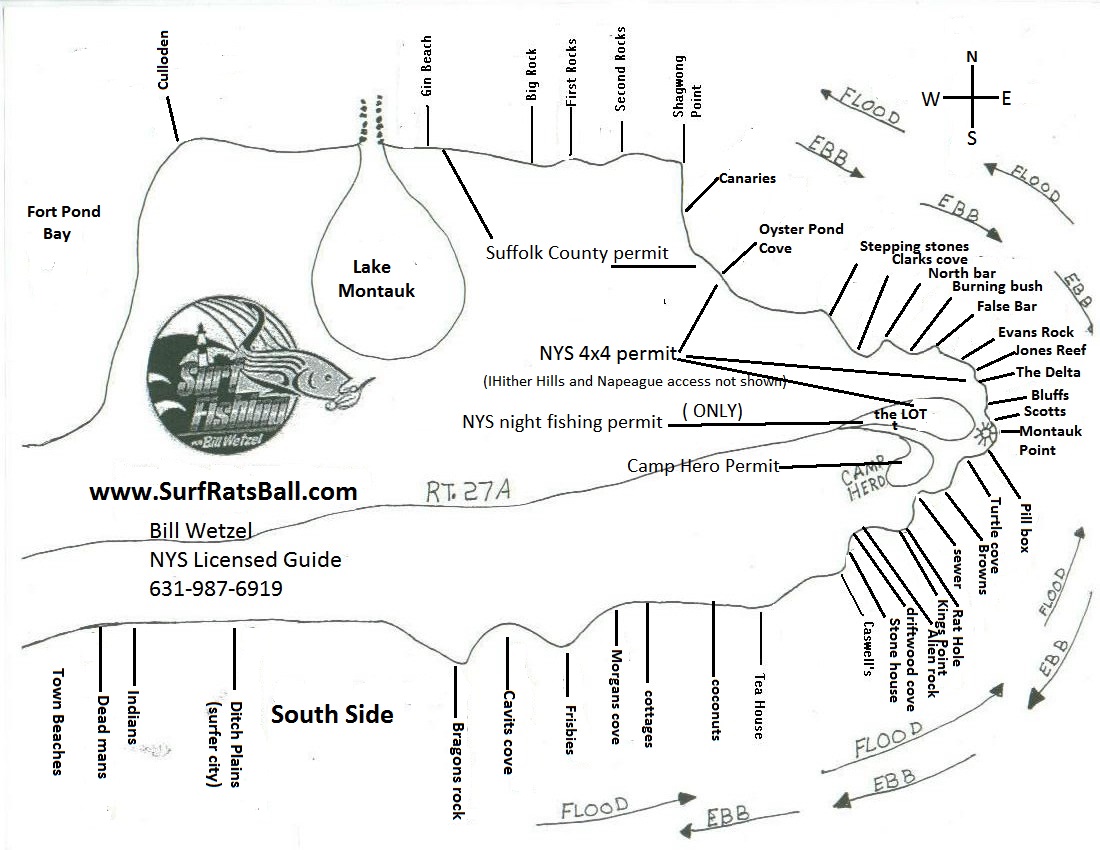
I believe it was the second week of December in 1991. The SW winds were blowing at a sustained fifty knots bringing the warm air from the south, and raising the night air to temperatures near sixty degrees. High tide was around 9pm and we had just came off a moon. New or full I do not recall. Montauks south side put the wind directly in your face making the Atlantic Ocean churned up and huge. The plan was to hit the stepping stones on the north side and work my way over to false and north bar on the dropping tide.

I was about twenty six years old and armed with a Saber 11 ½ foot fiber glass rod, and a Penn 850SS reel, spooled up with 20lb Ande pink. Most guys at that time had similar set ups. I arrived at the light at about 9pm and crawled my 1988 sky blue Nissan Pathfinder into the north side entrance.  Through the woods, and out at the false bar cut I kept heading west to get to the Stones.  I arrived to the rock piles and stepped out of my buggy, I remember thinking “this is not bad”. The water was flat and clean as the warm fierce SW winds blew over the bluffs and into my back. I crawled out onto some of my favorite rocks and began casting black with gold tint Long A Bombers.

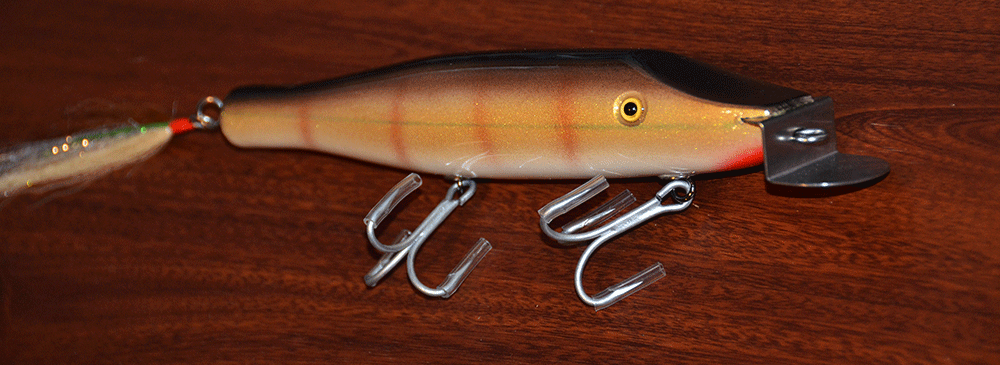
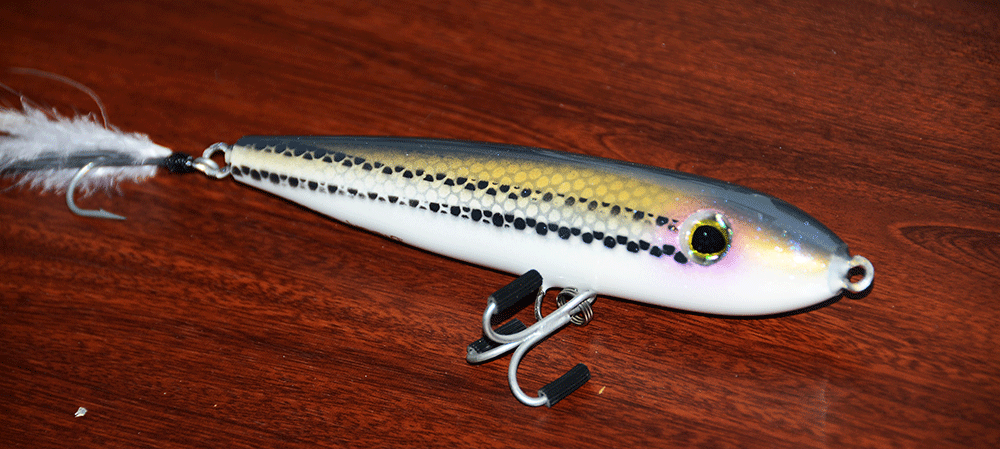
After about 11:30pm I took a drive to False and North bars. With the place completely disserted, I continued casting the bomber and would occasionally mix it up with the classic Gibbs yellow darter. Back then I do not think there was a Montauk caster alive that did not carry a Gibbs yellow darter. By 1am I had not a touch and took the drive around Clark’s cove, though the stepping stones, around the Oyster pond and into Shagwong. With my headlights off I noticed about ten casters lined up and one of them dragging a slob towards my buggy. My mind went completely numb. “Ya got a scale?” the caster asked. I pulled out the old brass Manley and confirmed the weight to be 44lbs.  “They got the herring pushed up to the beach, nothing under the 30lbs. Just throw a Super Strike yellow darter. That’s all they want”. I quickly grabbed my rod and stuck with my bomber. I knew I could cast it a mile with the wind at my back and I remember thinking “I’ll show these guys what a bomber can do”. I was young, cocky, and too green to listen to words of wisdom. I worked my way into the outside edge of the lineup and watched every guy hooking into huge fish, most of them well over 40 lbs with some schoolie 30’s mixed in. I could not even get a tap with my bomber, and after about 20 minutes of watching guys bail cows I tied on a Gibbs yellow darter. In 1991 Don Musso had introduced his plastic Super Strike darter and every caster in the lineup was using one. On the other hand I only had my trusty Gibbs.  I threw the Gibbs with passion and panic, but could not buy as much as a bump. My entire body was shaking and casters continued to pound slob after slob. I heard the whistle of the darter that night and today I can tell you that no other plug that I know of makes the whistling noise like Don’s plastic darter.  “It must be the darter. It’s not swimming right”, I thought. I put on another Gibbs darter but it only yielded the same results. By 3am there was barely any tide left and the lineup left one by one. Every caster had his share of multiple forties and maybe even a fifty or two. On the other hand I kept fishing until the tide slacked out. I did not manage so much as a bump. Although the Gibbs and the Super Strike darter are very similar in profile and action, the Super Strike has a slightly deeper dig and perhaps a little more zig and zag.

I was a young man without much money but I had been saving up $100 to buy a batch of plugs. The next day I took the money, walked into my local Bait and Tackle shop and asked “how many Super Strike darters can I buy for $100”.

montauk map type3 (2)

Bill Wetzel is what we like to call “The Hardest Working Guide in the Surf”. A quintessential Montauk Regular Bill works hard at teaching his clients the secrets of Montauk coves and consistently puts them on the fish. No wonder most of his customers come back for more year after year. Bill also runs a Surf Rats ball, Subscribers only forum at http://www.surfratsball.com/ There he exchanges ideas with his subscribers and of course, logs each and every one of his trips for all to read. Check it out at http://www.surfratsball.com/

surfratsball_logo3_30-300x90

Win a pair of Super Strike Show Special Poppers, Rattl’n Bunker and a Rattl’n Mullet

We are a little out of “sync” with not being home on weekends but we got some nice stuff lined up for you. A new blog post from Dennis Zambrotta, more good stuff from Charlie Witek, a Q&A session with Crazy Alberto Knie ..and more giveaways of course.

Lets get to it. Winners of the Big Rock swimmers giveaway, (each winner will receive one Big Rock Custom swimmers) are  CPollnow7@gmail.com and  mpac422076@aol.com . You both have 5 days to contact us with your shipping address at info@surfcastersjournal.com

DSC_3440

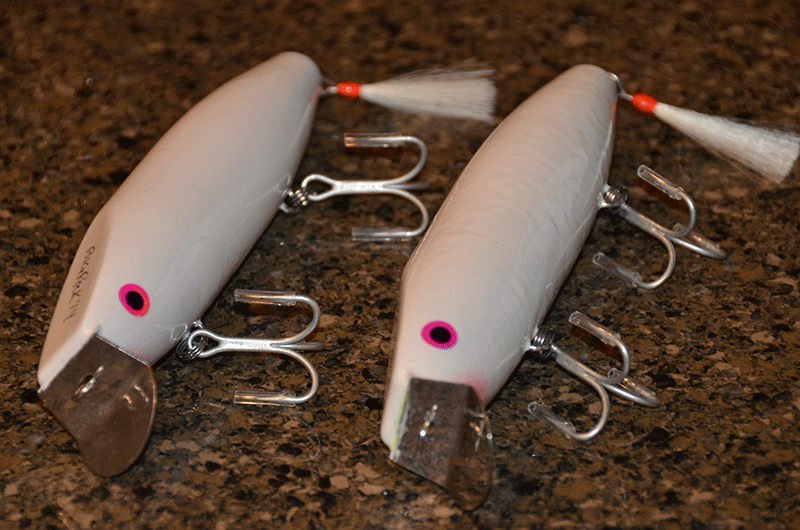
And for this week giveaway, we are tickled pink to be able to feature these Super Strike Show Special Poppers.

One winner will walk always with a Rattl’n Bunker and a Ratlt’n Mullet Super Strike Show Special poppers, courtesy of  Steve Musso at Super Strike Lures http://superstrikelures.com/

If you are not a fan on FB , you should be as they feature news and giveaways all the time. You can find them at https://www.facebook.com/SuperStrikeLures

Thank you Mr.Musso for your kindness, support trough the years and for making the best darn plugs on the planet.

In order to be eligible to win you must enter “I want these Super Strike Poppers”

2014 Show Specials

ONE ANGLER’S VISION: PART III GAMEFISH AND GROUNDFISH

Editor’s note

In a lot of ways, we consider anything Charles Witek has to say on fisheries management and conservation a “must read”. Charlie has recently started a blog at http://oneanglersvoyage.blogspot.com/

I hope many of you check it out and subscribe to be notified when Charlie posts his thoughts on this very difficult and often confusing subject. But in case you are too lazy to click it we will repost his blog right here. But I do urge you to subscribe to his feed on his blog

Zeno

ONE ANGLER’S VISION: PART III GAMEFISH AND GROUNDFISH

When the Theodore Roosevelt Conservation Partnership noted, in their report “A Vision for Managing America’s Saltwater Recreational Fisheries” (http://www.trcp.org/assets/pdf/Visioning-Report-fnl-web.pdf), that recreational fishermen “are more focused on abundance and size, structure of the fisheries, and opportunities to get out on the water” than in piling up dead fish on the dock, they acknowledged a basic truth.  But it is a truth that must be taken in context.
There are fish such as bonefish and tarpon that are valued solely for sport and not for their meat, and are killed only rarely.
There are fish such as permit that are might be fine eating, but are so valued as gamefish that killing one is something that, as a rule, “is just not done.”
And then there are panfish.  The species differ from place to place, but most of them are what they call “groundfish” up in New England—fish species that, when the stock is healthy, swarm in abundance on or near the ocean bottom.  They are the bread-and-butter of the party boat fleet, and a lot of the charter boats, too.  And while anglers may release most of the gamefish they encounter, when they go out after groundfish, they’re planning to bring something home.
Haddock fishermen just aren’t big on catch and release.
That has implications for management that the “Vision” report chose to ignore.
The report says that
“The NMFS should manage recreational fisheries based on long-term harvest rates, not strictly on poundage-based quotas.  This strategy has been successfully used by fishery managers in the Atlantic striped bass fishery, which is the most sought-after recreational fishery in the nation.  By managing the recreational sector based on harvest rate as opposed to a poundage-based quota, managers have been able to provide predictability in regulations while also sustaining a healthy population…”
It’s a nice statement, but the essential premise is wrong.  The most recent “benchmark” assessment of the striped bass stock (http://nefsc.noaa.gov/publications/crd/crd1316/partb.pdf)—a peer reviewed study that is as close to a “gold standard” as you can get in fisheries management—shows that the population is not healthy.  It has been subject to overfishing half a dozen times in the past ten years, has been steadily declining in abundance and is likely to be declared “overfished” in the next year or two.  (The only reason that the Atlantic States Marine Fisheries Commission can still claim that the stock is healthy today is because ASMFC has not yet incorporated the conclusions of the new stock assessment into its management plan; although it received the benchmark assessment last autumn, it is still using obsolete and since-discredited criteria to gauge the health of the stock, rather than the newest and best available science.  That, in itself, is an indictment of striped bass management.)
Anyone with even a casual familiarity with the striped bass fishery knows that managers deserve little credit for maintaining the fishery, whether through “predictability in regulations” or otherwise; instead, all credit should go to the striped bass anglers themselves, who choose to kill far fewer fish than the managers allow.  In fact, bass anglers have been begging fisheries managers to reduce striped bass harvest for years.  They have been repeatedly rebuffed.  Despite steadily decreasing abundance, managers have so far clung to a target fishing mortality rate (F=0.30) that is not only far higher than that recommended in the benchmark assessment (F=0.180), but is also well above the overfishing threshold (F=0.213).
How that sort of management can be considered a good thing, and preferable to kind of sustainable management that restored species such as fluke, scup and black sea bass, is beyond my understanding.  Because if striped bass managers don’t get their act together soon, bass could well become another great fishery that we speak of largely in the past tense.
The only thing that’s keeping that fishery off the ropes today are the serious striped bass anglers who respect the bass as a gamefish, and release far more than they kill.  If they all treated like a groundfish, the story would not be the same.
How can we know that is true?  Consider the winter flounder.
Winter flounder are arguably the definitive groundfish of the northeast coast.  When the stocks were healthy, flounder were everywhere.  Taking home a bushel basket or a burlap sack filled with fish was not unusual during the height of the season (and the fish averaged less than a pound).  They seemed to line the bottom.  In my home waters off western Connecticut and the South Shore of Long Island, flounder once provided a year-round fishery that only shut down when the bays were locked in ice.
The Atlantic States Marine Fisheries Commission never set a hard quota for flounder.  It merely established a harvest rate, which could be exceeded with impunity.  In time, flounder were overfished, and the inshore stocks collapsed.  They have fallen so far that the southern New England/Mid-Atlantic stock can muster just 9% of its spawning potential.  Even so, early last month ASMFC inexplicably decided to allow recreational fishing pressure to increase significantly, extending the season from two months to ten (see my earlier post athttp://oneanglersvoyage.blogspot.com/2014/02/winter-flounder-last-tuesdays-travesty.html for the whole sad story).
As I write this post, New Jersey is thinking about lengthening its winter flounder season to the full ten months allowed by ASMFC.  The collapse of the stock and low local abundance is not a part of the debate.  Instead, as Tom Fote, New Jersey’s governor’s appointee to ASMFC notes
“I don’t see any reason why they wouldn’t support opening up the whole the season mainly because there is no quota to go over” (http://www.app.com/article/20140303/NJSPORTS06/303030096/Winter-flounder-decision-due-Thursday?nclick_check=1)
In too many anglers’ minds, groundfish exist to be eaten.
Without a quota, such anglers will show no restraint.
That fact needs to be remembered when setting management measures.  Groundfish are good food, so many species support big commercial fisheries, attract a lot of anglers and are the darlings of the party boat fleet.
Some people fly thousands of miles in search of tarpon and bonefish, knowing that they’ll end up releasing them all.
Others spend countless hours in the wet, the cold and the dark, trying to catch striped bass.  When they finally land one, they often let it go.
But when people take a ride out on the bay on a summer afternoon, and try to catch some fluke, they’re planning to bring home meat.  Folks can talk all they want about the joys of spending time with friends on the water, but a fluke fisherman with an empty cooler is an unhappy soul.
And that’s why groundfish, rather than gamefish, seem to always be at the center of the hottest fisheries debates.  Florida maintains a 1-fish limit on redfish, and a narrow “slot” size limit, and is praised for its prudent management.  Its snook rules are even tougher, but not many anglers complain, because when you’re chasing gamefish, that’s often how it goes.
After a severe cold snap killed many snook down in Florida, Coastal Conservation Association Florida argued that the fishery on the west coast of the state should remain closed, even though biologists believed that it could be safely opened.  CCA Florida noted that
“snook was already predominantly a catch and release fishery before the big freeze kill…recreational anglers release more than 90% of the snook they catch, and since 2005 release more than 95%.”  (http://www.ccaflorida.org/index.php?start=57)
In other words, snook are a gamefish, and anglers can enjoy them without having to kill them.
But in a sort of Jekyll and Hyde transformation, that same CCA Florida took a very different position when it came to managing grouper, one of the iconic southern groundfish.  After the best available data indicated that the recreational fishery should be closed for just a few months to best protect the resource, CCA Florida attacked NMFS decision to do so, noting that
“Red grouper is almost exclusively a Florida fishery and the Florida commission has been consistently rejected.  What needs to be done is our congressional delegation needs to change the federal law so in situations like this, where you have a state that has a huge interest in a fishery, they need to have a greater role.”  (http://articles.sun-sentinel.com/2005-11-20/sports/0511190580_1_red-grouper-cca-florida-gag-grouper)
In other words, if the federal law requires fisheries managers to employ the best available science and protect the grouper from overfishing, then federal law needs to be changed.
Because grouper aren’t gamefish, they’re food.  Different rules apply.
If you think otherwise, just contrast the cries of anglers who demand to kill more red snapper (http://www.joincca.org/articles/143) (or fluke, or black sea bass or…) with the equally passionate cries of anglers who demand that fewer striped bass be allowed to die.  Listen for just a little while, and you’ll have no more questions about the gamefish/groundfish divide.
So we come to the effort to replace “poundage-based quotas” with “long-term harvest rates”, which may be less a fight over methodology and more of an effort to continue overharvesting groundfish.
As the theoretical level, the distinction between quotas and harvest rates is really no distinction at all.  Any harvest rate—or, more correctly, any “instantaneous fishing mortality rate”—can be converted into the percentage of fish that can be removed from the population annually.  Multiply that percentage by the estimated size of the stock (in pounds or in metric tons, it doesn’t matter) and you get a “poundage-based quota.”  Reverse the calculation, and you can convert a quota—or, in practice, actual landings—into the fishing mortality rate.
But at the practical level, the distinction is real.
Poundage-based quotas are easy to apply, and can be enforced proactively.  Managers can determine a reasonable fishing mortality rate, convert that into a quota, and then set appropriate seasons, size limits and bag limits to avoid overfishing.
That system isn’t perfect; there is always “management uncertainty” at play.  Angler effort can be greater than expected, weather can affect harvest, or the fish can be more or less “catchable” than expected; as a result, harvest may be significantly higher or lower than predicted.  In addition, because it is impossible to physically count every angler’s landings, such landings must be estimated through the use of a survey.  Under perfect circumstances, such estimates lag harvest times by about six weeks; in reality, overfishing may go undetected for two months or more.
Thus, quotas are often exceeded before managers can prevent it, and some anglers object when the next year’s quota is reduced as a result (“We don’t want to kill fewer fish…”)  On the other hand, high harvest levels early in the season can cause managers to shut down fishing earlier than planned, even though they later discover that the closure hadn’t been needed, and that causes other complaints (“We could have killed more fish…”).
But as a rule, hard quotas provide a lot of management flexibility, often allowing seasons to be closed early to avoid overfishing, and almost always allowing regulations to be adjusted in time to avoid overfishing in the following year.
Managing by harvest rate, as ASMFC manages striped bass, is trickier, in part because the mortality rate is determined retroactively.  Managers have no idea of whether their regulatory approach worked until well after the season is over, when it is already too late to change regulations for the following year.
That’s because managing by harvest rate requires managers to reassess the stock every season, which is an expensive and time-consuming process.  Because of the cost in financial and human resources, it is only practical to manage a handful of species that way (and, for most species, managers lack the data needed to calculate fishing mortality rates accurately).
When a stock is managed by harvest rate, it is impossible for managers to react quickly to changes in the fishery.  The mortality rate for any given year won’t be finally determined until about halfway through the following season (even the preliminary annual harvest estimates needed to begin the task aren’t available until mid-February).  Thus, if the fishing mortality rate in any year was too high, and overfishing occurred, it is likely to occur in the following year as well.  “Predictability in regulations” is not always a good thing…
Managing by harvest rate is a viable strategy for fully-recovered stocks such as striped bass, particularly when a large proportion of the anglers in the fishery practice catch-and-release and so keep the harvest rate well below the fishing mortality target.  In such a circumstance, overfishing in any one year (assuming that the fishing mortality target selected is the right one, which is not currently the case in the striped bass fishery) will have little lasting effect, and any impact that it does have will be quickly lost among the normal fluctuations that occur in the size of any healthy population.
On the other hand, the inherent delay in responding to overfishing events, and the likelihood of consecutive years of overfishing, makes such a strategy inappropriate for stocks that are still rebuilding, particularly those such as southern New England/Mid-Atlantic winter flounder or South Atlantic red snapper, which remain badly overfished.  In such cases, serial overfishing can slow, halt or even reverse the rebuilding process (it should be noted that, while recreational striped bass harvest may be governed by harvest rate today, back in the 1980s the collapsed stock was rebuilt by what amounted to a very strict quota—regulations had to assure that no more than 5% of any year class, beginning with that spawned in 1982, would be harvested in any given year), and more readily adjusted hard quotas become the more appropriate management tool.
In the end, there is no silver bullet, and one size does not fit all.
While management based on harvest rates may work for some stocks of gamefish, everything else needs hard quotas, either because the stocks are still recovering—and maybe even still overfished—or because angler demand is so high that there is some danger of overfishing just about every season.  Consistently high harvest levels militate against the “long-term harvest rate” approach recommended in the TRCP “Vision” report.  For what, precisely, does “long-term” mean, and when must managers finally be compelled to take action?
Would two consecutive years of overfishing require remedial measures?  Three out of five?  Six out of ten?  Or does the TRCP report envision overfishing going on indefinitely, with no mandatory tripwire at all?
That certainly seems to be the way New Jersey is headed with winter flounder.
Because when “there is no quota to go over,” too many fishermen will see no reason to exercise restraint.

Thank you NJ surfcasters and Striper Surf Day at CT March 22nd

My mind is a little blurry and I think I might be growing a mullet….but let me try to remember it all because it all seems like a blur now at midnight as I am writing this. Four consecutive weekends in NJ, first an awesome Surf Day, followed by Berkley and Asbury shows. Then this weekend my son and I were at Somerset where Tommy and Ray joined us today. I just got home but Tom and Ray are there at booth #10, so if you guys need to renew or subscribe, they have your free shirt and some other goodies.

20140314_175417

First of all, I want to thank ALL OF YOU for your kind words via email and particularly at shows. When people say “this issue is the best yet” it just makes our day. We all try incredibly hard to make next one better than previous one and credit for this goes to Dave Anderson who has amazing skills of working with writers, all contributors and of course our creative genius Tom who designs the best darn publication ever dedicated to the surf. And I cant believe how many of you stopped by and told us how much you love our You Tube channel and FB page. And I thought that was only for cool kids

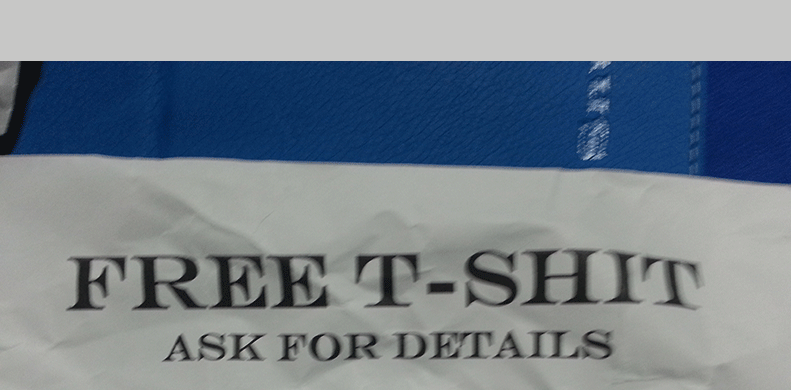
Yes, the shows take a toll on you. I mean, you guys know I have a unique ability to misspell every single word in the English language. But did you know we had Free SH*T at show this weekend? You didn’t? Neither did I until my (obviously) much smarter son pointed out just how low my IQ is by pointing at the sign that was hanging in our booth. And then you guys ask why do I always dumb myself down? There is a reason..haha

can I say I KVIT?

gffhu

Continuing in our never-see-wife-and-kids tradition, SJ crew will be at Surf Day next Saturday, March 22nd at River’s End Tackle in Old Saybrook, CT. They will have new Tools of the Trade t-shirts for you guys attending. If you never been to the Surf Day at Rivers End you owe yourself to stop by and cheek it out. Not only is the shop one of the nicest shops I’ve ever been in but its a surfcasters dream ,carrying everything from soup to nuts to eels. The food is awesome, the crowd is great and friendly, and seminars are off the hook, and this year, the line up is truly fantastic. And its all free

                                 STRIPER SURF DAY  

March 22th, 2014  10-4

Under the snow there really will be a spring run.  Get ready and celebrate it at Striper Surf Day. It’s a great day to hang out, take in a seminar and tell some lies with fellow surf rats. We’ll have great speakers and an emphasis on how to demonstrations, factory reps, sales, door prizes, gourmet road kill and good friends.


           FEATURED  SURFCASTERS  and  DEMOS

Bill  Wetzel – Legendary  Montauk guide is giving a seminar on “Reading the Water”. Bill’s knowledge and delivery will have you leaving for the beach immediately.

Steve McKenna – conducting a seminar “ The Top 10 Surf Lures”

Steve will also be demonstrating how to load Redfins and Northbar Bottle Darters.

Toby Lapinski – will demonstrate how to make the classic rigged eel.

Dennis Zambrotta – will demo how to rig eel bobs as well as show you how to fish with teasers. He’ll also be signing copies of his book “Surfcasting Around the Block”

 Surfcasters Journal Magazine Crew will be there to hang and chat

Adam Romagna – is displaying antique striper plugs and can help ID and appraise your old lures.

Shimano –Will demonstrate their new line of surf rods and reels.

We’ll also have reps from CTS Rods,

Van Staal,  Commando Surfcasting,

Super Strike, Zee Baas, Tsunami,

 Lunker City, Pure Fishing, Guppy Lures,

Northbar Tackle and more.

It’s free, just show up.

 ps

winners of Big Rock plugs coming up when i come to my senses and a new giveaway from Super Strike is on tap too. Here is the preview

dfr

Striped Bass Cooperative Anglers Program ..and Somerset Saltwater Expo

Our readers are always on alert about things that not only concerns them but the fisheries as a whole. Chris Scott is one of those anglers who walked up to us at the recent show and explained to us what NYS  DEC Striped Bass Cooperative Anglers Program is.

“Once you sign up to volunteer you receive a log book and scale envelopes. Anglers log their trips throughout the season and return their book at the end of the year so the data can be entered into the system. The log asks for general information about the trip (i.e. “I fished the south side of Montauk” not “I fished the sewer pipe”,) so there is no need to worry about giving away your fishing secrets. We are more concerned with what anglers are catching and how much effort they put into catching those fish. Anglers are also encouraged to take scale samples from each striped bass they catch before they release the fish. This allows us to age the fish based on the annuli of the scales (like rings on a tree).

The data from both the fishing logs and the scale samples help to build an important recreational data set. Anecdotal data of fisherman observing changes in the fishery become more concrete when there is physical data from multiple anglers collected throughout the season.”

Here is from NY DEC site link http://www.dec.ny.gov/outdoor/7899.html

New York State would like your help.

Here’s a chance for recreational anglers to participate in a fishery research project on its most important level, that of data collection for the DEC Striped Bass Cooperative Anglers Program (SBCA).

New York State is required by the Atlantic States Marine Fisheries Commission, an interstate cooperative fishery management agency, to supplement the Marine Recreational Fisheries Statistics Survey (MRFSS) with additional information from our recreational fishery. We satisfy this requirement with the help of New York State volunteer recreational anglers. We provide volunteer anglers logbooks and small envelopes and they send us information about their fishing trips and scale samples. The scale samples are used to determine the age of the fish and create age-at-length keys. The logbook information helps us determine catch per unit effort (CPUE) or fishing success for New York waters. All this information is used to help determine striped bass populations and help in forming management measures for striped bass along the Atlantic coast. At the end of the year all the fishery data we collect are analyzed and presented in an annual report. The report describes any trends and the quality of striped bass fishing for the year and compares it to previous years. You can look at our most recent report and get an idea of what is done with the samples provided by the volunteer anglers by opening the PDF file in the Important Links column to the right.

Perhaps you would like to participated in the SBCA Program. When you join the program you will receive a logbook, scale envelopes and instructions on how to collect scales and what information to collect. At the end of the year you send us the information which will be entered in our database. Your logbook will be returned to you for you to keep for your own records. We also need information from catch and release fishing; therefore you can participate in this program year round. When collecting scales, please collect them from any size fish you may catch. You do not have to worry about the fish, the scales will grow back.

If you would like to participate in the Striped Bass Cooperative Angler Program, please contact our office at (631) 444-0488 and ask for the SBCA program coordinator. Or you can e-mail us at the Bureau of Marine Resources (fwmarine@gw.dec.state.ny.us).

Electronic Fishing Logbook (eLogbook)

New York State recreational anglers can now report their catch in a voluntary online angler logbook, called eLogbook. Anglers can document their fishing activities, compile their fishing data and plan more effective fishing trips. They will also be contributing needed fishing data to researchers and resource managers by sharing what they catch, the sizes of their catch, and where and when they fish. Recreational angling information can be used by DEC and other coastal resource agencies to assess catch levels, estimate discards, and measure fishing effort. If you wish to use this online logbook, please register and log on online at the Atlantic Coastal Cooperative Statistics Program (ACCSP) web site. Check the DEC ACCSP and Electronic Reporting web page for more information.

Happy fishing!

Surfcaster’s Journal Crew will be in booth #10 at the Saltwater Expo in Somerset, NJ all weekend. Stop by, catch some blitz footage on our big screen and pick up any shirt we make for free with subscription or renewal. Plus discounted hoodies and other gear

Have a great weekend

somerset_banner

Win two large Big Rock swimmers

I hope you guys are enjoying the new issue of the Surfcaster’s Journal Online Magazine. I think the whole crew once again outdid themselves and put out another solid issue.

We need to announce the winter of last week  Big Water GRS plug and Black Label Spook. Without further suspense, the random computer program we use spit out a winner and its Mark Catalano

You have 5 days to contact us at info@surfcastersjournal.com

DSC_3434

DSC_3438


Continuing with the thoughts on custom  plugs…

No, I wont go into the all the craziness that surrounds some of these makers, I am totally disinterested in the subject. Its nice to see your hard work appreciated, we feel the same way here at SJ.

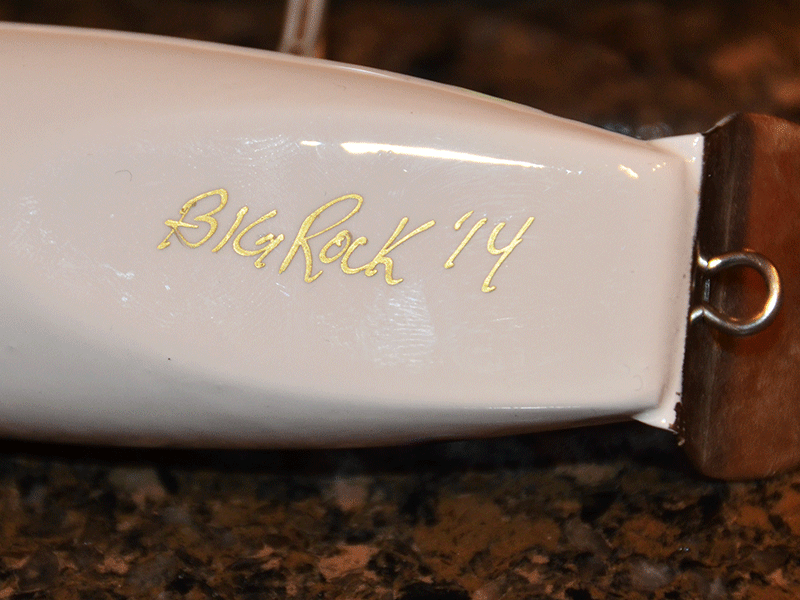
Half way trough the last week Asbury Show I attended with my son, Russ “Big Rock” Paoline, Surfcaster’s Journal columnist and maker of wildly popular Big Rock Custom plugs walked up to us and stuffed few lures in our hands. “This is for your readers” he said.

And so it will be

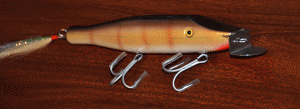
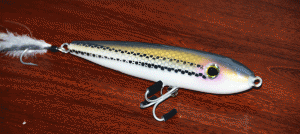
Today’s giveaway is courtesy of Big Rock, two large Big Rock swimmers, two winners. Each will receive one Big Rock lure.

DSC_3441

The skinny?

In order for your entry to count, you must tell us what is your favorite story, feature or picture in the CURRENT issue of the Surfcaster’s Journal Magazine. Everyone that enters with “I am in” will be ineligible to win.

Yeah, this means that the giveaway is only open to subscribers. And yes, there are benefits beyond original articles, original video and free t-shirts.

This one is for you guys, because you are the ones that keep the lights on at SJ

Good Luck

DSC_3440

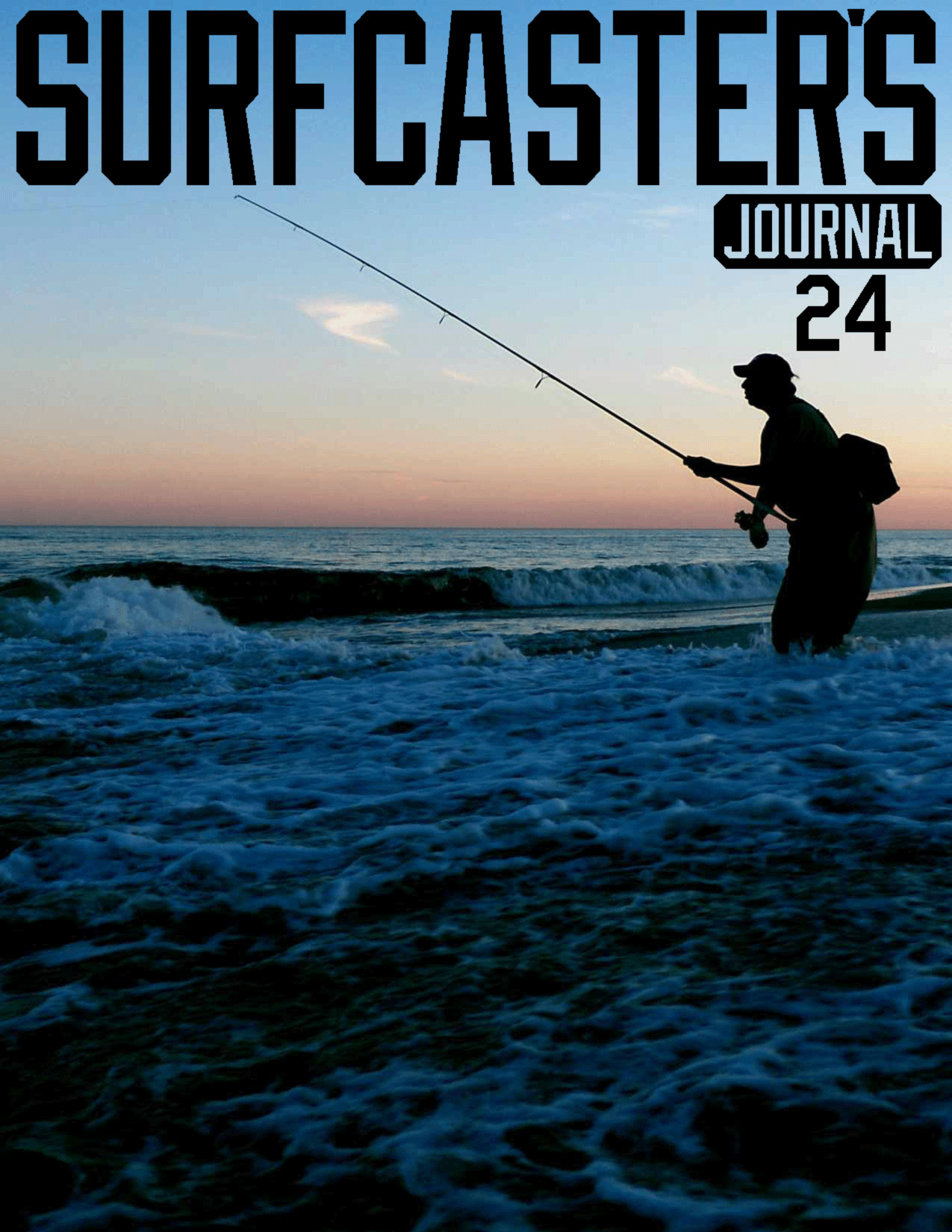
The new issue of the Surfcaster’s Journal is up for your viewing pleasure

The new issue of the Surfcaster’s Journal is up for your viewing pleasure.

issue24web

Stories from

Crazy Alberto Kine

Bill Jakob

Zach Harvey

Dave Anderson

Frank Pintauro

John Skinner

Big Rock

Rod Guru Lou Caruso

Roger Marin

Al Albano

John Papciak

Chef Chris Blouin

Introducing new column “Ask Alberto” by Crazy Alberto

Bunch of new videos

More than 188 pages of surf fishing heaven sprinkled with some magic dust by our own resident genius, Art Director Tommy Corrigan.

Enjoy

One little change to announce. You can now download the issue for offline reading on your laptop, PC or Mac. I am pretty confident that by Next issue you will be able to download it to your tablet and phone and also pinch/zoom on your tablets. We were hopping for this issue but these shows are leaving us no time to breathe. We will be at Somerset Saltwater Expo this weekend at booth #10 and at RISAA in Providence in few weeks. Stop by and pick up any shirt, free with your renewal or new subscription.

And last and not least, many of you have an expired SJ subscription for variety of reasons, maybe your card was expired or you subscribed at the shows but did not do it this year. When you log into your account click on “Main Page” tab and if it says  “You have no active subscription”  you need to renew to read the new issue

C’mon spring…..sick of this weather

Charlie Witek – ONE ANGLER’S VISION: PART II MANAGING FOR ABUNDANCE

Editor’s note

In a lot of ways, we consider anything Charles Witek has to say on fisheries management and conservation a “must read”. Charlie has recently started a blog at http://oneanglersvoyage.blogspot.com/

I hope many of you check it out and subscribe to be notified when Charlie posts his thoughts on this very difficult and often confusing subject. But in case you are too lazy to click it we will repost his blog right here. But I do urge you to subscribe to his feed on his blog

Zeno

ONE ANGLER’S VISION: PART II MANAGING FOR ABUNDANCE


Last Thursday, in Part I of this series, I questioned a premise behind a recent report issued by the Theodore Roosevelt Conservation Partnership, entitled “A Vision for Managing America’s Saltwater Recreational Fisheries” (http://www.trcp.org/assets/pdf/Visioning-Report-fnl-web.pdf).  I asked whether it is truly possible to create a “unified vision” for both anglers and the recreational fishing industry, and whether any effort to do so would inevitably leave the recreational angler, and particularly the recreational angler who cares about the effective conservation and restoration of fish stocks, as the junior and oft-ignored partner in the enterprise. 

However questionable such “unified vision” might be, parts of the report are unquestionably true.  It is difficult to take issue with the statement that

“Recreational and commercial fishing are fundamentally different activities that require different management approaches.  Currently, federal fisheries managers set catch limits for recreational and commercial fishing at or near maximum sustainable yield.  While this may be an ideal management strategy for commercial fishing, where harvesting the maximum biomass is desired, it is not an effective management tool for saltwater recreational fishing.  Recreational anglers are more focused on abundance and size, structure of the fisheries, and opportunities to get out on the water…”

Ricky Gease, Executive Director of the Kenai River Sportfishing Association, was a member of the commission that produced the final report.  He expanded on the above concepts at a recent Senate hearing, noting that

“Recreational fisheries are based on angler days, and reliant on maximum sustained production, which is getting the most fish into an ecosystem, rather than maximum sustained yield, which looks at value from the fishery.”  (http://peninsulaclarion.com/news/2014-02-27-4)

As an angler, it all strikes me as common sense.  For example, the current striped bass regulations generally allow an angler to keep two 28-inch fish every time they go fishing.  From a “quality fishing” perspective, there is a very big difference between a day when you only catch two bass, even if you keep both of them, and a day on which you land a dozen fish, keep a couple and let the rest go free.  If all you want is a couple of fish for dinner, it is far quicker, easier and—especially—cheaper to pick them up at the store.  Recreational fishing should offer something more.

What seems to make no sense at all is that after correctly identifying the problem, the “Vision” report turns around and makes recommendations that do exactly the wrong thing, perpetuating the sort of management that emphasizes harvest rather than abundance.

Before I explain that comment, we should probably take a brief detour to examine concepts related to “maximum sustainable yield” and their implications for fisheries management.

NOAA Fisheries defines “maximum sustainable yield” as

“the largest long-term catch or yield that can be taken from a stock or stock complex under prevailing ecological and environmental conditions.”

A stock managed for maximum sustainable yield (“MSY”) may seem abundant, but will generally have an attenuated age and size structure.  There will be almost no older, larger fish.  Such a stock reflects the adage that “any fish that dies of old age is wasted;” fish are harvested when still relatively young, and successful spawning depends on having a large number of newly-matured fish in the population, as the high fishing mortality rate allows few older fish to survive.

Because the data available to biologists and to fisheries managers are, at best, imperfect, trying to manage a stock for maximum sustainable yield is risky.  Any error can cause harvest to exceed sustainable harvest levels.

Still, MSY provides a useful benchmark for federal fisheries managers.  A stock which is much too small to produce MSY—in most federal management plans, about half the size needed to produce MSY—is deemed to be “overfished”, and the Magnuson Act dictates that it be promptly rebuilt.

Similarly, a fishing mortality rate that exceeds MSY—that is, the harvest rate that’s too high to be sustainable—constitutes impermissible “overfishing” under Magnuson, which currently emphasizes sustainability.

In practice, federal fisheries managers normally set an “Overfishing Limit” equal to MSY but then, to allow for the inevitable “scientific uncertainty”, set a lower “Allowable Biological Catch” (“ABC”) to cap harvest.  They then set an “Annual Catch Limit” that may be equal to the ABC, but is typically set somewhat lower, to account for “management uncertainty” resulting from any errors in predicting the effect of regulations on landings or in quantifying what such landings (particularly recreational landings) actually were.

Commercial fishermen generally want to see the Allowable Biological Catch set as close as possible to the Overfishing Limit, and the Annual Catch Limit set right at ABC, because doing so will lead to the highest possible landings, and will thus yield the highest economic return.

However, as the “Vision” report noted, anglers want something else.  They don’t want to kill as many fish as they can, they want to catch as many fish as they can—even if most of those fish are let go.   And they want a reasonable chance to catch a “big one” once in a while.

Managing at MSY won’t produce that kind of fishery.  Instead, managers must grow the population beyond what is needed to produce maximum sustainable yield, and keep harvests well below MSY, if they want anglers to “encounter” plenty of fish, including a few “big ones” that don’t get away.

Such a management approach, which sets landings well below MSY, is also prudent from a conservation perspective, as it provides a buffer that protects against years of poor recruitment, normal environmental variability and the errors that inevitably plague managers’ calculations from time to time.

Thus, there are a lot of reasons to maintain harvest well below the limits permitted by federal law.  Anglers will encounter more fish.  Anglers will catch bigger fish.  And the fish themselves will have a “cushion” against hard times.

Yet the TRCP’s “Vision” report doesn’t propose such reductions in landings.  Instead, the report recommends changing the Magnuson Act to let folks kill even more fish than the law allows now.  And it recommends handing the management of some species over to the states, where they would have no federal protection at all.

The management approach described in the report would lead to anglers encountering fewer fish.  The fish they catch would be smaller.  And the overfishing would slow or halt stock rebuilding; it could even cause stocks to decline.  But it would allow anglers to kill more fish in the short term, and maybe that’s what it’s really about.

Of course, the “Vision” report can’t come out and say that.  So it uses certain “code words” that don’t raise red flags—and in fact, might sound downright reasonable—when most folks read them, but are fraught with meaning to those engaged in the fisheries management debate.

Of all those kind of words, none is as filled with meaning as “flexibility”.  It might sound like “reasonable accommodation”.  But in this context, it means something closer to “continued overfishing” and ‘indeterminate rebuilding times”.

The “Vision” report notes that

“The Magnuson-Stevens Act currently states that the timeline for ending overfishing and rebuilding fisheries ‘be as short as possible’ and ‘not exceed 10 years” with a few limited exceptions to allow for longer timeframes.  While some stocks can be rebuilt in 10 years or less, others require longer generation times, or factors unrelated to fishing pressure may prohibit rebuilding in 10 years or less.”

Of course, it never completely closes the circle, and discloses that those “limited exceptions to allow for longer timeframes” that are already a part of the law include “cases where the biology of the stock of fish, [or] other environmental conditions…dictate otherwise,” which would cover both “longer generation times” and “factors unrelated to fishing pressure.”  That’s something that should have been caught by the proofreader, because it could make someone unfamiliar with the law believe there’s a problem, when no problem really exists.  Sloppy drafting, at best…

“Echoing the concerns raised by stakeholders and many of the regional fishery management councils, a report by the prestigious and nonpartisan National Academy of Sciences concluded that the 10-year rebuilding provision should be revised to provide greater flexibility than is currently allowed under the law.  Instead of having a fixed deadline for stocks to be rebuilt, the NAS recommended that the regional councils and fisheries managers set lower harvest rates that would allow fish stocks to recover gradually while diminishing socioeconomic impacts.”  [emphasis added]

Note that the concerns about flexibility were raised by “stakeholders,” and not by “anglers.”  That sheds real light on the motivation for weakening Magnuson, and it’s the same motivation that rendered the law essentially toothless prior to its amendment by the Sustainable Fisheries Act of 1996.

It looks a lot like the same motivation that has motivated fishing industry interests—on both the recreational and commercial side—to try to weaken the law ever since Sustainable Fisheries was signed into law:  “socioeconomic impacts.”

It’s not about abundance, and it’s not about big fish.  It’s certainly not about conservation.

The report, in recommending “flexibility,” echoes the position of the Gloucester groundfish fleet (http://www.gloucestertimes.com/opinion/x86521185/Editorial-Science-report-shows-need-for-Magnuson-changes), a group not renowned for their conservation ethic.  It echoes the position of a lot of other commercial groups as well.

For conserving marine resources may be a noble endeavor, and the Magnuson Act may be the best and most effective fisheries law in the world, but in the end, there are costs associated with the effort.

Conservation isn’t compatible with short-term profits, and if you’re in the industry, that matters.

That is nothing new.  Conservation writer Ted Williams, who is also a hardcore angler, pretty well said it all back in 2010 (http://www.flyrodreel.com/node/14680).  He started by explaining that, prior to ‘96

“Quotas could be modified by short-term, short-sighted ‘economic considerations,’ and such considerations always ‘justified’ overfishing. Whenever scientists cautioned against overfishing, the ‘stake holders’ would overrule them, regulating in flexibility. ‘There’s no such rush to rebuild,’ was the mantra. Rebuilding while continuing to overfish is, of course, impossible.  Overfishing means you kill fish faster than they reproduce, that you’re in a hole and digging.”

When we see “flexibility” recommended in the “Vision” report, we see the same kind of pre-1996 thinking starting to reemerge.  Given how badly things turned out the last time, we also have to wonder why.

We also have to wonder why anyone who claims to want to manage for “abundance” thinks that it is OK to manage fish that way.  Again, Ted William might supply an answer, while showing that the “Vision” report is little more than history repeating itself.

“Enter Rep. Frank Pallone, Jr. (D-NJ), who in 2008…introduced the ‘Flexibility in Rebuilding American Fisheries Act.’ Pallone’s bill…would supposedly do the impossible—that is, permit overfishing while restoring stocks. What it would really restore is the pre-1996 system of manipulating scientifically determined quotas with short-term, shortsighted economic considerations.

“Of course, the proponents of Pallone’s bill don’t call what they’re trying to do ‘overfishing,’ arguing instead that the rebuilding timeline of 10 years is ‘arbitrary,’ that there’s no such rush. For instance, timelines are not ‘a moral issue’ to Flexibility in Rebuilding American Fisheries Act co-sponsor Rep. Barney Frank (D-MA), who accuses the National Marine Fisheries Service of harboring ‘an anti-fishing bias.’ [BLOGGER’S NOTE:  Frank’s comment re NMFS ‘anti-fishing bias’ almost seems a distorted echo of the ‘Vision’ report’s comment that ‘the federal system to control commercial fisheries exploitation is largely inappropriate to managing recreational fishing.’  Could it be that ‘bias’ or an “inappropriate’ system isn’t the issue, but rather the fact that no business really wants to be regulated for the good of the general public?]  What attracts Frank and his allies to the bill is that it would allow continued procrastination while shielding managers from both lawsuits and the obligation to rebuild fish populations.

“Give the councils 50 years, and they will still opt for the largest short-term harvest,” one enlightened council member told me. “In year 47 we’ll be right where we are today, with the industry people weeping about their hard lot and demanding flexibility.’”

“The Oz figure behind this attempted gutting of Magnuson is the Recreational Fishing Alliance (RFA), which reports that Pallone’s bill has the backing of 100 fishing groups and industry members. The board and staff of the RFA is dominated by fishing-boat builders, fishing-gear manufacturers, advertisers fronting as fishing writers, party-boat owners and charter-boat owners…

“There’s scarcely anyone involved who doesn’t make money killing fish—not that there’s anything wrong with that. But the RFA would get more respect if it was honest and called itself a trade association.”

The RFA had nothing to do with the “Vision” report, but there’s another group which did, and is arguably as much a “trade association” as RFA.  That group, the Center for Coastal Conservation, is listed as a “contributor” to the “Vision”, and was formed by several other such “contributors”—including the Coastal Conservation Association, the American Sportfishing Association and the National Marine Manufacturers Association—specifically to lobby for their vision for fisheries management (http://www.coastalconservation.us/index.php).  If you take a look at who sits on the Center’s board of directors (http://www.coastalconservation.us/board_members.php), calling them a “trade association” doesn’t seem like a stretch at all.

People who have the same interests tend to have the same goals.

And when you realize that, and when you note that of the seven organizations—not including TRCP—that “contributed” to the “Vision” report, four were either the Center for Coastal Conservation or it’s “Partners”, one, the Berkley Conservation Institute, states on its website that it “is working closely with American Sportfishing Assn., Coastal Conservation Assn., the Center for Coastal Conservation” on various fisheries, and that the President of the Center for Coastal Conservation sits on the Board of Directors of yet another contributor, the Congressional Sportsman’s Foundation, you might start to believe that the effort to weaken Magnuson is being driven by a single “trade association” this time, too.

Which may explain why they talk about abundance, butact to weaken Magnuson, just like another trade association tried to weaken Magnuson before.

Magnuson isn’t perfect.  But if you really want to manage for what recreational anglers want—for abundance and for more big fish—you change the law to make it even harder to overfish.  You change it to make the prompt rebuilding of diminished stocks easier and more certain.

You don’t try to impose “flexibility”.

Win two custom lures, GRS and Black Label swimmers

The reason you haven’t heard much from us is because we are in the middle of putting together new issue of the Surfcaster’s Journal Magazine. Between that and shows and trying to hold down our jobs and be parents and husbands, the “free” time is basically nonexistent. The weekends? What weekends? That is the time when we run around northeast doing shows like chickens without heads. But its all good, we’ll be at Asbury on Sunday and we should wrap us the new issue this weekend for you.

What do we have for you ?

Stories from

Bill Jakob
Zach Harvey
“Crazy” Alberto Knie
Frank Pintauro
Dave Anderson
Zeno Hromin
DJ Muller
John Skinner
Russ “Big Rock” Paoline
John Papciak
Lou “Rod Guru” Caruso
Al Albano
Roger Martin
Chef Chris Blouin

Some videos too

Speaking of new issues and shows. This is just a note, because part of my brain is telling me that many of you who signed up at last years shows are unaware that your subscription has expired. The easiest way to check is to log into your account

ec

If you get a screen like this that tells you that you have No Active Subscription, your subscription is expired. You can renew on line or at any shows we will be this year. I just do not want to get emails from people on Monday as to why they cant read the new issue. Where will we be ?

Asbury Park Flea Market this Sunday March 9th

Somerset Saltwater Expo Somerset NJ March 14th to 16th

River’s End Surf Day March 22nd (still working details on this)

St Joseph College Flea Market in Patchogue on March 29th

RISAA in Providence RI  March 28 -30

Ok, now for the fun part of my day, when I get to give something away. Hmm, what to give away today?

How about something special? Like stuff that people line up at 3 AM at these shows to buy

Let me dig into the box, sent in by anonymous reader recently, and see what I can come up with

Well, golly, isn’t this one of them fancy Garry “Big Water” Soldati GRS pikies?

Yes it is and its obviously gorgeous

DSC_3434

And we’ll toss in a sweet Black Label Spook for a winner, so that your GRS is not lonely during shipping to your house

DSC_3438

Good luck and Come On Spring!!

Charlie Witek speaks on conservation ……we listen

Editor’s note

In a lot of ways, we consider anything Charles Witek has to say on fisheries management and conservation a “must read”. Charlie has recently started a blog at http://oneanglersvoyage.blogspot.com/

I hope many of you check it out and subscribe to be notified when Charlie posts his thoughts on this very difficult and often confusing subject. But in case you are too lazy to click it we will repost his blog right here. But I do urge you to subscribe to his feed on his blog

Zeno

****************************************************

ONE ANGLER’S VISION–FISHERIES MANAGEMENT: PART I THE MYTH OF “COMMUNITY”

Earlier this month, the Theodore Roosevelt Conservation Partnership issued a report entitled “A Vision for Managing America’s Saltwater Recreational Fisheries” (http://www.trcp.org/assets/pdf/Visioning-Report-fnl-web.pdf).  The report is apparently intended to inform federal legislators during the run-up to the Magnuson Act reauthorization, and serve as a guide to how anglers want federal fisheries laws to work.The problem is that I’m an angler, and you’re probably an angler, and there’s a pretty good chance that TRCP never asked any of us whether we shared this “Vision” of theirs.  I’m not sure who represents my point of view these days—the folks who once did have since changed their minds—but given how the “Vision” came out, I don’t think that anyone consulted them, either.  Yet, because of the people behind the “Vision”, it is going to be promoted as our agenda, whether or not we were asked, and whether or not we agree.That said, the “Vision” report isn’t irreparably bad.  It contains some pretty good ideas.  But because it tries to please everyone connected to recreational fishing, it also contains some really awful suggestions that, on balance, outweigh the good.  After I read what was probably the inspiration for the “Vision” report—a paper produced by one of the report’s “contributors” about a year ago—I walked away from the folks responsible, even though I had worked with them for seventeen years.  Those bad parts are really bad…Do you remember Procrustes?  In Greek myth, he was a sort of innkeeper from Hell, who invited weary travelers to spend the night.  If someone was too tall and didn’t fit in his bed, Procrustes would just chop of their legs to fix things.  And if someone was short and didn’t use the full mattress, he was more than glad to stretch that squat body until it filled the available space.

TRCP’s “Vision” is a sort of Procrustes’ bed for the angling community.  TRCP notes that

“The work to implement a national policy for recreational fishing will take a collective effort in which all segments of the recreational fishing community will need to come together and engage with fisheries managers, policymakers and other stakeholders to create a unified vision.”

That sounds pretty nice in a Kumbaya sort of way, but when TRCP took it upon itself to “set the foundation for a management system that addresses the needs of anglers and industry,” it assumed an impossible task.

That’s largely because, despite wishful thinking, no “recreational fishing community” truly exists; rather, there are a lot of discrete and often mutually hostile interest groups that are involved with recreational fishing.  What is mother’s milk for one group is anathema to another.  The folks who contributed to the “Vision” report have been involved in their share of internecine squabbles, and know that as well as I do.

As far as anglers go, there are fish hogs who kill everything that the law allows—plus a few more—and anglers who never keep fish at all.  Most, including me, fall somewhere in between those extremes.  And as far as the angling industry goes, there are those who cater to the pigs, those who cater to the catch-and-release folks and the majority who sell to anyone with a dollar to spare—which usually means catering to the least common denominator, because that way, their doors are open to all.

To get all of those folks under the same big tent, the “Vision” report must also take a least common denominator approach.  It freely admits that conservation is important to anglers (the report makes 22 references to “conservation” in just 11 pages of text).  But when it becomes time to put words into concrete recommendations, conservation concerns are subordinated to economic and allocation issues that require weaker fisheries laws.

Thus, the “Vision” will appeal to people who want to kill more fish, people who sell stuff to anglers who kill more fish and to people who run boats out to places where more fish can be killed.  It probably won’t be so attractive to those who want to promptly restore distressed fisheries, who enjoy an abundance of fish or who want to leave healthy fisheries behind for their children.

I’m one of the latter sort, and TRCP’s vision certainly doesn’t resemble mine.  But then, I’m probably never going to agree with headboat captains over in Sheepshead Bay, where enforcement folks can run out of summons books when they take on the poachers.  Yet those captains are part of the “recreational fishing community,” and if TRCP wants them to share in the “unified vision,” some compromises must be made.

I worry about fish stocks collapsing.  I have watched winter flounder, once the most abundant recreational fish in our bays, all but disappear.  Representatives of the local marine trades, bait dealers and tackle shops freely acknowledge that there’s a problem—but oppose any concrete efforts to fix it, out of fears that their incomes could fall.  Those folks are a part of the “recreational fishing community” too, and given TRCP’s emphasis on economics, a more important part of the “Vision” than my fellow anglers and I.

I’ve been involved with fisheries advocacy for a long time.  I don’t get paid for it, and it’s more work than fun—if I ever quit, I’d have to start sticking pins in my eyes to keep up the pain—but I’ve been an angler for all of my life, and I feel an obligation to leave something good behind for the generations that follow.  If there is anything that I’ve learned along the way, it is that the professed interests of fishermen and the fishing industry seldom coincide.

That doesn’t make intuitive sense, because fishermen are the industry’s customers, but it seems true just the same.

A decade ago, when I sat on the Mid-Atlantic Fisheries Management Council, the debate over summer flounder was reaching is rhetorical peak.  The greatest opposition to needed rebuilding measures came from party boat operators and tackle dealers—members of the “recreational fishing community.”  If they had their way, the spectacular recovery of the summer flounder, which led to the abundance and the size of the fluke we enjoy today, might never have happened.  As an angler, do you share that “vision”?

Take that a step further.  Many—probably most—of the captains and mates on the for-hire boats also hold commercial licenses.  They’re more than happy to sell their passengers’ fish.  Do you think that their “vision” is anything like yours?

There is a reason that the Magnuson Act contains different definitions for “charter fishing” and “recreational fishing.”  The sectors’ interests and motivations just aren’t the same.  If they can’t be included in the same definition, why should we think that they can be included in the same “Vision”?

Maybe I’m a little sensitive about this, but I’m a veteran of the various striped bass fights here in New York, when conservation-minded anglers repeatedly squared off against a profit-minded industry.

I was here during the moratorium, when some Montauk boats engaged in “civil disobedience,” publicly landing illegal bass, to protest regulations that impeded their business.

I was here the only time that legislation outlawing commercial bass harvest had even a slim chance of passage, when the Montauk Captains’ Association refused to support the bill, because—well, a lot of them sold fish.

I was here in ’95, when striped bass were declared to be “recovered,” and the Atlantic States Marine Fisheries Commission said that it was OK to take two 28-inch fish.  New York’s striped bass anglers filled hearing rooms, asking that the state keep the old limits of one fish at 36 inches, while the for-hires and the tackle shops demanded two at 28.  There was money to be made by turning a gamefish into a panfish that could replace disappearing fluke, tautog and flounder in their customers’ buckets, conservation considerations—and public opinion—be damned.

And I was here during the Amendment 6 debate, when the owner of a fishing website and magazine asked his readers whether they wanted harvest reduced, so that more big spawning females survived.  Anglers strongly preferred conservation, and the site owner said so at an ASMFC hearing.  Early the next morning, the shops and the boats initiated a boycott to punish him for representing anglers’ interests instead of theirs.

Based on such experience, when people talk about a “unified vision” of the “recreational fishing community,” I hear “the unified vision of the recreational fishing industry,” because the price that the industry imposes for “unity” is doing things their way—making sure that conservation never interferes with their business.

Which takes us back to TRCP’s “Vision”, and to this blog.

As  I wrote at the beginning of this piece, TRCP’s “Vision” isn’t mine. However, it might be yours—that’s up to you to decide.

To decide, you need information, and that’s not easy to come by.  Pretty soon, you’ll probably start reading a lot of articles hyping the “Vision” in the angling press.  But you’re unlikely to find much thoughtful analysis, and you probably won’t see any criticism at all, because advertisers would never approve.

So, beginning with this post, and continuing for the next three weeks, I’m going to be analyzing aspects of the “Vision”.  I’ll tell you what I think, and more importantly,why.  You might think I’m right or you might think I’m wrong, but in many ways, that doesn’t matter.

What really matters is that you think—long and hard—about how people want to change the Magnuson Act, and whether making such changes is the right thing to do.

And when the time for thinking is done, I’m going to ask you to follow up and to act—to contact your Congressmen, your fishing clubs, your friends—and tell them exactly whatYOUR vision for fisheries management might be.

Because the industry doesn’t just have their “Vision.”  They have their staff and their lobbyists and a friendly press at their beck and call.

But we anglers, particularly we anglers who care about rebuilding and conserving the fish we depend on, have no one but ourselves.

But there are a lot of us.  And if we think and act and speak with the courage of our convictions, maybe—just maybe—that will be enough to win the day.

A NOTE ON THIS SERIES OF POSTS

I’ve touched on a number of fisheries management issues over the short life of this blog.

The “One Angler’s Vision” series of posts that began with this post may well be the most important thing that will ever appear here.  There are about 11,000,000 salt water anglers in the United States, and right now, maybe two dozen people, representing a handful of business and fishing advocacy organizations, are getting ready to tell Congress and federal policymakers how the fish crucial to those 11 million anglers should be managed.  They will try to shape policies that may well determine whether your children’s children ever see a winter flounder, catch a codfish or experience the diversity of a healthy southern reef.

The TRCP’s “Vision” represents those folks’ effort to shape the fishery management process.  We can expect it to be rolled out in the press and at conferences, as its supporters try to create a bandwagon effect and win broad angler support.  But anglers should know what they’re supporting before they jump on that wagon.

So I’m writing this series, which reflects my own vision for the management process, to provide anglers an alternative to the stories they’ll read in an industry-friendly press.

If you believe that it’s important for anglers to hear what I have to say, and if you think that this blog is worthwhile, I ask you to forward it to your fishing friends, and to anyone else who you might think is interested.  Mention it in a club newsletter, or post it on a Facebook page.  Just try to get out the word, and ask others to do the same, before the coming hype makes folks deaf to others’ voices.

Maybe my vision is wrong, and TRCP got it right.  Maybe it’s the other way around.

But either way, anglers should decide for themselves, and not let a handful of industry folks and a few of their friends make the decision for them.

In case you’re interested, the whole series will look like this:

Part I:  The Myth of “Community”

Part II:  Managing for Abundance

Part III:  Groundfish and Gamefish

Part IV:  South vs. North

Part V:  The “Cooperation” Con

Part VI:  A Time for Visionaries

I hope that you read them and pass on the word.  And that you find them worthwhile.