Dedication, Insanity or just plain Stupid?

Dedication, Insanity or just plain Stupid?


By Dave Anderson

It all started in late-June 2012. I was at the Canal and I felt like I had lost my ability to cast! I was somersaulting plugs and really laboring to fight the few fish I was able to flop my plug in front of. I chalked it up to just having an off day and returned on Wednesday feeling fine. Friday I was back again and feeling a bit off but fighting my way through an odd foggy feeling; by the time I set foot in the office, I had a pounding headache and felt slightly feverish. I took some Ibuprofen, had a salad for lunch and felt slightly better. (I think that might have been the only time in my life that I had a salad for lunch!) Late that night I awoke with terrible shivers—they were violent and uncontrollable—I felt cold and sweaty. I had to shut off the air conditioner and pile the winter blankets onto the bed. My pounding headache returned again. I was starting to think I had malaria! My wife thought I was insane.
When I was finally able to get back to sleep, I had the strangest dream. I was in a weird state of suspension, it was dark and foggy and everything around me was shades of dark gray and mottled, dingy white. I was barely awake in the dream but I found a tick on me in the dream, ripped it off of my body and knew instantly that I had contracted Lyme disease… in the dream. The next morning I still felt awful my fever was pushing past 101 and I can honestly say I’ve never felt so out of it. On the way to shower I caught a glimpse of my shoulder in the mirror and noticed a red spot about the size of a silver dollar that would soon grow into the telltale ‘bullseye’ rash that Lyme disease is so famous for. Tell me that’s not weird! My wife swears it was my Native American ancestors speaking to me through my dreams—I’m about 1/32nd Native American, so I think no.
I called my fishing partner to vent about my newfound hatred for ticks and he said, “Well, I don’t know if it makes you feel any better but I stepped on a framing nail this morning with flip-flops on and it went in far enough that I had to pry the board off my foot!” We had a good laugh about the seemingly precise syncopation of our ailments—and then, of course, went on to discuss whether or not we thought we could pull off a fishing excursion that night. And we ultimately decided that we could.
As luck would have it the wind, tide, wave heights and all other condition variables pointed to a very specific spot, one that’s a good drive and a LONG walk more than a mile each way over varied terrain. We met there instead of driving together in case one of us died on the way out! I swallowed my Ibuprofen with a splash of Gatorade and tried to shake my Lyme disease cobwebs free of my tainted brain while I slipped into my wetsuit. Dave was hobbling around a bit but he’s a tough dude, and within 10 minutes we were suited up and walking down the beach.
At this point I was feeling fine, with the meds surging through my arteries I was riding a wave of masked pain and brain fog. When we finally hit our first destination, a shallow jut with a good sweep, I could tell Dave’s foot was hurting but we were both all business. Stepping into the water must have felt so good on the overworked hole in his foot, I know it felt good to my feverish body. Our plan was to fish a two hour window in the tide and then head home. We hadn’t taken five casts collectively before my friend hooked up to a nice fish on a needle. As luck would have it, she dove into the veggies and scrubbed the plug off but it was a great sign.
The next three and a half hours were filled with action! Fish from schoolies to 23 pounds were crushing our needles. Do the math on how long Advil usually lasts and you’ll start to get the gist of how I was feeling! As the fourth hour of the tide neared the bite slowed and we decided to call it a night. We had each beached over a dozen fish but my shivers and dizziness were coming back and Dave was hobbling like a lame race horse. I don’t need to tell you how tough that walk back was. The next day my fever had risen to 103.8 and the rash had expanded to the size of a large cantaloupe! The walk-in clinic is no picnic on a Sunday but after sleeping an hour in the exam room, vehemently arguing against a spinal tap and having blood drawn I had my Lyme disease meds in hand.
That tiny tick kicked my ass! It took about 36 hours for the symptoms to lift and a month for me to complete the course of the medication. I was lucky because I had that dream and found the rash—but because the symptoms of Lyme can vary so greatly not everyone catches it so quickly and the long term effects can be very dangerous. Don’t ignore these feelings if you have them, I am the type that tries to “power through” everything but I’m really glad I didn’t this time. If you’re wondering about Dave, he was fine—he needed a Tetanus shot and was no worse for the wear after a few days.
I suppose the real morals of this story lie in our collective drive to fish through anything, let’s face it; that was really stupid. But we did have a pretty awesome night. When I ask myself the question: was it dedication, insanity or just plain stupidity that drove us onto the rocks that night? I’m sad to admit that it was option C—what do you think? Maybe if Dave hadn’t dropped that first fish…?

OLYMPUS DIGITAL CAMERA

Custom wood plug set giveaway

Lets start a weekend on a right note with a BIG giveaway to celebrate the opening of the striper season for most of us. Let me see, how about a whole stack of custom plugs? You like it?

then here it is…generously donated by SJ readers who prefers to remain anonymous. He has way too many plugs and wants to share them with SJ blog readers.

So here we have a set of Black Label wood custom plugs

3 oz Pencil Popper

3.5 ounce Slant Nose Swimmer

2.25 oz Rattling Slant Nose Swimmer

1 oz Monkey Shot swimmer

DSC_3452

Two winners, each gets two very fine looking lures.

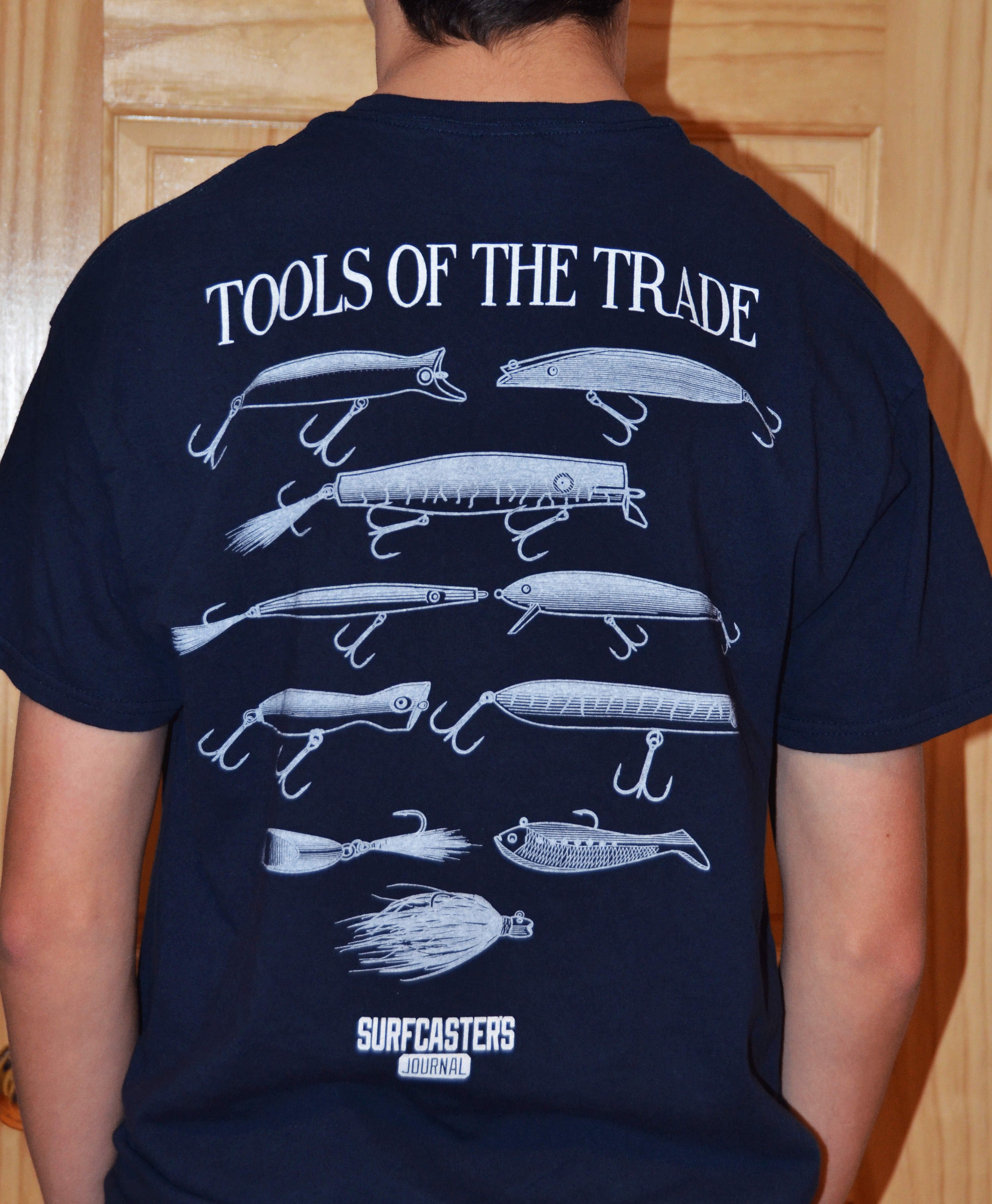
And a quick note in closing. We know many of you have asked about when Tools of the Trade shirt will be available in our store. We told you if there is any left,we would add them after show season is done. Well, they are in the store now in limited quantities. You guys get a first crack at them.Just go to www.surfcastersgear.com or click on ONLINE STORE link on the top.

 tool-front

and for few days we will be offering our new SJ Heavyweight Hoodies for a special price for those of you who could not attend shows. Regularly $50, now on sale at $35 till Monday. L,XL,2XL&3XL are heavyweight… while small and medium only come in lighter version

navy-hoodie-backsmal

Show season done..time to fish

Another video  from our resident genius, John I-can-catch-fish-in-the-roadside-puddle Skinner. This time John is catching fish at will with Daiwa SP Minnows.

Btw, thanks to all of you who stopped by our booths and tables at the shows. And no, for the umpteenth time, I cant tell you were John fishes and putting a gps on his car is out of the question.

[youtube]http://youtu.be/zDIkj2cHnJQ[/youtube]

By the way, after last weekend in Providence, I will never be able to say “car” the same way when traveling east of the Bronx.


d4t56

Special thanks to SJ new chef Chris Blouin for hooking Tommy and I, and fellows from StormR with some insane burgers at Luxe Burger over the weekend. A awesome burger topped with pastrami, jalapenos , mushrooms, cheese and onions was out of this world. Shout out to our friend and fishing buddy Chef Andrew from Café Katja in NYC. He provided SJ readers with a lot of mouth watering recipes over the years. We miss you buddy. You will always be a part of SJ family.

wdftyui

and sushi Chef Chris sent over at the bar…holy crap was that awesome!!

wer

Thankfully our traveling days are

done and we can now concentrate on getting a dedicated tablet  “app” tested for the next issue, family and fishing.

Hopefully there will be a lot of opportunities for shots like these

Chef Andrew at Cuttyhunk few years ago

IMGP1671

Striped Bass Cooperative Anglers Program….by Edward J. Messina, Ph.D.

Editor’s note

Ed Messina is just not a\only a dear friend, a long time fellow member of High Hill Striper Club and our conservation chairman, but also one of my mentors and a hell of a surfcaster in his own rights. After listening his passionate plea to our club membership, I asked him to write it for SJ blog.

Zeno

Edward J. Messina, Ph.D.

For the last several years recreational anglers have been confused by the lack of action on the part of the Atlantic States Marine Fisheries Commission (ASMFC) to do something about their perceived decrease in the striped bass population. Additionally, this lack of action has frustrated the recreational angler community because of the failure to respond to the coast wide urging of the fishing community that something was wrong with the striped bass population. This has led to a perceived bias towards the commercial side of the fishery because they are better organized and financed.

So when activists within the recreational fishing community ask anglers to call, e-mail or write their representatives at the ASMFC, or their state legislators, they are loathed to do so because “nobody cares and nothing is ever done about it”. Whether true or not the argument from their side is that the ASMFC’s track record is pretty poor since its establishment in 1942. In the New York area more often then not they say “yeah what happened to the fluke, flounder and weakfish”, the species most often targeted.

So this is the background for this piece. However, what is the reality? Well in spite of the admonitions of the recreational angler, that the sky is falling, the ASMFC by law does not have to do anything unless its so-called measures of stock assessments fall below some threshold level for action. I do not want to get into the technical nature of these measurements but suffice it to say that if these stock assessments thresholds are not breached the ASMFC does not have to do anything. This is the first problem with fishery management, as stocks assessments are loaded with many inaccuracies and the forecasts and projections made by these assessments faulty at best.

The ASMFC uses two sources of data 1) fishery-dependent data and 2) fishery-independent data. The first is collected from information collected from fisherman and dealers. Can you imagine that! What fisherman the one on the dock and warehouse or the one on the beach, a pile of rocks or the one on a bridge or pier? The second is collected by scientists via a long-term survey or other scientific study. While I have problems with both sources of data it is the last of these two that I will focus on because in my 50 years as a surf caster, I and many of you that prowl the beaches, bays, rock piles, bridges and piers have never been a part of a survey. So who are they surveying? Where do these surveyors lurk? What is the quality of the information? Is the population of fisherman surveyed more representative of the boating angler or the shore bound angler? Are adjustments made to the data given the advantage a boater has over a shore bound angler?

It is these questions and many more that now urges me to ask all NY recreational fisherman, who fish for their beloved striped bass, to be active in the generation of more accurate data by enrolling in one of the two data collection programs run by the NY State Department of Environmental Conservation. For all other anglers I urge you to find out if your state has similar programs. I must admit until a few days ago I did not know this program existed. The collection of real data by a wider spectrum of anglers will carry greater weight with the policy makers and perhaps lead to quicker action.

Basically there are two data collection programs. 1. The Striped bass Cooperative Anglers Program and 2. The Electronic Fishing Logbook. Both programs can be found on the NYS DEC website.

DIRECTIONS FOR ENROLLING INTO THE STRIPED BASS COOPERATIVE ANGLERS PROGRAM OR THE ELECTRONIC FISHING LOGBOOK.

Step 1.:   Go to NY State Department of Environmental Conservation web site. The URL is below
http://www.dec.ny.gov/

Step 2.: On the left hand side of the screen you will find a group of Headings that have drop down menus. Click on Outdoors Activities and the subheading Saltwater. On the left side of the screen you will see the Striped Bass Cooperative Anglers Program (11 headings down).

Step 3.:Click on this and then scroll to the bottom and you will now see the information for the eLogbook. I prefer this program as you do not have to remove scales from the bass and keep the fish out of the water any longer than necessary. Under eLogbook, on the 10th line down click on register and log on line. The SAFIS screen will appear. For your user name type in your e-mail address and for your password use your e-mail address password. After you enter this information another page will come up where you will fill in your profile information. When you finish and submit the information you will be given a USER name by SAFIS. Now to log on use the USER name given to you by SAFIS and your e-mail address as you password. When you arrive at the reports page click on your favorites and add the URL to a Folder you name fishing. In the future, you will just go to your favorites and click on the URL and you will get to the Report screen immediately. It saves time and frustration.

If you have any problems call Julia Socrates at: 631-444-0473. She is very helpful.

It is extremely important that in whatever program you sign up for, do not make the common mistake of only filing reports when you catch a bass. For the data to have a basis in reality, all fishing efforts have to be reported whether or not you catch a bass!

See you on the beach!

Win a camouflaged ZeeBaaS ZX27 reel

We are going to post this once a month until we draw a winner on the Memorial Day weekend

There is no greater service anyone can enlist in than putting their lives on the line so wee can live safely in the greatest country in the world. We are all forever indebted to all members of our armed forces past, present and future. Regardless if you did your tour of duty in WWII or just returned from the Middle East, you are a hero to us and our families.

It is our distinct pleasure to announce a very special giveaway. ZeeBaaS Reels, one of the world’s premier reels for surfcasters is going to award one member of our armed forces, past or current, a very special, one of a kind digitally camouflaged ZeeBaaS ZX27 reel. The reel will be engraved with their name and branch of service.zbcamo

How do you win this very special giveaway?  You cant. You have to nominate a friend, neighbor, fishing partner, brother, sister or anyone who you admire that is a past or current armed force member and who you think it’s a special person.

We are aware that EVERY armed force member is deserving of our thanks and admiration. But we only have one reel to award. So send us a email, letter or essay. Hundred words or five thousand words, we don’t care. Just dont send us five.Tell us why you think your nominee is deserving of this special ZeeBaaS reel, what makes him a special surfcaster, friend or someone you look up to. That is it.

You spent a life time enjoying the safe life in this great country of ours without giving much thought as to why and who made it so safe. Today, take a minute to reflect , take a look at your family who is joyfully gathered around you, and nominate someone who you think its responsible for us all having a great life.

Just a few rules

  • Past or active duty veterans must be nominated by friend, family member, fishing partner, etc. If you have someone you would like to nominate, send us a email LETTER, NOT TWO SENTENCES with your buddy’s name and branch of service, along with  why you chose to nominate them. (its ok if you don’t know their branch of service )
  • Nominee MUST be a surfcaster. Even if you know the guy who shot Bin Laden, he won’t win if he’s a trout fisherman only.  We really want to put this reel in the hands of a Surfcaster.
  • While all who have served this country are more than deserving, we only have one prize to give so finalists will be selected by Ultra-Top Secret committee (known only by the NSA).   Winner will be selected by a random drawing of finalists.
  • Winner will be announced on Memorial Day 2014 and will receive a 1 of a kind, digital camo ZeeBaaS ZX27 with their name and branch of service engraved in the reel.
  • Send your letters, emails or essays to info@surfcastersjournal.com

Sit down, and tell us why you nominate him, what makes him a special surfcaster, and a veteran, where did he serve, family, life, write as long as you want but short few sentence entries will not be accepted

wdedfe


Blood and Gatorade By Dave Anderson

Blood and Gatorade
By Dave Anderson
Exploring new spots requires more than taking a cast into new water, you have to be inspired. There is this one rock that always seemed too far away, a long a walk over unfriendly terrain protected it from my boots for years. One particularly ugly day I thought that a walk to this far away rock might find some clean water to fish in—I was wrong, but I got my inspiration.
The water out front dove off into blackness—something surfcasters rarely see—and it was surrounded by countless ambush points and varied depths. This rock had potential. High seas and dirty water kept the rod on my shoulder, but I still took the extra time to find casting perches and to lay out battle plans for the different areas that I would be casting into.
The following June a friend and hit a mother lode of big bass about a mile west of this new spot. For several days we had a lot of nice fish and then, like they so often do, the bass moved off. The obvious track came together inside my head, the fish would be migrating east and the rock was a mile or so east.
We put some fresh scratches in my friend’s truck as we weaved down the twisty back trail and made the long walk. A bright moon was hanging low in the sky on this warm and windless night. I was so excited to get an eel into the drink that I didn’t even wait for my companion to catch his breath. I made a long cast and let my eel settle. As I began my retrieve the line came tight, it felt heavy, not so much like there was a fish on there, it just didn’t feel right. So, I set the hook and my drag began to whine.
I had miles of deep water to play with so I let the fish run and when she stopped, I pulled back to feel my line had been wrapped through a minefield of sharp stones. I wanted to cry as I tried to haul her out of the mess. Every time I gained some line she took more back and seemed to sink further into the hopeless gnarl of hell in front of me. Finally she made a slow and determined move straight away from me, the line strained and tinked over a few hangs before it parted. The rest of the summer and through September the big rock was not producing and my confidence in the big rock began to wane.
On the fourth of October it called my name again. With the same friend and a bucket of eels we made our way out and decided to try a different portion of the rock. On my way out I stepped between two rocks and severed the strap on my left Korker. I would have to fish with just one on this night. The steep sides of this high portion of the rock were black and slick, and without a complete pair of Korkers, I’d have to fish from high, dry rock.
Off to my right I knew there was an undercut in the rocks and it seemed like a spot that might hold some big fish. I flipped my eel in front of the “cave” and my eel was immediately jolted—I set the hook on a heavy fish and she came unbuttoned a millisecond later. This happened about five more times and I began to lose my patience.
I was hell-bent on hooking up. Looking back it could have been any number of reasons that caused the misses. Maybe it was the angle of the line from being so high on the rock, maybe it was the rough seas coupled with the short cast I was making leaving little give when the fish tried to beat tail into the rocks? But on my next hit, I held back and let the fish eat it. This was a dirty trick because the fish just swam off and then suddenly felt the sting a good swim out from the safety of the rocks.
The fish pulled hard to the right and I knew it was decent—I also knew that if I didn’t stop her I was going to break off. I upped the pressure incrementally until I found that magic moment when she turned. In an instant, she passed me and I had to swivel around and shuffle my feet to maintain pressure. As I shifted my weight to the Korker-less foot I slipped and before I knew it I was on my back and sliding down the rock! Holding the rod tight to my hip with my right hand I instinctually braced myself with my left and I ran it over a jagged section of barnacle-covered rock—and I knew I was cut, but I decided that I was not even going to look at it until I had this fish on the rocks.
Finally I had her, 46 inches and 35 pounds. We took a quick photo and released her. Finally I got a look at my hand, it wasn’t pretty. The wound was hanging open and would most certainly require stiches. Further, there was a good accumulation of black “stuff” in the wound collected while sliding down the rock. So, I did what any insane surfman would do, I cleaned it out with Gatorade, cut a strip off my t-shirt, wrapped the cut and kept fishing.
Guess how many more fish I caught that night? Yeah, that’s right, zero. All I can say is thank God for Super Glue—emergency room in a bottle.

ugh 002

ONE ANGLER’S VISION: PART V THE “COOPERATION” CON

Editor’s note

In a lot of ways, we consider anything Charles Witek has to say on fisheries management and conservation a “must read”. Charlie has recently started a blog at  http://oneanglersvoyage.blogspot.com/

I hope many of you check it out and subscribe to be notified when Charlie posts his thoughts on this very difficult and often confusing subject. But in case you are too lazy to click it we will repost his blog right here. But I do urge you to subscribe to his feed on his blog

Zeno

ONE ANGLER’S VISION: PART V THE “COOPERATION” CON

Although this is only the fifth of the six planned “One Angler’s Vision” essays, it is the last post that analyzes the Theodore Roosevelt Conservation Partnership’s report “A Vision for Managing America’s Saltwater Recreational Fisheries” (http://www.trcp.org/assets/pdf/Visioning-Report-fnl-web.pdf).  The sixth and final essay in this series will present an alternative vision that, I believe, would better benefit anglers, and might help and encourage anglers who might want to present their own vision to federal decisionmakers.
But the issue that this essay addresses, the innocuous-sounding recommendation that the Magnuson Act be revised to promote more “cooperative management” between state and federal managers, is the most insidious recommendation of them all.  For, although cast in the guise of “cooperation,” what the “contributors” to the “Vision” report are trying to do is take away the federal authority to manage some species, and turn that management over to the states, in order to get out from under the burden of federal conservation and rebuilding requirements.
They’re seeking to have bodies similar to (and including) the Atlantic States Marine Fisheries Commission have the responsibility for managing fish.  That way, Magnuson’s mandates for rebuilding deadlines, ending overfishing and even following the dictates of the best available science just won’t apply.  Everything can be managed as badly as ASMFC has managed stocks of winter flounder, tautog and American shad; industry-controlled management boards trying to squeeze the last drop of profit out of a resource would be able to drive fish stocks beyond the brink of collapse, just as ASMFC allowed the collapse of northern shrimp (http://oneanglersvoyage.blogspot.com/2014/01/of-stock-collapse-shrimp-and-asmfc.html), and no court will be able to intervene.
TRCP’s “Vision” report tries to justify its position by claiming that
“Striped bass, red drum, black drum, summer flounder, sheepshead, snook, spotted seatrout and tarpon are examples of successfully managed state fisheries that sufficiently meet the needs of recreational anglers while providing extensive economic benefits to their state and the national economies.”
The entire statement runs for two full paragraphs, but there are enough problems with in that one sentence to serve the purposes of this essay.
For one thing, parts of it are just plain wrong.
Take summer flounder, which is hardly an example of a “successfully managed state [fishery].”  In fact, summer flounder is not only a tribute to the success of federal fisheries management pursuant to the Magnuson Act, it is the fishery that, as the focus of the court decision inNatural Resources Defense Council v. Daley(http://www.cadc.uscourts.gov/internet/opinions.nsf/E36DAC79549F797D85256F180065A726/$file/99-5308a.txt), established the minimum legal requirements for federal fishery management plans.  All the state managers at ASMFC do is parcel out the recreational summer flounder quota among the various states, and they mishandled even that simple process so badly that, fifteen years after the fact, the states are still squabbling among themselves and federal legislators are getting involved in an effort to straighten it out (http://www.pressofatlanticcity.com/news/press/atlantic/lawmakers-question-new-fluke-rules/article_5c5065c8-ef06-5689-bd28-cfa12a6bf945.html).
That’s not exactly “successful” state management.
And serious striped bass fishermen would have to ask why the “Vision” report places striped bass in the “successful” category.  As mentioned in earlier posts, the stock has been in a steady downhill slide.  ASMFC received a peer-reviewed benchmark stock assessment last October that came to the conclusion that the stock had been subject to overfishing for six out of the last ten years, is likely to become overfished in the near future, and that the target harvest level needs to be substantially reduced (http://nefsc.noaa.gov/publications/crd/crd1316/partb.pdf).
Despite that, ASMFC still claims that the stock is “not overfished” and that “overfishing is not occurring” because, five months after receiving the new stock assessment, it has not yet incorporated it into the management plan, but instead still clings to outdated and discredited information;
MAYBE the conclusions of the new assessment will be adopted by August, fully 10 months after the fact.
And maybe they won’t be.  Because ASMFC, and the majority of the states, may ignore the best available science with impunity.
Responsible fisheries managers, after reading the benchmark assessment, tried to reduce harvest in time for the 2014 season but, as an opinion piece in the Boston Globe (http://www.bostonglobe.com/2014/03/11/podium-bass/ieYsaf8jNzfQhIX9Wz1HnO/story.html) explains
“…all appeals to the Atlantic States Marine Fisheries Commission for conservation have run straight into a political wall.
“Last year, in the face of a dire outlook for the future of striped bass, a coastwide reduction in catch limits was proposed by Massachusetts’ own director of the Division of Marine Fisheries, yet the two political appointees with whom he serves [on ASMFC’s Striped Bass Management Board]—both of whom have ties to the commercial fishing industry—opposed their own director, forcing him to vote against his own measure.”
That same Boston Globe piece describes how state striped bass management really works:
“Similarly, a petition signed by more than 1,000 citizens proposing a 50 percent reduction in the recreational and commercial striped bass harvest was presented to the Massachusetts Marine Fisheries Advisory Council.  The nine-member council—eight of whom have direct ties to the commercial fishing industry—denied the petition.”
I sit on the New York Marine Resources Advisory Council, a body with duties similar to those of the Advisiory Council up in Massachusetts, and I have no doubt that if such a petition was presented in New York, the result would have been the same.  Although the New York council is equally divided between commercial and recreational representatives, the recreational side is dominated by folks with industry ties, and getting them to approve conservation measures is a very, very difficult thing to do.  In the short term, people make more money by killing more fish; in the long term, well, that’s just too far away…
Maybe I should cut the TRCP “Vision” a break when it says think that striped bass managers are doing a good job, because that “Vision” was shaped by “contributors” based on the Gulf of Mexico, and the only thing they know about striped bass is what they can learn from the flabby hatchery fish dumped into southern reservoirs.  They know nothing about our wild bass, that fight rips, waves and tides in their fight to survive, and migrate hundreds of miles each season; they know nothing about how badly those bass have been mismanaged by the states and ASMFC for the past few years.
But as southerners, they certainly know about tarpon, and the fact that they are hardly prized as a food fish.  And that makes management easy, because as I explained in an earlier part to this series, “Gamefish and Groundfish” (http://oneanglersvoyage.blogspot.com/2014/03/one-anglers-vision-part-iii-gamefish.html), it is the fish that everyone wants to take home and eat that present the management challenges.
At this point, it might be time to stop talking about specific species, and look at the very language of the sentence in question, particularly the part that praises state managers who “sufficiently meet the needs of recreational anglers” but provide “extensive economic benefits” to industry.  As an angler, that sort of language sets off some pretty loud alarms, as it seems to suggest that fish should be managed in a way that’s just good enough—“sufficient”—to keep anglers more-or-less happy while providing “extensive” benefit to business.  That’s just the sort of language one might expect from a report being pushed by a trade association such as the Center for Coastal Conservation and its affiliate organizations.
But we’ve seen that kind of thinking before, and it didn’t work.
We saw it here in New York, when the striped bass fishermen wanted to keep the bag limit at one fish and the size limit at 36 inches, while the recreational industry wanted two twenty-eight inch fish.  The state split the baby, giving the for-hires what they wanted, but limiting all other anglers to one at 28 (later increased to one 28-40 inch fish and one over 40 inches).  Now, as a result of excessive harvest, the bass, and the bass anglers, are feeling the effects of coastwide overharvest.  When state managers heeded angling industry entreaties to phase in regulations for winter flounder and tautog back in the 1990s, so that anglers patronizing the for-hire boats could retain the “perception” that they might still have a “big day”—read “big kill”—they adopted a too-little, too-late approach to regulations that sent both species into a downward spiral from which they have never recovered.
We see it at just about every meeting at ASMFC, when one commissioner or another rises to oppose science-based restrictions on harvest in order to protect some segment of the fishing industry.   We saw it when the weakfish stock collapsed, and ASMFC still insisted on killing more fish than the scientists advised.  We saw it last February, when ASMFC voted to increase exploitation of the collapsed winter flounder stock, and made no progress toward incorporating the best available science into the striped bass management plan.  We saw them take 15 full years to accept the reduced fishing harvest rate first recommended by their Tautog Technical Committee in 1996.  And when you read the minutes of all the meetings, the same reason always arises.  They want to do what’s good for business, even though it hurts the fish—and so, eventually, we anglers.
And, most importantly, we saw it at the federal level prior to passage of the Sustainable Fisheries Act of 1996, when economic arguments were regularly used to justify overharvest, and led to the decline of stocks important to recreational fishermen everywhere along the United States’ coast.  By the early ‘90s, fish were scarce and small; that’s what the Sustainable Fisheries Act was passed to correct.  Not even twenty years ago, people had already learned that emphasizing “extensive economic benefit” in the short term, without enough thought for the future of the resource, was a bad idea.
Now, folks want to repeat the mistakes of the past.
As with most bad ideas in fisheries management over the past few years, this one emerged in the Gulf of Mexico, and was driven by red snapper.
I’ve touched on red snapper in earlier posts, and don’t want to belabor the point again.  To summarize for the first-time reader, red snapper were badly overfished, and the National Marine Fisheries Service instituted a rebuilding plan, which put real restrictions on recreational and commercial snapper fishermen.  The stock slowly began to recover, and as it did, anglers began catching more and bigger fish than managers expected, and quickly overfished their quota.  The result was a descending spiral of serial overfishing by the recreational sector, followed by ever-tightening federal regulations.
Several states refused to follow the federal lead, and permitted anglers to land more fish over a significantly longer season in state waters.  That led to higher overall recreational landings, which in turn caused NMFS to tighten up the rules even more in order to keep the recovery on track.
The federal season became astonishingly short.  Anglers wanted to kill more fish than the accepted science allowed, and the angling industry wanted a longer, more lucrative season.  So they looked at the states, and the fact that they were bound neither by science nor federal law, and decided that it would be nice to let the states manage snapper everywhere (http://www.joincca.org/articles/628). No longer bound by the conservation provisions of the Magnuson Act, anglers would be able to take more fish home.
At least while they lasted.
And no, that’s not speculation, because I know a lot of the people involved.  I sat in on the meetings, and I listened—ad infinitum—to the plans and debates, at least until I got so disgusted by their self-entitled attitudes and their blatant disregard for the health of the resource that I washed my hands of the whole thing and walked away from the table.
Anglers like to knock the commercial guys, and they often have justification.  But after listening to the conversation for years, and particularly for the past three or four, I can say with all honesty that when it comes to red snapper, at least, every accusation that anglers have leveled at commercial fishermen apply equally to the recreational side.  Those folks talk a good conservation game, and they’re pretty good at conserving other people’s fish, but they squeal like slaughterhouse pigs when someone suggests that they take a real cut in their own kill.
So we’re left with the TRCP’s “Vision” report, and the incredibly bad idea of sidestepping federal conservation and rebuilding requirements—if there are any left when these folks are done—and hand management over to states that are free to act without regard to the science or the health of our publicly-owned fisheries.
Proponents of such measures try to seduce anglers with pretty words.  But when those words must give the states false credit for the successful recovery of summer flounder and must misrepresent the health of the striped bass stock in order to be convincing, and when, even with careful editing, they reveal the intent to manage fisheries in a way just good enough—“sufficiently”—for anglers, so that industry may enjoy “extensive” benefits, those words don’t looks so pretty any more.
In fact, they look pretty damned ugly.
When we read the TRCP’s “Vision” report, we read the same tired arguments that we read before the Sustainable Fisheries Act was passed, the same ones that have been made by commercial fishermen in every year since.  Today, they’re just written by a different hand.
For the most part, the commercial and recreational fishing industries seem to want the same things.  They only really disagree about who ought to profit from the overfishing that their policies would ensure.
But in the end, a fish doesn’t care who kills it, and overfishing by recreational fishermen is neither better nor worse than overfishing by the commercial side.
So when the “Vision” report hails the virtues of conservation and managing for abundance on the one hand, and on the other talks about evading federal conservation mandates by letting states manage the stocks for “extensive economic benefits,” it is engaging in a monumental con, hoping that you’ll watch the hand that holds noble ideals while ignoring the hand working to tear the heart out of federal fisheries laws.
Anyone who falls for their ploy might also think about buying the Brooklyn Bridge.
And anyone who would market such ploy might do well in the bridge-selling business…

Crazy Alberto Knie – FISHING EQUIPMENT


Today’s blog is a little different than ones we usually feature here. Crazy Alberto Knie, Surfcaster’s Journal Magazine columnist and world renown fisherman wanted to be more of a Q&A then just a standard blog. So feel free to ask question and I will make sure that the Great One answers..lol


All kidding aside, Crazy Alberto will be doing a seminar at St Joseph’s College this Saturday at Patchogue Fishing show. Those of you that are in the area, stop by and say hi. Surfcaster’s Journal staffers will be there and so will Al at Tactical Angler’s table all day answering your questions when he is not doing his seminar.


Here is the info

image001

The rest of Journal’s Crew will be in Providence, RI for RISAA , our last show of the season. So this weekend is your last chance to renew or subscribe at these shows and pick up a free shirt and discounted hoodies, hats and stickers. See you there

Zeno


By Crazy Alberto Knie


People often ask me about tackle, and think they have to spend a ton of money or having to buy the most expensive and the “best”. Well, everything is relative and you do not have to buy the best. What I am really trying to say is this


The $$$ price tag does not equate to the best. Let’s put things into perspective, you wouldn’t want to buy a Luxury Rolls Royce or convertible Ferrari and run it on the beach. That is just downright silly.


Before making the right investment, it is best to determined by the its applications and not by how deep your pocket is. Other things to take for consideration is maintenance and wear-and-tear because certain application can be demanding on the product. By understanding the equipment’s features, it will ultimately help you determine what the proper needs are.


So next time you ask anyone for advise, think about this first.


dfr


For Less Than a Fin By Dennis Zambrotta

For Less Than a Fin
By Dennis Zambrotta
If I were to tell you that three of the best surfcasting striped bass producers all cost less than five bucks; would you believe me? Read on. I’ve been playing this surfcasting game a long time and experience has taught me that you can limit yourself to three very affordable (under $5) presentations and have a very good chance at success. A few years back I started to work part time at the Salt Water Edge retail tackle shop located in Middletown, Rhode Island. One of the most common questions I get is, “What is the best lure to catch striped bass from the surf?” Well, as we all know there are many different answers to that question and the SWE has thousands of potential lures to choose from. I could easily recommend three plugs that could very well total over $50. Now don’t get me wrong, there are definitely times when you may need specialized plugs to catch bass but not everyone has an unlimited budget. For customers with a limited budget my normal response is that I can recommend three of the most effective striped bass surfcasting catchers of all time…and all are less than $5.00 each.
So what are they?
A ½ – 1 ounce white bucktail jig: This one item should be a staple of every surfcaster in the northeast. It’s a very effective lure in almost all conditions and catches striped bass from schoolies to cows. It’s no wonder that a bucktail jig is included in every military pilot’s survival kit. Very versatile, a bucktail jig can be fished as is or adorned with a plastic curly tail, pork rind, or even white felt. In many scenarios all you have to do is cast it out and reel it in. I’d be willing to bet the basic white bucktail jig has taken more surf caught striped bass than any single plug around. Cost: $3.50 – $4.50.

A live eel: The natural eel presentation has probably taken more large surf caught striped bass than any other method. Even during times when bass are finicky they often will readily strike an eel. Much has been written about using eels in the surf, it’s a legendary technique to say the least. And it’s recyclable! When it dies continue to use it as a rigged eel. Cost: $2.00

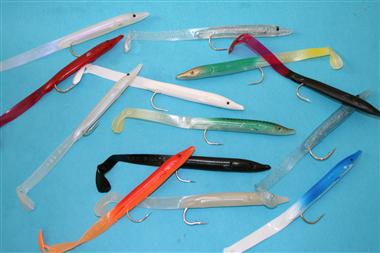
A teaser (also referred to as a “dropper”): For those that don’t know about teasers/droppers. Teasers are considered anything that you tie ahead of your primary presentation. Generally attached via a six inch section of stiff mono to the lower ring of the barrel swivel of your main leader. Teasers/droppers have been around for a VERY long time and are have been used with great success by sharpies and novices alike. Nowadays teasers are generally made from saddle hackle feathers and/or bucktail hair tied onto a strong single hook. They should be attached approximately two feet in front of your main offering. The idea is to present a small natural looking artificial to mimic smaller baitfish. Teasers/droppers will readily take finicky bass that may not hit your main offering. They can be extremely effective and on many occasions will out fish your main offerings. Many sharpies can relate occasions when if you didn’t use a teaser you would go fishless. Another popular teaser is the 4 ½ inch Red Gill Rascal. This soft plastic dropper imitates a small sand eel and has taken more cows than you can imagine. Cost: Feather $2.25 – $3.50
Red Gill $2.75

178mm-red-gill-group-l

So there you have it, three proven killer striped bass lures for less than the cost of a fin. If you were a surfcaster on a limited budget and these three items were all you could use for an entire season… you would still be very successful.


Rivers End Surf Day ..plus…ONE ANGLER’S VISION: PART IV SOUTH VS. NORTH

The winner of is adamsotiryadis@yahoo.com. You have 5 days to get us your shipping address at info@surfcastersjournal.com

I have blog posts from Dennis Zambrotta, Dave Anderson and Crazy Al lined up for you guys, in addition to continuing series from Charles Witek

STRIPER SURF DAY                                   March 22th

River’s End Tackle in Old Saybrook CT

Under the snow there really will be a spring run.  Get ready and celebrate it at Striper Surf Day. It’s a great day to hang out, take in a seminar and tell some lies with fellow surf rats. We’ll have great speakers and an emphasis on how to demonstrations, factory reps, sales, door prizes, gourmet road kill and good friends.


FEATURED  SURFCASTERS  and  DEMOS

Bill  Wetzel – Legendary  Montauk guide is giving a seminar on “Reading the Water”. Bill’s knowledge and delivery will have you leaving for the beach immediately.

Steve McKenna – conducting a seminar “ The Top 10 Surf Lures”

Steve will also be demonstrating how to load Redfins and Northbar Bottle Darters.

Toby Lapinski – will demonstrate how to make the classic rigged eel.

Dennis Zambrotta – will demo how to rig eel bobs as well as show you how to fish with teasers. He’ll also be signing copies of his book “Surfcasting Around the Block”

Surfcaster’s Journal crew will be there  with new Tools of the Trade shirts , free with your renewals or new subscrption

Adam Romagna – is displaying antique striper plugs and can help ID and appraise your old lures.

Shimano –Will demonstrate their new line of surf rods and reels.


We’ll also have reps from CTS Rods,

Van Staal,  Commando Surfcasting,

Super Strike, Zee Baas, Tsunami,

Lunker City, Pure Fishing, Guppy Lures,

Northbar Tackle and more.

It’s free, just show up.

Editor’s note

In a lot of ways, we consider anything Charles Witek has to say on fisheries management and conservation a “must read”. Charlie has recently started a blog at  http://oneanglersvoyage.blogspot.com/

I hope many of you check it out and subscribe to be notified when Charlie posts his thoughts on this very difficult and often confusing subject. But in case you are too lazy to click it we will repost his blog right here. But I do urge you to subscribe to his feed on his blog

Zeno

ONE ANGLER’S VISION: PART IV SOUTH VS. NORTH

I’ve had the good fortune to fish along most of the American coast, from the cod and pollock ledges off New England to the Gulf Stream off Florida, from the reefs of the Keys to the snapper banks of the Gulf of Mexico.  I’ve chased fish of various kinds from southern California up to the Columbia River and to Alaska’s Cook Inlet and Prince William Sound.  I’ve even done some fishing in Hawaii.
No two places I’ve fished are exactly the same.  The fish are different, the water is different, the bottom is different; even anglers’ attitudes and the ways they prefer to fish change as one travels along the coast.
But the really big dividing line is the one that separates warm, subtropical seas from the cooler waters farther north.
Southern seas are filled with a plethora of life.  When I fish for snapper down in the Keys, I’m always amazed at the variety of fish that I see over the course of a day.  My first fish might be a yellowtail; on the next drift, a cero mackerel hits the bait on its way to the bottom.  There will be mutton snapper and margates, gray snapper and grunts, and in the midst of it all maybe a bright blue parrotfish or a spotted, snapping, sinuous moray eel.
My friend Mike Mucha describes a trip on a Keys headboat as “going out for aquarium fish” because of the variety and varied appearance of everything that comes on board.
And that’s not unexpected, because southern waters are known for high biodiversity.  They hold a lot of different kinds of fish.
But what a lot of folks—anglers and non-anglers alike—don’t realize is that despite such high biodiversity, southern waters support a relatively low biomass.  When you take all of the fish and combine them together, there aren’t nearly as many fish as there are up north.
That’s because southern waters are pretty infertile; they can’t support too much life.  The crystal clear water that lets you see a hooked fish flashing when it’s still sixty feet down holds very little plankton, the tiny plants and animals that form the foundation of the marine food web.
For abundance, you need to go much farther north, to the soupy green seas off New England, where a rich broth of single-celled plants and the animals that feed on them can nourish a truly huge, if less complex, web of life.
It is no mystery why whales feed in high latitudes, for that is where the food is.
Bait can seem abundant in southern waters; there are halfbeaks and saury and flying fish, and at the right time of year, big schools of mullet migrate along the coast.  But there is nothing in those southern seas that can equal the huge shoals of herring and mackerel that the northern ocean can readily support; nothing ever recorded in the south could equal the immense abundance of the cod, haddock and other groundfish that swam off New England, fish abundant enough to feed much of the Western world for more than four hundred years.  And even those once-abundant stocks would probably take a back seat to the hordes of pollock that swim off Alaska.
Northern waters don’t hold many different kinds of fish—the biodiversity is fairly low—but it can support a huge abundance of them.  Biomass was once amazingly high.
Down south, there isn’t a lot of any one species (although if you hit the yellowtail right, and see the huge mass of fish that changes the very color of the water as it rises up in response to your chum, you might have trouble believing that’s true).  Thus, it is very easy to overfish.
In the north, there aren’t many species, and the very vastness of the stocks made it impossible for anglers—and early fisheries scientists—to believe that they could be harmed by the hand of man.  But that abundance concealed more complex stock structures than anyone suspected, and the very abundance might, in itself, have created a vulnerability—perhaps similar to that of the extinct passenger pigeon—in which high numbers are needed for successful reproduction.  Whatever the cause, we discovered that northern stocks could be overfished, too.
Federal fisheries law, in the form of the Magnuson-Stevens Fishery Conservation and Management Act, must prevent overfishing, and rebuild overfished stocks, in all of America’s waters.
Thus, one would expect the Theodore Roosevelt Conservation Partnership’s report “A Vision for Managing America’s Saltwater Recreational Fisheries” (http://www.trcp.org/assets/pdf/Visioning-Report-fnl-web.pdf), which proposes changes to that law, to be as relevant to fisheries off Oregon, Maine and Alaska as it is to fisheries off Alabama or Texas.
Unfortunately, that isn’t the case.
The “Vision” report is very much a response to southern fisheries issues, that gives little consideration to anglers on the West Coast or those who fish north of the Georgia-Florida line (OK, maybe if I was being charitable, north of the Pee Dee River, which divides the Carolinas).
The first, largely superficial hint of that comes from the graphics that accompany the document.  Out of the twenty or so photos that grace the inside, you don’t see a single fish or a single photo that doesn’t represent the Gulf of Mexico.  There are snook, but no striped bass or salmon.  Snappers and red drum, but no cod, fluke or halibut.  Mullet, but no menhaden or mackerel.
As you begin to read the text of the document, you also see the same kind of disconnect with anglers who fish far from the five Gulf states.  You see an indictment of the federal fisheries management system, but no acknowledgement of its successes in the Mid-Atlantic, where every species under federal management is either fully recovered or well on the way back, and none are overfished or subject to overfishing.
The “Vision” report, in its effort to promote state, rather than federal, management of important recreational species notes that
“Many state natural resource agencies,especially those in the South, recognize the benefits of a vibrant recreational fishing community and have managed to promote it while conserving their saltwater resources. Striped bass, red drum, black drum, summer flounder, sheepshead, snook, spotted seatrout and tarpon are examples of successfully managed state fisheries that sufficiently meet the needs of recreational anglers while providing extensive economic benefits to their state and the national economies.
“Many coastal states have adopted management models that are well tuned for their particular saltwater fisheries. These models conserve fishery resources, provide multi-year consistency in regulations and allow for ample public access.  However, these approaches have not yet been embraced by the NMFS, which is a significant contributing factor to the current dilemma in saltwater recreational fisheries management.”  [emphasis added]
Even if we ignore the fact that part of that statement is blatantly wrong—summer flounder were the species which set the legal standards for federal fisheries management, and a significant majority of striped bass fishermen would take issue with the stock being “successfully managed,” given that it poised to descend into “overfished” territory within the next year or so—the words “especially those in the South” should be creating a very big red flag for any angler who fishes Mid-Atlantic, New England or Pacific shores.
Because when it comes to problems facing anglers there, the “Vision” report just doesn’t get it.
While the “Vision” report rhapsodizes over “state natural resource agencies, especially in the South” who supposedly “sufficiently meet the needs of recreational anglers,” it ignores the multiple failures of what is undoubtedly the biggest coordinated state fishery management effort—the Atlantic States Marine Fisheries Commission—which in the past 20 years has managed to restore only one stock, striped bass, to health (and is now dithering and delaying taking necessary action called for in the recent benchmark stock assessment, as the striped bass stock comes ever closer to returning to “overfished” status—while over the same period overseeing the decline, and in some cases the collapse, of stocks that include weakfish, Gulf of Maine winter flounder, tautog, American eel, American shad, southern New England/Mid-Atlantic winter flounder, northern shrimp, alewives, southern New England lobster and blueback herring, among others.
Because when you don’t raise your eyes above the Florida border, you’re not going to notice such things.
Nor are you likely to notice that up in New England, and even in the Mid-Atlantic, “state natural resource agencies” are pretty close to the commercial fishing sector, as well as the party and charter boat industry, which generally wants the same sort of risk-prone management that the net boats support.  Up here, we’ve already seen what “flexible” management—avoiding hard quotas and using weak proxies such as daily trip limits and limiting days at sea—has done to the cod stocks (there aren’t many left), winter flounder (there are almost none left) and minor groundfish such as whiting (there are quite a few left, but you can’t catch them from piers any more; you need to run 75 miles offshore).  We don’t need more “flexibility”; we need more hard quotas, before the little we have left is gone.
It might already be too late for winter flounder and local populations of cod.  But if your sole focus is on southern reefs, what happens up here is completely blurred.  You neither notice nor care.
And it’s not only here.  The West Coast isn’t in focus, either, so you probably don’t see anything wrong with giving even greater authority to those “state natural resource managers” in California who have already closed anglers out of once-prime fishing grounds.
When you manage northern—or at least cold-water—fish, you can’t afford to let a stock collapse.  Down south, if you lose a single species, you have scores of others to take up the slack.  Up north, that single species may be the only thing anglers can fish for.  Here on Long Island, we used to start fishing sometime in March; with the winter flounder all but gone, fishing is barely worthwhile until May.  There used to be a winter cod fishery; the fish didn’t show up this year, and I’ve been on shore since before Thanksgiving.  If anything happened to the fluke, our bays would be nearly empty throughout the summer.
So when you manage our northern fish, you need to manage for abundance.  Conservation matters, because if one species goes missing, you may be left with nothing at all.  When stocks are restored to abundance, seasons are long, but there aren’t many things that we fish for.
In the south, biodiversity is so great that you can catch a little of everything.  But emphasis must be placed on “a little,” because, by northern standards, nothing is really abundant.  You can’t afford to kill a lot of any one thing.  And because no species is truly abundant, bycatch becomes a far more significant issue.  One of the books that I keep near at hand when writing about fisheries issues is Fisheries Ecology and Management by Carl Walters and Steven Martell.  It is a standard and well-respected text, and its authors note the need to be aware of bycatch down south, saying that
“in multispecies situations such as the reef fisheries off the coast of Florida…the bionomic equilibrium with respect to the targeted fish species may be at efforts high enough to drive some ‘incidental’ or nontarget species toward biological extinction.”
I think we can all agree that extinction is bad, yet if we don’t manage all fish in a multispecies complex, such as the reef fish complexes managed by the South Atlantic and Gulf of Mexico fishery management councils, extinction might can happen just because folks want to catch a particular species—such as red snapper—so badly that they don’t take enough time to consider what harm they’re doing to something else.
In such situations, managers need to keep the seasons short to minimize bycatch of the least abundant species while maximizing, to the extent practical, harvest of those that are most abundant.  The ideal example may come from waterfowl management; we are given a 60-day season, during which we are allowed a total of 6 ducks, but can take only one black duck, one pintail, etc.  Similarly, a short reef-fish season may provide a relatively liberal overall bag, but just one or two red snapper or other still-rebuilding species.  Because of the south’s high biodiversity, anglers can easily switch off to mackerel, dolphin, wahoo or inshore species when the reef fish season is closed.
That probably won’t be too palatable to some of the folks down south, who seem to spend all of their time obsessing about red snapper, and figuring out ways to kill a few more.
And, unfortunately, that’s relevant to TRCP’s “Vision”.
Like many groundfish, red snapper have been hit hard over the years by both recreational and commercial anglers.  Stocks were overfished, and managers were compelled to adopt strict rebuilding measures.  The fish responded.
Anglers are seeing more fish, are catching more fish, and are killing more and larger fish, but the red snapper stock is far from rebuilt.  Anglers don’t understand what it will take to fully recover the stock, and they don’t understand why, if the population is growing, they can’t take more snapper home.
So organizations which represent anglers and the fishing industry have spent the past few years trying to find ways to kill more fish.
They found a few friendly scientists who were willing to argue that there were more snapper around than the managers believed; most scientists disagreed, so that didn’t work.
They found a few friendly Congressmen who drafted the Fishery Conservation Transition Act and, later, the Fisheries Science Improvement Act, both of which would delay stock rebuilding, and allow a bigger kill, while more research was done.  Neither bill passed, so that didn’t work.
They found a few more friendly Congressmen who drafted the Gulf of Mexico Red Snapper Conservation Act, which would render federal fisheries law irrelevant by handing red snapper management to the states.  That bill is still alive, but unlikely to pass, so that probably won’t work, either.
But the reauthorization of the Magnuson Act offers another possibility.  The same folks who supported the Gulf of Mexico Red Snapper Conservation Act and other failed attempts to evade the conservation provisions of federal fisheries law (http://www.coastalconservation.us/images/db_newsfiles/45.pdf) are for the most part the same folks who “contributed” to TRCP’s “Vision” report.  And so the same themes—delayed rebuilding, turning management over to the states—that showed up in the failed legislation is now showing up as their “Vision” for the Magnuson reauthorization.
They would make the Magnuson-Stevens Fisheries Conservation and Management Act the “Frustrating Conservation and Rebuilding So We Can Kill More Act.”  They’re going to get a bigger red snapper harvest if it’s the very last thing that they do.  And if they have to trash the fisheries up north and in the Pacific to do it, they don’t really care.
There’s a saying in presidential politics, “As Ohio goes, so goes the nation,” which suggests that Ohio is so typical of America that whoever receives the majority of votes there will prevail nationwide.  The TRCP’s “Vision” report seems to be suggesting a similar paradigm of “As Texas (or Florida, or Louisiana) goes, so goes the nation’s fisheries.”
But the federal fisheries in those southern states are very different from the fisheries that prevail off Maine, Alaska, California or New York.  And answers that work—and perhaps more relevant to this discussion, answers that don’t work—for red snapper off Alabama or Mississippi shouldn’t be forced on cod off Maine, summer flounder off Virginia or rockfish off the Oregon coast.
We don’t have red snapper on Long Island.  They’re pretty scarce of New Hampshire, New Jersey and Washington, too.
When it comes to the Magnuson Act, we need a “vision” that serves not just the Gulf Coast, but every coast.
We need a “vision” less myopic than the one presented by TRCP.